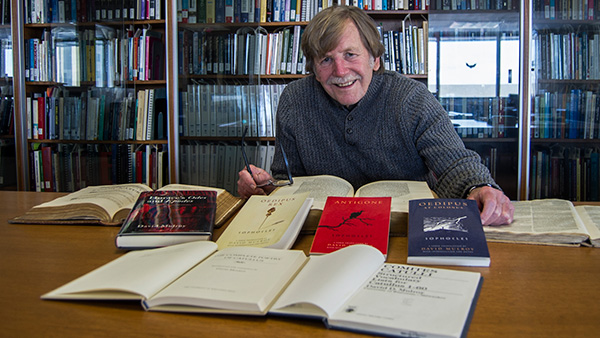
David Mulroy at the UWM Libraries Special Collections area with some of the works he’s translated or written. Photo by Kenny Yoo
David Mulroy, professor emeritus of classics at UWM, recently completed translating “Oedipus at Colonus,” the third in Sophocles’ trilogy of Greek tragedies. (The trilogy focuses on the king of Thebes and his unhappy family, and includes “Oedipus Rex,” and “Antigone.”)
“Oedipus at Colonus,” published earlier this year as part of University of Wisconsin Press’s Wisconsin Studies in Classics, has received critical praise for its combination of scrupulous scholarship and a fresh poetic style. Mulroy, who taught classics at UWM for nearly 40 years, has published six books of translations of Greek and Latin poetry as well as “The War Against Grammar,” a popular history and defense of grammar.
He is currently translating another trilogy of classic Greek plays – Aeschylus’ “Oresteia,” which includes“Agamemnon,” “The Libation Bearers,” and “The Eumenides.” He talks about his translation of Sophocles’ trilogy from Greek to English and the value of the classics in modern society.
Why did you translate these plays, which have been translated before?
I find the other translations very hard to read. The original tragedies were combinations of speeches and songs. Most translators use free verse for all the parts of the tragedies. The result is that readers don’t know which passages were spoken by the actors and which were sung by them and/or the chorus. I translate the spoken portions of the plays in strict iambic pentameters and the musical passages into short rhyming stanzas. That makes the texts much more accessible to modern readers, just like they were for the original audiences. Reviewers tend to be hypercritical of rhyming poetry, but in my experience actual readers like it, so I’m sticking to my guns in that area.
How long did it take you to translate all three plays?
“The issues that fascinate the students are different with each play. ”
– David Mulroy
They take approximately a year apiece. Once they’re done they take another year to prepare for publication, with proofreading, designing the cover and all of that stuff.
What made you decide on this trilogy?
“Oedipus Rex” and “Antigone” are the best Greek tragedies in terms of entertainment, if nothing else, and they’re the most frequently used in classrooms. “Oedipus at Colonus” is less popular, and probably not as great as a drama. But it finishes off the story, and is deeply significant historically. It was Sophocles’ last play and was written during a time of political turmoil that he had lot to say about.
How do you think these plays speak to modern readers, and to students?
The issues that fascinate the students are different with each play. With Oedipus there are the psychological issues – self-knowledge and willful ignorance. In the case of “Antigone,” it’s altogether different. You have a fascinating character Antigone, the heroine, who is a very ambiguous character. You have to admire her idealism and courage, but they only result in her own suicide and that of her fiance and his mother.
And in “Oedipus at Colonus,” you have a hero facing old age and mortality. This raises the whole question of the meaning of life and the redemptive power of love in the face of suffering and tragedy. Each one of the plays is quite distinct.
What attracted you to the field of classics in the first place?
I think my mother, who died when I was relatively young. She had been a very enthusiastic student of the humanities at the University of Wisconsin-Madison, but she had to drop out of school because of the Depression. She left some books around the house. After she had passed away, I came across some of this material and was really fascinated, particularly by Plato’s “Dialogues.” I happened to go to a Catholic school where I learned Latin and when I went on to college, I had a choice between Ancient Greek and advanced mathematics, so that was the final nudge.
What is the value of the classics today?
Well, definitely Latin and Greek languages courses are great for the development of analytical skills. In “The War Against Grammar,” I argued that the inability to analyze the meanings of complex statements is a widespread problem in our schools and society at large. It’s hard to think of disciplines that improve that ability more than Latin and Greek.
The texts themselves are great literature and they have the value of all great literature in stirring thoughts and reflection. They win over students.


