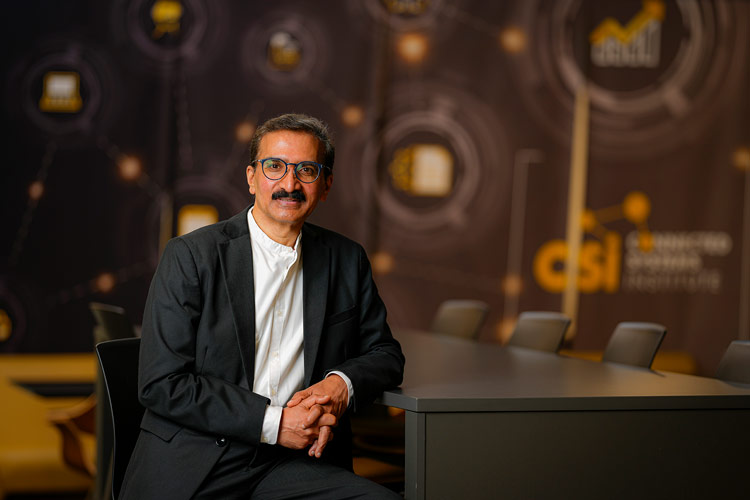
Dijo Alexander has always been a thinker. As a child, he had a knack for logic and was curious about machines and how they work.
That mindset led Alexander from a small village in India to a thriving career as a technology executive in the United States. Now, as a professor of practice in information technology management at the University of Wisconsin-Milwaukee’s Lubar College of Business, he teaches courses in applied artificial intelligence and data science.
His goal is not just to teach students how to work with AI, but also how to harness it to reshape entire business models and tackle problems across industries.
“I want to make it so that anyone can build what they can imagine,” he said. “I want to inspire our students to dream big and make their dreams a reality.”
From engineer to executive
Alexander’s natural affinity for math and science led him to engineering. After studying mechanical engineering at the University of Kerala in India as an undergrad, he got his master’s in industrial engineering at Marquette, supported by his aunt who lived in Milwaukee.
“I realized I’m good at planning and working with a team,” he said. “That’s what made me switch to industrial engineering and management.” Later, he received a PhD in management science from Case Western Reserve University.
Alexander climbed through various roles, from software engineer to software architect to head of technology. He held the latter position at SAP — one of the largest business software companies in the world, boasting over 100,000 employees — for over a decade.
Along the way, he also launched a startup company, BridgeFront, with a few colleagues. Working in the early days of the internet, they built an online platform that businesses use to train employees and customers. They were eventually acquired by SAP and merged with SAP Litmos. Although Alexander is no longer involved, the tech he helped pioneer continues to support people in over 150 countries.
In 2024, after several years of teaching as an adjunct professor at UWM, Alexander took another leap — this time into full-time academia. Today, as both a professor of practice and director of the Lubar College’s Information Technology Management program, Alexander is generous in sharing lessons from his experiences with his students.
“We are at a transition point in the technology era,” he said. “People like me cannot sit on the sidelines. We have to jump onto the court and play.”
Working with AI
At Lubar, Alexander wants his students to be equally proficient — or bilingual — in both business and technology, particularly artificial intelligence. “I hope to inspire students to approach the business world confidently, with no fear of technology,” he said. “So they can utilize artificial intelligence to do business better.”
Dismantling that fear is key to Alexander’s teaching philosophy. In his class on AI, he encourages his students to treat it like a teammate, not a tool. Then, through hands-on learning, he wants to empower them to apply AI to problems traditionally seen as outside their expertise as business students.
In one project, his students worked alongside UWM’s cafeteria managers to map out AI-powered systems for predicting food ordering. Once implemented, those systems could reduce waste and make surplus food more readily available to the school’s food pantry.
In another class, each of Alexander’s students developed their own snack company — completely with AI. The students guided AI-based tools through creating their company’s name, logo, ad copy and even its marketing jingle.
“Business school is about preparing students to lead and manage other people,” he said. “I’m trying to prepare our students to lead and manage AI agents along with people. That’s the story we’re trying to tell.”
Dreaming bigger
That story extends to research, too. When Lubar doctoral student Vishvak Bhatt fell victim to scammers while buying sneakers online, he worked with Alexander to create an AI system that can spot fraud in online payments.
The system, supported by a grant from the Northwestern Mutual Data Science Institute, acts as a watchdog. As designed by the pair, it constantly monitors financial transactions and flags anything suspicious, like urgent-sounding language or fake websites associated with the payment. If built into banking systems, those alerts would give human operators a chance to take a closer look.
“With faster financial transactions and instant payment services, hackers will have a field day if we don’t step up and prepare for it,” Alexander said. “That research was all about finding some of the methods we can use to safeguard consumers.”
As companies race to deploy their own AI systems, Alexander is also researching the choices that separate AI deployments that build workforce value from those that destroy it. The distinction carries direct consequences for companies’ talent strategy, risk management and ability to stay competitive.
That’s also why Alexander presents his AI course as a business class. By training his students to tackle business problems with AI, he aims to expose them to the ways that it can reimagine business operations, from marketing and finance to management. In doing so, he wants to give them the confidence to reach for the stars.
“Conceptualizing and building can now come hand-in-hand,” he added, describing how he teaches students prompt engineering – the process of giving AI models clear, sequenced instructions – as a way to verbalize their goals. “If you can speak (an idea) as simply as possible to a computer, the computer can help you build it.”


