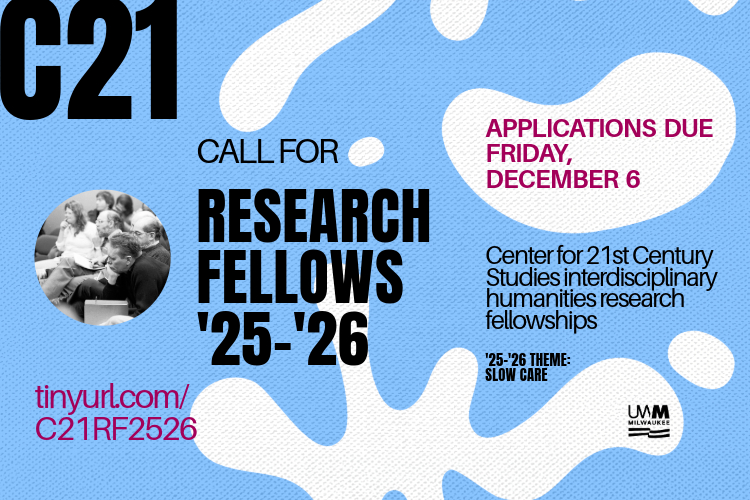
The Center for 21st Century Studies offers interdisciplinary humanities fellowships to UWM faculty and academic staff, as well as other Universities of Wisconsin faculty, that provide the time, space and collegial support to generate new knowledge and ideas. The deadline for applications for 2025-26 fellowships is Friday, Dec. 6.
A Universities of Wisconsin Center of Excellence, UWM’s Center for 21st Century Studies (C21) offers the fellowships as part of its mission to build a community of scholars to address the pressing issues of our time. C21 centers the humanities in its belief that innovation comes from diversity of opinions, disciplines and experiences.
In dialogue with our advisory council and community partners, C21 has identified SLOW as the theme that will inform our offerings for three years (2024-2027). Slow movements — across food, cities, science, scholarship and beyond — call attention to embodied processes of building and maintaining collective life that resist the fast-paced efficiency models, rapid rewards and short attention spans that increasingly dominate human responses to 21st century social, political and ecological challenges. The theme is intentionally broad to capture a wide range of scholarship and practice while encouraging innovative methodologies.
C21’s 2025-2026 programming focuses on SLOW CARE. Across health, climate, labor, technology and more, we ask how pacing affects the institutions, policies, cultural infrastructures, and social and political processes that support or disassemble an ethic of care. We welcome multiple interpretations of this open topic, including explorations of time, pace and speed as they relate to pressing issues of our time and/or work inside and outside the university. Methodological, pedagogical and research topical interests are all welcome in relation to this theme.
Applicants should propose a research project related to this thematic area. Projects can be individual or collaborative. Examples of projects include:
- Researching/preparing material for public presentation in a wide variety of forms including (but not limited to) monographs, essays, podcasts, performances; art installation/exhibits, community programs; digital interfaces; archives or artifacts.
- Researching for/development of large-scale collaborative projects (grant proposals, building networks, etc.).
- Researching/preparing syllabi for innovative, interdisciplinary team-teaching initiatives or credit-bearing programs such as certificates, minors and degrees.
For more information on eligibility and how to apply, please visit the C21 fellowship webpage.