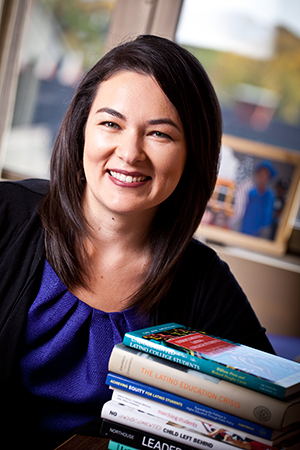
Some college students are living their lives two years at a time.
That’s the challenge for undocumented young people who have achieved legal status in the U.S. because of DACA (Deferred Action for Childhood Arrivals), which gives those brought to the U.S. illegally as children certain protections and opportunities.
At the same time, their status is still uncertain, says Susana Muñoz, assistant professor in UWM’s School of Education, who studies the issues surrounding these young people.
DACA is “double-edged,” says Muñoz. Launched by the Obama administration in 2012, DACA allows these young people to remain in the U.S. temporarily with a two-year renewable status as long as they meet age, education and residency requirements.
“It gives young people some liberties,” she says. “It allows them to work and go to school legally, and they’re able to find employment. On the other hand, you’re living your life in two-year increments and that’s emotionally exhausting.”
Muñoz began focusing her research and writing on the lives of undocumented young people after trying to help a young Mexican-American student.
Muñoz was working in a program for low-income and first-generation students and discovered that this student was undocumented. Muñoz realized that helping the student within working hours might jeopardize the federal funding of her program, so she offered to meet with the student at an off-campus location during her lunch hour. The student never showed up.
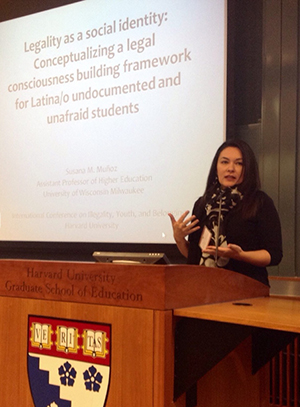 “This bothered me immensely,” says Muñoz, a U.S. citizen who came here with her family at age 6 and speaks fluent Spanish. “Yet, perhaps this student felt unsafe to see me.”
Starting with her dissertation at Iowa State University six years ago, Muñoz began looking at the factors that held back these undocumented students as well as the supports and attitudes that helped them succeed.
Her work has focused on identity issues that undocumented students face, how colleges and universities deal with these students, and on students who are “coming out of the shadows” to advocate for changes to immigration policy.
She recently completed a book on the journeys of these “undocumented and unafraid” young people and their impact on higher education. The book, scheduled for publication this spring, focuses on how these students see themselves and how their status affects their activism.
“They’re fighting a system that doesn’t see them as legally present in the U.S.,” says Muñoz.
She has also recently published a paper in Teachers College Record, a journal published by Columbia University, on Georgia’s Freedom University.
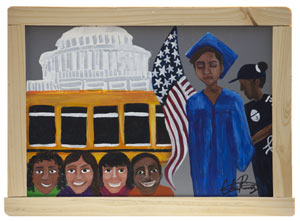
Freedom University in Athens, Georgia was started by University of Georgia faculty members in response to a 2011 policy enacted by the Georgia Board of Regents that denied qualified students without documentation access to five selective state institutions of higher education. Freedom University offered these students a chance to continue their education for learning, though not for credit.
“It (Freedom University) is a form of civil disobedience for faulty and empowerment for undocumented students,” says Muñoz. “They are not getting a college degree, but the mere fact they are coming to learn shows the importance of education to them.”
The Georgia Regents’ action, in a state with only a few hundred potential undocumented students, illustrates the complex politics surrounding immigration, says Muñoz.
Some anti-immigration politicians are also blaming DACA and its alleged “free work permits” for the influx of unaccompanied children coming across the U.S. border from Central America. These children don’t qualify for DACA or work permits and are often fleeing violence in their home countries, says Muñoz. In addition, research shows that unaccompanied minors seeking refugee status from Central America have been crossing the borders since the 1980s, says Muñoz.
“These are children and we are sending them back to a life on the run or to face death squads. Would we be doing this if they were Canadian children?”
While she is cautiously optimistic that further executive orders may help the status of undocumented young people, she’s discouraged about Congress’s inability to act. “We have band-aid solutions, not real reform.”
DACA has helped those who’ve lived in the U.S. since childhood somewhat, according to Muñoz, but many young people still face challenges in pursuing education if they are not citizens. For example, they don’t have access to federal student loan programs and only 20 states allow them in-state tuition. In many states, they aren’t allowed to apply for driver’s licenses, and if they do drive illegally, they may be faced with jail time or deportation.
Getting a DACA card can be challenging also.
“They have to be a certain age to apply, and they need documentation demonstrating continuous presence in the U.S.– either school records or receipts.
Then they have to retrieve these records,” says Muñoz. “There is a $465 fee, and then they have to reapply — and pay the fee again in two years. That’s a lot of money for people with limited financial resources.”
As one young person told her of the DACA card: “I tasted my DACA card and it didn’t taste like freedom.”