
Welcome to the Year of the Humanities at UWM – an opportunity for scholars and students to have a productive discussion about the role of the humanities in college education.
 “There was a certain amount of serendipity in the choice of this year,” says Nigel Rothfels, director of the Office of Undergraduate Research and chair of the organizing committee for the Year of the Humanities. “It’s timely because our campus discussion is part of a larger national discussion of the roles traditionally played by the humanities.
“There has been a great deal of focus on STEM [science, technology, engineering and mathematics] areas in recent years. People are thinking now about what other fields are doing, looking at the status of the humanities and clarifying their role.”
UWM’s core humanities departments include art history, English, communication, languages, comparative literature, women’s studies and philosophy. In addition, faculty in related areas such as history, political science, geography, linguistics and journalism, advertising and media studies also consider their fields related to the humanities.
“Humanities are strong on our campus,” says Rothfels, noting several nationally ranked departments. “We haven’t seen a drop in the number of students taking humanities courses.”

Furthermore, research shows that while graduates in the STEM fields and career-oriented majors often make more money right after college, the pay gap narrows over time. Studies in Britain and the United States shown that leadership in organizations often falls to people with core training in the humanities. Nearly two-thirds of members of the British Parliament and CEOs of Fortune 500 companies, for example, have degrees in humanities, arts and letters. (See infographic.)
“We’ll have much to show during the Year of the Humanities about what these fields have to offer to students and to our society at large,” says Rothfels. Critical thinking about issues, the ability to work effectively with others and communication skills are among the valuable results of humanities studies. “There are jobs out there…and good jobs.”
And, just as important in today’s increasingly interconnected world is the knowledge that humanities fields offer. “Our students are recognizing that it’s important to know more about other countries if we expect to have positive bilateral relations with them,” says Rothfels. “We cannot expect to understand other countries without a sense of their language, history and culture.”
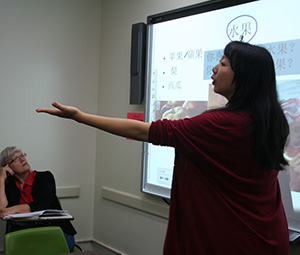
Languages, in particular, are growing in popularity, with much of the growth in Spanish, Middle Eastern and Asian languages. In these areas and other humanities disciplines, the university works closely with employers and surveys parents and students to make certain the courses being offered are responsive to their needs, according to Rothfels.
The Year of the Humanities at UWM will highlight the value of the humanities, with 20 to 30 events each semester. Some will be new events and others will be ongoing, including the Distinguished Lecture Series and film series sponsored by language departments. The University’s 21st Century Studies, International Education, and Jewish Studies centers, in addition to the humanities departments, will be involved.
“We’re taking this opportunity to highlight work that too often goes on under the radar,” says Rothfels. “We want to make this an opportunity for the campus and broader community to learn more about the humanities and join the discussion about the importance of these disciplines.”
See uwm.edu/humanities for more information on presentations, conferences and events.


