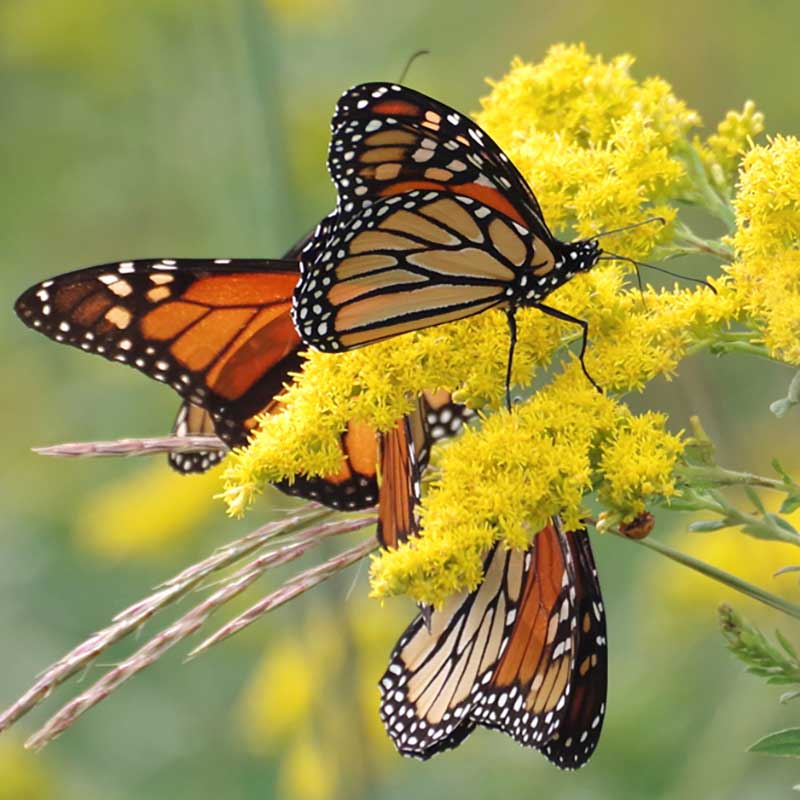
Monarch Butterfly Rerun
Howdy, BugFans, The BugLady saw her first monarch butterfly about 10 days ago, and today saw the first on her property. Here’s a rerun from two years ago on the status of the monarch, with different pictures, and a few …
May is American wetlands month, so we’ll end it in the swamp, in the company of Marsh Marigolds, the flowers that turn newly thawed wetlands a riotous yellow from the last days of April through much of May. Skunk cabbage and pussy willows may whisper the arrival of spring, but marsh marigolds crank up the volume. The BugLady should have started this project two weeks ago when the marsh marigold was at its peak, but the truth is that despite the masses of flowers it produces, she seldom sees many insects on it, and the ones she sees are as likely to be resting as dining.
The BugLady likes spiders, and she can even hail a number of species by name when she meets them, but she’s never applied herself to their taxonomy, and she jokes that maybe she shouldn’t be identifying them all by herself (to which BugFan Mike graciously replied that maybe nobody should be).
The BugLady has been checking the Wisconsin Odonata Survey website religiously to see if the dragonfly season has commenced, and she is pleased to announce that it has! Keep the site in mind on your spring and summer ramblings and share your sightings. Observers started reporting Common Green Darners on April 26, and the first Variegated Meadowhawk was logged on April 30. The BugLady is more than ready.
The BugLady visited Riveredge Nature Center recently looking for adventure, and she found it even before she hit the trails. A dozen or so mining bees were flying around over a dirt bank near a bench – they were either nesting there or thinking about it (she came back a week later, and nesting was well-established). Mining bees are solitary, ground-nesting bees in the family Andrenidae, a large family with about 3,000 species, almost half of which are in the genus Andrena (there are 450 Andrenas in North America).
Phantom midge larvae orient horizontally in the water, turning slowly, rising and sinking in the water column, reminding the BugLady of a young pickerel she once knew. One of the great rewards of scooping in the ephemeral pond is finding phantom midge larvae. Phantom midges (family Chaoboridae) are flies in the order Diptera. They are not mosquitoes, but they’re often lumped with mosquitoes (family Culicidae) and midges (family Chironomidae) in field guides.
The BugLady was visited by another moth recently, this time a Tufted Bird-lime/Tufted Bird-dropping Moth/Cherry Agate (Cerma cerintha) that appeared in her bathroom and, later, in her kitchen. It’s a lovely little moth with a one inch-ish wingspan, in the Owlet moth family Noctuidae.
The BugLady’s message to people who are pining for the wildflower season to begin is this: Get thee to a wetland and watch the non-flowering plants. Mosses, especially, are going crazy these days, their green leaflets (the gametophyte part of the plant) bristling with the stalks of sporophytes, topped by variously-shaped spore capsules. They’re happier now than when the canopy above leafs out and casts them into shade. Ground-hugging liverworts are covered by reproductive pits and umbrellas, and any day now, cinnamon ferns will push up through the dead leaves and dried fronds that top the wetland hummocks. It’s beyond life-affirming.
The BugLady was working on this week’s episode about a lovely little spider, but then she took a walk at the north end of the Bog and encountered a mob of springtails. She searched for a collective noun for springtails and found a few on-line discussions about it. “Mass aggregation” is the science-y choice, but other suggestions were cluster, swarm, sprinkle (for a small swarm), furcula (in honor of the springtail’s jumping appendage – teachable moment), and sproing.
The BugLady has been elbow deep in her tax packet, and she’s bummed by the global pandemic (as one author put it, we’ll probably learn a lesson from this affair, but probably not the lesson that needs learning), so she offers this rerun from 2014, which includes an suggestion of what the earth might look like if we vanish from the face of it (the Beat, BugFan Tom, will go on).