By Al Dickenson
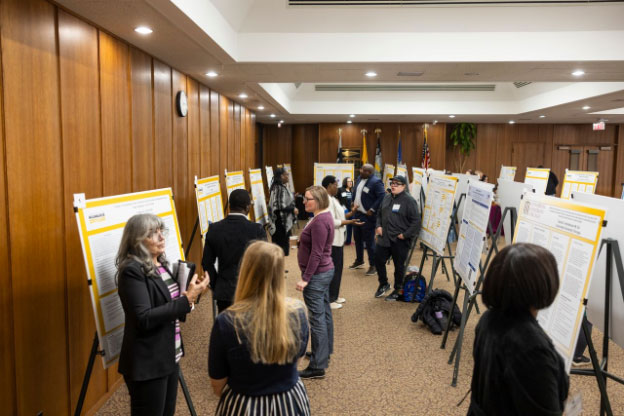
Early April saw the First Annual Institute for Urban Education (IUE) Research Symposium hosted at UW-Milwaukee. According to Dr. Leanne Evans, the Institute’s Director and an associate professor at the university, the purpose of the event was to create a dynamic space centering research and projects in urban education and communities. The IUE Research Symposium presentations, both in-person and virtual, offered participants and attendees an opportunity to collaborate, dialogue, and advance transformative work.

Over the course of two days, with 140 presenters/co-presenters, a total of 112 poster and roundtable presentations took place. “Over half of the presenters were affiliated with the University of Wisconsin-Milwaukee and colleagues from several other Universities of Wisconsin schools,” said Evans. “We also welcomed presenters from across the country and internationally. In total, participants represented 20 U.S. states, the Virgin Islands, the Philippines, Brazil, Turkey, and Canada.”
The symposium opened its doors to presenters from a wide range of backgrounds, including current and retired faculty, students attaining undergraduate, master’s, or Ph.D. degrees, and various individuals and organizations from the community.
“The two-day event succeeded in bringing urban education researchers, educators, and community members together to advance research and projects, deepen conversations, and expand networks related to urban education and communities,” said Evans.
“We are grateful to the presenters and attendees who engaged in these critical conversations that directly impact youth, families, and communities. Our keynote speaker, panel of individuals in the field of urban education, and array of presenters centered the significance of elevating underrepresented voices, power in relationship-building, and advancing change through action. We are currently planning for the 2026 IUE Research Symposium, aiming to continue facilitating relevant and courageous conversations at the intersections of research and practice in urban education.”
The keynote speaker of the symposium, Dr. Latish Reed, also agreed to sit down for an interview regarding her experience at the event, and to discuss her research. The interview is as follows and has been edited for length and clarity.

What was the main topic you focused on for your keynote address, or the issue you wanted to highlight/solve?
Since this was a research symposium, I situated the talk with the title, “Relevant Research in Real-Time.” My goal was to encourage attendees to consider how they will continue to speak truth in a time when voices are being muted. Using frameworks from my new book, The Complexities of Equity: Navigating Shades of Gray in Schools and Organizations, I encouraged the audience to reflect on the current times and what that means for their work. I used some personal and historical anecdotes and current events to reinforce the audience’s reflections. I closed with a call to action for undergraduates, graduates, and practitioners to make sure their research matters during this critical time.
Give us a little more background about your professional roles, including your roles as an equity leader at MPS, professor at UWM and UNC-Chapel Hill, and as an independent consultant. How did these roles lead into each other, or is there any overlap within them as well?
My first professional role after graduating from Marquette University with a B.A. in sociology was being an admissions counselor for the University. During that time, I applied to be a fellow in an alternative certification program that recruited teachers of color to work in MPS. After a few years of teaching, I moved into school administration to have a broader impact throughout the school.
After obtaining my master’s degree in Education from Alverno College and working as an assistant principal, I pursued a Ph.D. in Educational Leadership and Policy Analysis from University of Wisconsin-Madison. After graduating in 2007, I became an assistant professor of Educational Leadership at UNC-Chapel Hill. After a couple of years, I joined the UWM School of Education as an assistant professor.
In 2016, I began working for MPS as the district’s first equity specialist. In that role, I was responsible for creating a district-wide equity policy and revising the non-discrimination policy to become more gender-inclusive. I supported staff at all levels in understanding what equity is. Throughout my career, I have consistently consulted with schools, districts, non-profits, businesses, government agencies, and health organizations on ways to lead in a just and fair way.
What are your thoughts on the work the IUE is doing? How important is it to share findings in a symposium-like format?
Colleges and universities are spaces for intellectual exchange. Being able to share your research and findings are a vital part of engaging in higher-order thinking and analysis of complex issues. The IUE is providing an opportunity for scholars and practitioners to be thought-partners with others to refine their findings and communicate them with more clarity.
What did you learn at the symposium, if you were able to attend?
Following the keynote, I participated in the roundtable discussions where I sat with Fidel Verdin and Shalina S. AliIt of TRUE Skool. Their research was “Exploring Hip Hop Culture as an Experiential Education Model at TRUE Skool.” I was already familiar with TRUE Skool from the work I did in MPS. It was exciting to hear about their impact up close and personal. This organization has been a conduit for many students who have found traditional education inaccessible. We discussed how their findings could be perhaps developed into a process to help traditional teachers better engage students. Outstanding work! As an urban school of education, this is the kind of idea exchange that can make a difference in Milwaukee-area school districts.
Could you also discuss your upcoming book, The Complexities of Equity: Navigating Shades of Gray in Schools and Organizations?
The core of education has always been to find ways to support students who are not reaching their fullest potential for whatever reason. Currently, our society is highly divided politically. As
new limitations emerge regarding how to facilitate teaching and learning, this book offers a reflective guide. Readers are challenged to assess their current position, acknowledge constraints, clarify their objectives, and take meaningful action, even in the face of growing resistance to the core mission of helping those who need it most. The Complexities of Equity: Navigating Shades of Gray in Schools and Organizations was released by Corwin Press in April 2025. The book can be ordered at corwin.com (Use the code SAVE20 for 20% off.). It can also be purchased on amazon.com.
To access additional highlights of the First Annual Research Symposium and to follow the information for the Spring 2026 Institute for Urban Education Research Symposium, see the IUE website at https://uwm.edu/education/community-engagement/institute-for-urban-education/.