Many Wisconsin school districts today face challenges finding teachers.
At the same time, the overall number of potential college students is declining and students and their families are concerned about the cost of college. Both factors impact the number of students in education majors.
The University of Wisconsin-Milwaukee’s School of Education is tackling the issue by collaborating with local high schools to offer dual enrollment courses — college credit classes for potential future teachers.
Other local organizations in southeast Wisconsin also offer high school students and paraprofessionals already working in K-12 schools opportunities to become certified teachers.
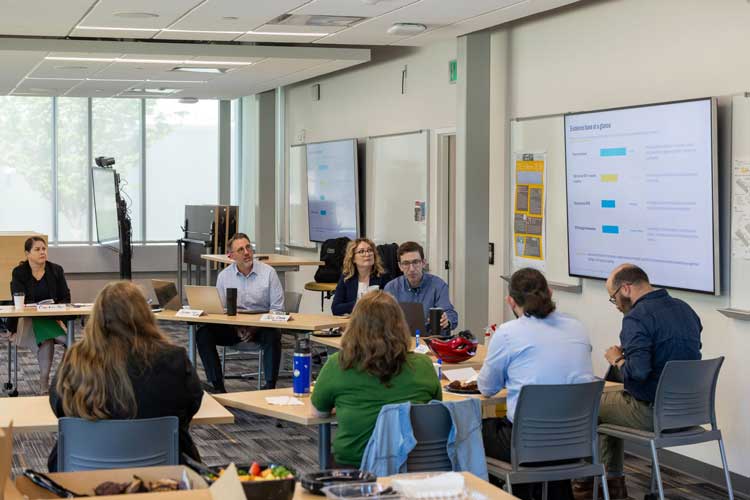
However, while successful and growing, these programs face some challenges, according to Jeremy Page and Vicki Bott of UWM, who hosted a conference on Teacher Education Pathways June 18. Page is special assistant to the provost for academic initiatives and assistant dean of strategy, analysis and innovation in the College of Community Engagement and Professions. Bott is academic partnership manager in the Office of Dual Enrollment.
The June conference brought together teachers and experts from the high schools with whom UWM is working, faculty members and representatives from other community organizations offering and supporting education pathway programs. All involved are trying to build the teacher pipeline through a variety of dual enrollment or “Grow Your Own” programs.
Among those participating in the conference were representatives from schools in the UWM dual enrollment program, Teach for America, Employ Milwaukee, Milwaukee Public Schools, Educators Rising, the National Academy Foundation Pathway Program at South Division, and UWM’s art education program.
The participants discussed current research on education pathways programs, looked at ways to collaborate and measure success and identify the data needed to support their program goals. Schools and community partners also offered brief presentations highlighting their strategies.
Dual enrollment programs have had some strong positive results in encouraging high school students to enroll in college, earn college credit, attend school full-time, persist in their education, complete their degrees and improve their grades, according to the data and research Page and Bott shared. Wisconsin alone doubled the number of dual enrollment credits in the past decade.
During the last academic year, 243 students from 10 high schools and the MPS district-wide education pathway program were enrolled in UWM education classes, according to Bott. The students earned college credits toward an education degree.
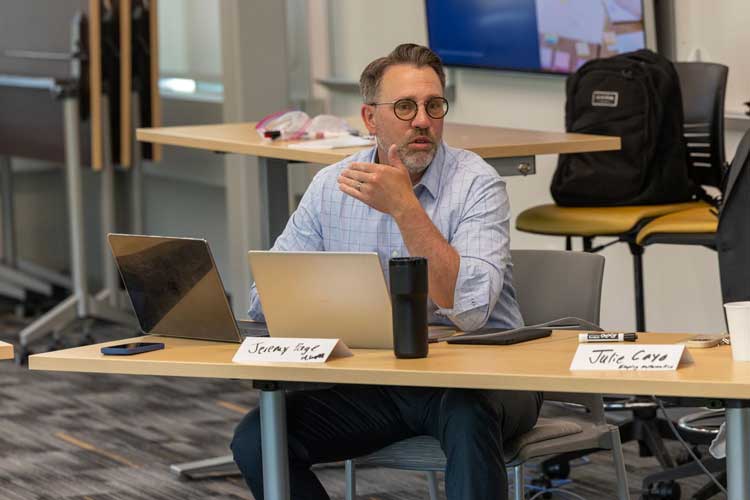
“Students are doing very well in dual enrollment classes in high school,” Page said.
A 2025 survey of the School of Education’s dual enrollment education program showed positive results. In fact, 75% of those taking the education class increased their interest in teaching. At the same time, data from the National Student Clearinghouse showed only about 11% of the students enrolled in the program declared an education major once they enrolled as a full-time college student.
One of the goals of the Education Pathways conference, according to Page, was to share information and address the issues like this — why students taking part in dual enrollment and grow your own classes are interested in education but not enrolling in education degree programs.
“I had two students who were super promising and super excited to go into teaching,” recalled Michaela Kaiser, the School of Education’s recruitment and scholarship coordinator. “Then they just stopped communicating.” She later found they’d signed up for computer science instead.
One issue that participants in the conference identified was guidance from parents that encouraged students to choose careers that they felt were more prestigious or offered better long-term economic prospects. Hollie Bandt of the Hmong American Peace Academy and Sam Epstein of South Division High School’s Pathways Program mentioned that this a particular concern among first generation/immigrant parents.
One way to address this, according to several conference participants, is to provide students and families with up-to-date information about Milwaukee and Wisconsin education salaries as well as benefits and pensions.
However, even those who don’t go directly into education often come to the field later. “Mike (Nguyen) and I are both examples of people who did not get an education degree when we were undergraduates, but came to the profession as post-bacc folks,” said Franz Meyer of Teach for America’s Pathway program. Nguyễn is director of Teach for America.
“We need to sit down and listen to people. We don’t know what’s going to resonate with actual students unless we actually listen and invite them into the conversation.”
Associate Professor of Educational Policy and Leadership, Marquette University
Matt Wood, a teacher in the dual enrollment program at Reagan High School, said many of the teachers he knows did not decide to become teachers until after college. “We need to share with the students that it is a career option at any point.”
Participants also emphasized that education offers many career opportunities working in schools. Counselors, librarians, school psychologists and speech pathologists, for example, are among the professionals working in schools.
The conference also looked at how data can help improve pathways programs.
Gabriel Velez, associate professor of educational policy and leadership at Marquette University, stressed to participants that it’s important to align data collection with program goals.
Surveys and standardized tests are valuable, he added, but can lead to data overload. Programs need to look at “What are the decisions we have to make and what’s the data connected to that?”
Most importantly, he said, pathways programs need to hear from participants.
“We need to sit down and listen to people. We don’t know what’s going to resonate with actual students unless we actually listen and invite them into the conversation.”