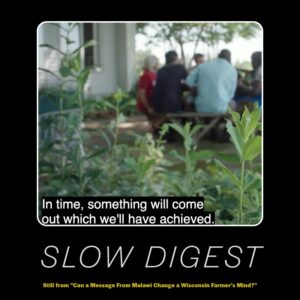
This week’s edition of Slow Digest explores how we can make meaningful changes in our environment. Written by C21 Graduate Fellow Yuchen Zhao.
How does meaningful change begin? We often associate social and environmental action with large-scale movements, major policy reforms, or dramatic moments of transformation. Yet lasting change can also emerge from smaller, everyday efforts: neighbors transforming an unused parking space into a gathering place, students learning alongside local communities, or activists traveling across borders to share their experiences and build understanding. These seemingly modest actions remind us that meaningful change often begins at the community level, through the participation and collective efforts of ordinary people.
As C21 explores Slow Action, we are interested in the often-overlooked work that makes collective change possible. Slow Action is not simply about doing things slowly. Rather, it asks us to consider how small actions, sustained relationships, and community participation can create meaningful change over time. In this sense, slow and small are closely connected. Small actions can bring people together, encourage participation, and create opportunities for collaboration, while their impacts may unfold gradually through continued engagement and collective effort. What begins as a temporary neighborhood intervention, a shared learning experience, or a conversation across communities can become part of a longer process of social and environmental transformation.
This week, we’re highlighting three resources that explore how small actions can contribute to lasting community change through different approaches: tactical urbanism, place-based education, and climate activism. Together, they invite us to consider how communities can become active participants in shaping their own futures, and how small, collective efforts can grow into meaningful transformations over time.
Tactical Urbanism: Short-term Action for Long-term Change
Mike Lydon and Anthony Garcia | Book (2015)
Improving our cities often requires substantial investment, years of planning, coordination among stakeholders, and sustained political and community support. But can meaningful urban change also begin with smaller, more immediate actions? In Tactical Urbanism, Mike Lydon and Anthony Garcia explore how small-scale, low-cost interventions can help residents and communities reimagine public spaces. Through examples ranging from temporary parks to redesigned streets, the book illustrates how short-term experiments can test new ideas, encourage participation, and inspire more permanent improvements. From this perspective, tactical urbanism shows us that meaningful urban change is not simply about the speed of an intervention. While a temporary project might be completed in a day, turning that experiment into lasting change often requires sustained community engagement, collaboration, and commitment.
Teaching Toward Slow Hope: Place-Based Learning in College and Beyond
Douglas Haynes | Book (2026)
Meaningful changes can begin with something as simple as learning more about the places and people around us. In Teaching Toward Slow Hope, Douglas Haynes explores how place-based education can foster connections among students, communities, and their environments. Drawing on experiences across the Upper Midwest, from urban gardens in Milwaukee to ecological restoration projects in Madison and community food initiatives in Kalamazoo, Haynes introduces the idea of “slow hope,” grounded in listening, reciprocity, collaboration, and learning through shared experiences.
Like tactical urbanism, place-based learning encourages people to engage directly with their surroundings and recognize their capacity to shape them. While the outcomes of these educational experiences may not always be immediately visible, they can cultivate relationships, a sense of belonging, and collective responsibility that extend beyond individual projects. Through the lens of Slow Action, Haynes illustrates how lasting community change can begin with small acts of learning, caring, and working together, gradually creating possibilities for more connected and resilient communities.
“Can a Message From Malawi Change a Wisconsin Farmer’s Mind?“
PBS | Short Documentary (2023, 9 minutes)
In this short documentary, Malawian climate activist Anita Chitaya visits Wisconsin to speak with American farmers about climate change. Drawing on her experiences in Malawi, where changing weather patterns threaten agricultural livelihoods, she brings a perspective that challenges how some farmers understand the issue. Their conversations reveal both the difficulties of communicating across cultural and political differences and the possibilities that emerge when people encounter unfamiliar experiences firsthand.
The documentary does not offer a simple story of persuasion or an immediate change of heart. Instead, it draws attention to the importance of creating opportunities for difficult conversations. A brief encounter may not resolve disagreements, but it can introduce new perspectives, raise questions, or encourage people to reconsider what they previously took for granted. Unlike the physical interventions and educational experiences explored in the first two recommendations, this film highlights a less visible form of action: the willingness to enter a conversation without knowing where it might lead.
All Slow Digest posts are independently researched and written by individual contributors. All opinions expressed therein are the author’s and do not necessarily reflect the views, policies, or positions of UW-Milwaukee or the UW system.