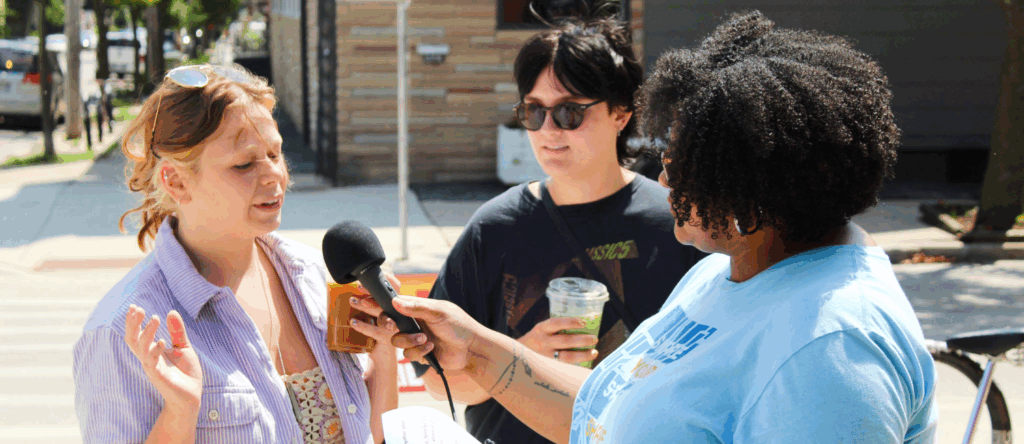
Story Cart is a mobile story collection program that travels to community spaces and engages Milwaukeeans in conversations about their lived experiences.
Our Story Fellows craft questions related to the current C21 research theme, record participant responses to those questions, and add them to our Story Cart digital archive (forthcoming).
The stories form the basis of our exhibitions, are referenced in our publications, and occasionally spawn spinoff events and related programming.
Frequently Asked Questions
What is a “Story Cart”?
C21’s mobile Story Cart is designed as a site for exchange, collaboration, and learning through story. Each year the Story Cart will focus on a theme that is part of C21’s extensive programming (podcasts, roundtable discussions, online resources). The C21 team designs a line of inquiry that invites stories in response to that theme. C21 hires and trains students to accompany the Story Cart to a range of locations across Milwaukee. Stories are typically shared through audio recordings, but may be supported by photographs, video, drawings, or writing.
Story Cart is currently on hiatus for the 2026-27 academic year to focus on the development and launch of the Story Cart Digital Archive.
How did the C21 Story Cart come about?
In 2022, C21 hosted a series of retreats that incorporated faculty, student, and community stakeholders in a conversation about the pressing issues of the time. The retreats focused on the place of the university in Milwaukee, the restructuring of the traditional academic conference, and the inclusion of multiple expert voices into conversations about topics both studied and lived. Mobility – honoring experience and expertise outside the space of the lecture hall or Zoom room, and meeting people where they are – anchored much of the discussion.
The leadership team at C21 decided to build a Story Cart to meet Milwaukeeans where they live their stories. We engaged Glenn Williams (UWM Art & Design) to design and fabricate a mobile work of art with craftmanship that would convey the value and care with which we would approach people’s stories. With a small, internal UWM grant, the Story Cart was born.
In the 2022-2023 academic year, C21 hosted the Nourishing Trust symposia which focused on the relationship between trust and food. Inspired by Martice Scales’ comment “The problem is that people in Milwaukee have no idea what it is like to have to walk a mile with two 10-pound bags of groceries,” we decided to use the Story Cart to invite stories of the journeys people take to secure food. The Story Cart and the Story Cart team visited grocery stores, farmers markets, block parties, and food centers across Milwaukee County and encouraged people to share their stories. That summer, the Story Cart team visited more than 25 locations and collected over 175 interviews.
The stories gathered by the Story Cart have been included in several exhibitions, including one created by C21. We have worked with community partners such as LUNA ( Latinas Unidas en las Artes) and TRUE Skool to create artwork based on the collected interviews. This work has been highlighted in numerous news articles such as this one by WUWM’s Lake Effect.
What happens to the stories?
People who share their stories can choose to use their names or not. With their permission, their stories/responses will be archived and made available for public education and use through the Story Cart digital archive (forthcoming).
What kinds of questions are asked?
C21 focuses on “story and sensory” surveys that invite participants to reflect on the feelings, sounds, smells, and colors evoked with a given topic. The answers to these questions are often hard-to-reach data, and they are meant to inspire creative solutions in the face of difficult topics.