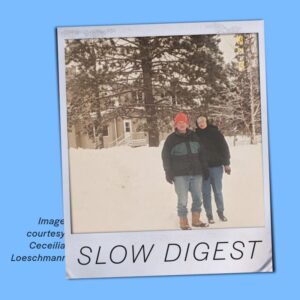
This week’s edition of Slow Digest is written by C21 Graduate Fellow Ceceilia Loeschmann.
Photographs, videos, documents, and other ephemera often exist as objects of memory, valuable to the families and individuals that create, collect, store, and steward them. Anna Woodham explores the idea of the family archive and what makes an archive “official” or “unofficial” in the article “We Are What We Keep: The ‘Family Archive’, Identity and Public/Private Heritage.” Woodham et al. ask such questions as: what do our possessions say about us? More specifically, what do they say about our past, present and our future? What do families see as valuable to themselves as individuals, to their wider families, and to a bigger national history? What role does the family archive play in the construction of individual and family identity?
As a child, I would spend weekends at my grandparents’ house. I loved it. I only had one set of surviving grandparents, and besides the usual joys of not being around my parents, my grandma Janet and I had an established ritual. I would choose for her a single photo album out of the stacks that lined the living room. Then I would sit in her lap as she flipped through page after page of glossy snapshots, eagerly listening to the stories associated with each one.
Each album contained a different moment in my family’s past. Portraits of my grandparents, my father, my mother, my sister and me. Of aunts, uncles, cousins, great-grandparents, great-great-grandparents, pets, and family friends. Scenes from the family farm, of rolling pasture and the inside of barns, my grandmother and her siblings doing chores, my great-grandparents squinting at the camera. Blurry impressions of my grandfather at work, drywalling the inside of someone’s home. 4 x 6 stills of family Christmases, birthdays, weddings, the occasional funeral. Prints of road trips to Northern Wisconsin and places farther away from home: Colorado, New York, Florida, Washington State. My grandmother could vividly recall the names of each person and place and remember each experience in detail.
In the wake of my grandmother’s death on September 22, 2022, similar questions to those asked by Woodham haunted me. Janet had been the family’s memory keeper, even as she was losing her own memory to dementia in the years preceding her passing.
By the time she had entered the land of Dementia (as Suzanne Finnamore, the author of My Disappearing Mother: A Memoir of Magic and Loss in the Country of Dementia, calls it) my grandmother had already begun to pass the title of memory keeper down to me. With it came thick albums of photographs, the stacks of home videos, and the uncounted bins of more photographs and other ephemera.
As an archivist myself, I was ready to take on these things and this title. The time of my grandmother’s passing also coincided with the decision to sell her and my grandfather’s home. In a sense, the house left behind was their greatest possession. Over four decades worth of belongings had accumulated within it. Every room stood as a reminder of their lives together. This was reflected in the furniture my grandmother had picked out for them, the linens that lay tucked away in the drawers, and in the Christmas cactus that outlived Janet’s time on earth. Each item seemed to carry traces of their presence.
Historically across cultures, the passing of material objects and family knowledge through generations is nothing new. Yet family chronicles, objects, and storytelling are often placed within the category of “unofficial” archives. The article “From the Sidelines to the Center: Reconsidering the Potential of the Personal in Archives” states: “the nature of archives and their treatment focused on the records of government and public bodies, stressing the “official” qualities of records and specifically denying record status to documents and collections created by individuals and families.” Recently, there has been a larger movement within archivists to acknowledge and work on closing the gap between the official and the unofficial. This process often starts with the activation of records or objects within an archive. As explored in “Touchstones: Considering the Relationship between Memory and Archives”:
- A death certificate is a statement of fact, created to confirm reality, not beget sentiment. But reading the death certificate of a beloved grandmother, a newborn baby, or a newlywed on honeymoon will each give rise of different emotional responses. And the association of the reader to the deceased – from stranger to kin – will change the reaction yet again. Thus the record ultimately serves many purposes and facilitates many responses, some evidential and some psychological.
The process of deciding what was valuable in my grandparents’ home and cleaning it out was rushed and frustrating. Taken at surface level, the material objects left behind were just reminders that a person once brought and kept these objects. Yet even the most mundane of the objects left for my family and I to sift through served as trigger points of memory meant to be activated. In sorting through what could be kept or discarded, we were also navigating the boundaries between memory and loss, preservation, and letting go.
I am grateful for the hours spent with my grandmother, turning the pages of family photo albums and caring for her in her later years, and for the opportunity to now steward the objects she once held so dearly. As the archival profession continues to push the boundaries between the “official” and the “unofficial,” it becomes increasingly clear that the everyday and the institutional are deeply intertwined. I can only hope that the archival profession continues the work to close this gap between archives left behind by others, and that personal archives continue to be seen as sites of engagement and possibility.
Citations
Douglas, Jennifer, and Allison Mills. “From the Sidelines to the Center: Reconsidering the Potential of the Personal in Archives.” Archival Science 18, no. 3 (2018): 257–77. doi:10.1007/s10502-018-9295-6.
Millar, Laura. “Touchstones: Considering the Relationship between Memory and Archives.” Archivaria 61, no. 61 (2006): 105–26.
Woodham, Anna, Laura King, Liz Gloyn, Vicky Crewe, and Fiona Blair. 2017. “We Are What We Keep: The ‘Family Archive’, Identity and Public/Private Heritage.” Heritage & Society 10 (3): 203–20. doi:10.1080/2159032X.2018.1554405.
Recommendations for Further Exploration
Events
Hands-On Heritage Week, a week-long opportunity to celebrate and learn about the history, experience, and individuality of those around you. Children and their families are invited to drop in at the Children’s Activity Area any time during Hands-On Heritage week to gain inspiration from the thinkers and storytellers that we celebrate during Heritage Months and Identity Recognition days. This event is from November 3–7 during open hours of the Washington Park Branch Library, 2121 N Sherman Blvd, Milwaukee, WI.
Story Cart: Attention with Symphony Swan – Memory Activation, a memory and archival workshop with one of C21’s Story Fellows. Participants will tap into memory, unearthing and documenting personal and collective stories as a way of building archives that reflect the full spectrum of the Black experience, particularly in Milwaukee. The event is on November 8 from 1-3 pm at the CR8TV House in Old North Milwaukee. Registration is required.
Fact, Fiction, and Storytelling in the Archive, a visually led talk by visiting author and artist Faythe Levine who reimagines archives and collections through a queer feminist lens. The talk explores her many-year research process about her recently published fourth book, As Ever, Miriam (2024). The event is on November 18 from 3-4 pm in the American Geographical Society Library in Golda Meir Library, 2311 E. Hartford Ave. Milwaukee, WI.
Archive Dive, a week-long opportunity to look back at our city and neighborhood history. Children and families are invited to dive into the people, businesses, events, and culture that made Milwaukee, solving historical mysteries using clues from the Milwaukee Public Library’s collection. Drop in at the Children’s Activity Area any time during Archive Dive week to explore this month’s historical mysteries! This event is from November 17–21 during open hours of the Washington Park Branch Library, 2121 N Sherman Blvd, Milwaukee, WI.
Books
Home Possessions: Material Culture Behind Closed Doors, edited by Daniel Miller
My Disappearing Mother: A Memoir of Magic and Loss in the Country of Dementia, by Suzanne Finnamore
Creating Family Archives: A Step-by-Step Guide to Saving Your Memories for Future Generations, by Margot Note
Local Resources
Milwaukee County Historical Society’s Oral History Collection
UWM Libraries Oral Histories Collection