This week’s edition of Slow Digest is written by C21 Managing Director Katie Waddell.
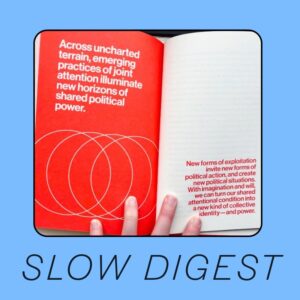
On April 1, C21 will lead an edition of the Cactus Book Club focusing on the book Attensity! A Manifesto of the Attention Liberation Movement by The Friends of Attention. Attensity! expands upon the attention activist manifesto championed by C21’s partners at the Strother School of Radical Attention, and it offers an opportunity for the attention activism-curious to explore why our attention matters, how to choose attentional agency over digital enthrallment, and why awareness is even better with friends.
Many readers will recognize the uneasy feeling that opens Attention! A Manifesto of the Attention Liberation Movement: the sense that something about everyday life—especially life online—has gone profoundly wrong.
We live in a moment when our lives are structured by the rhythms of digital capitalism: consumption, production, and endless circulation through feeds. The creeping awareness of the fragmenting effect, the digital environment in which we are perpetually immersed, has, at the time of this writing, accelerated to an unbridled gallop. The algorithms that typically dump run-of-the-mill commercial content into feeds everywhere are punctuated by images of oil raining down on an inferno in the Middle East, followed by what may or may not be an AI-produced video of a family of racoons jumping on a trampoline, followed by announcements that a film adaptation of a Thomas Pynchon novel won Best Picture at the Oscars (too on the nose?). It’s one distraction after another.
Distraction from what?
(Yes, sure, ok, the Epstein files. But not just the Epstein files.)
The argument at the heart of Attensity! is that the consequence of this constant disruption and redirection of our attention is a growing sense of alienation—from our interior worlds, ourselves, and each other. Attention, the book insists, is not merely information-processing or screen-focused concentration. It is the fundamental act of giving our minds and senses over to something, whether it’s a difficult concept from a challenging book, a heartfelt conversation, or the precise texture of your dog’s fur when you know you are scratching his ears for the very last time. Attention is the connective tissue between ourselves and everything else—the natural world, lived experience, one another, and consensus-based reality.
If attention is the medium of human connection, then the stakes of the modern “attention economy” become clear. Over the past three decades, the authors of Attensity! argue, the drivers of digital capitalism turned attention into a resource to be extracted. Platforms convert attention into profit not only through advertising but through constant tracking and measurement. In this sense, the resource being exploited is not just our time—it is us: our thoughts, senses, emotions, and consciousness.
The Friends of Attention provocatively call this process “human fracking.” Just as industrial extraction industries burrow into the earth to capture energy resources, digital systems are inserted into human awareness to capture attention.
The authors substantiate their claims about human fracking with a distilled history of clinical science. Attention extraction, they argue, was made possible by the twentieth-century study of attention, which, funded by military, industrial, and advertising interests, focused on how humans function as components within large technological systems. Though the array of methods by which humans attend to things is vast and varied, one kind of attention drew the interest of industry—task-based focus. “Focus” became “attention span” when discussed in the context of temporalized, interrelated tasks. From radar monitoring during the Cold War to magazine readership metrics, focus became something that could be measured, optimized, and monetized.
Focus is a particular, definitive way of attending—one that can be taught. One that can be produced through personal discipline, sometimes to the detriment of other, less utilitarian forms of attention such as contemplative immersion or conviviality. Distraction, the supposed disruption of focus, is perhaps better understood as the exchange of one object of focus for another. Framing it as distraction both individualizes a systemic problem and imparts a sense that our distracted condition is inevitable. Our supposed “short attention spans” are part the power of the broader attention-extraction industrial complex. Forms of attention are learned, and the systems that capture or disrupt our attention are constantly teaching us how to attend.
Which means that attending can be understood differently, can be taught differently.
One possible remedy proposed by the Friends of Attention is attention activism: a collective movement to reclaim attention as a shared human capacity rather than a privately monetized resource.
Drawing parallels with the rise of labor and environmental movements, Attensity! authors suggest that our “psycho-sensory environment” deserves protection just as much as the natural one. If industrialization produced factories and the labor movement, digital capitalism has produced pocket-sized factories of attentional capture. It follows that the struggle for the right to free thought, free consciousness, is on its way, and only wants for willing midwives to guide its passage from the realm of could happen to happening.
What might resistance look like? Attensity! offers some ideas, if not replicable models. Like most manifestos, it works best as a point of convergence for like minds, and as the basis for a movement’s beginning.
So what kinds of attention exist beyond the narrow forms measured by screens and metrics? And what kinds of worlds might become possible if we learned, together, to attend differently? We—you, I, and the fine folks at the Cactus Club, can start with these questions on April 1. I don’t know where these questions will lead, but I do know that questions are pathways, and a welcome alternative to the treadmill of doomscrolling.
The views, information, and opinions expressed in Slow Digest are those of the individual contributors and do not necessarily represent the views, policies, or positions of the Center for 21st Century Studies, the University of Wisconsin–Milwaukee, or the University of Wisconsin System.
Resources:
Cactus Book Club with C21: Attensity!
Wednesday, April 1, 5:30-7:30 at the Cactus Club, 2496 S Wentworth Ave, Milwaukee. Free and open to the public. Registration is not required to attend, but if you RSVP with C21 by Monday 23, you may have a chance to get a free copy of Attensity!
Cactus Book Club (CBC), organized by Cactus+, meets on the first Wednesday of the month from 5:30-7:30 in the back room at Cactus Club. Each month a different community organization, collective, mutual aid group, or business chooses the book and recommended bookseller, then leads the discussion.
Attensity! A Manifesto of the Attention Liberation Movement
C21’s recommended local bookseller is Boswell Book Company. Mention Cactus Book Club at checkout to receive a 10% discount!
No time to read a whole book before April 1?
Fill in the gaps with the Strother School for Radical Attention’s Toolkit for Attention Activism and their Attention Lab podcast on Apple Podcasts.