This week’s edition of Slow Digest includes recommendations compiled by former C21 Graduate Fellow Jamee N. Pritchard.
Our last Slow Digest post featured a list of recommendations for further reading on C21’s current research theme, Slow Action. This week, we’re sharing a selection of media pertinent to our exploration of collective organizing across communities and institutions.
To recap, this year, C21 will explore the practices, methodologies, histories, and theories of collective organizing across communities and institutions within the theme of Slow Action. Slow Action asks the following questions:
- How do attention and pace shape what is possible – inside and outside the university – as we face the most pressing challenges of our time?
- How might the humanities help us understand and enact organizing as a form of care?
- What does it look like to build actionable pathways that are both purposeful and adaptable, rooted in values yet open to change?
The list of recommendations below is organized by media type: archives, film, and storytelling.
Slow Action in the Archive
- Neal, L. (1968). “The Black Arts Movement.” The Drama Review, 12(4), 29–39.
Writing at the height of the Black Arts Movement (1965-75), Neal argues for Black cultural practice rooted in community, self-determination, and the needs and aspirations of Black people. He rejects the separation of the artist from their community, positioning cultural production as part of the broader work of social and political transformation. This essay asks its readers to consider how art, cultural institutions, and collective creative practices can build the foundation for change that extends beyond a single protest or political moment. See also Langston Hughes’ essay, “The Negro Artist and the Racial Mountain” (1926).
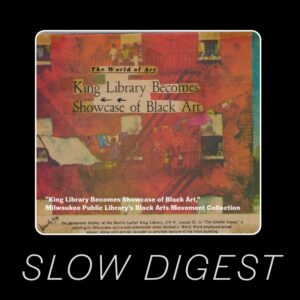
- Milwaukee Public Library’s Black Arts Movement Digital Collection
MPL’s digital collection documents the artists, organizations, exhibitions, and cultural spaces that shaped Milwaukee’s Black Arts Movement from the 1960s into the early 2000s. The collection demonstrates how archives can preserve the cumulative work of community memory and cultural production, allowing movements to remain accessible to communities long after their original moment. It also asks us to consider archiving itself as Slow Action – the ongoing work of collecting, preserving, describing, and making memory available across generations. See also UWM Archives March on Milwaukee Digital Archive Collection. Find the MLP website in this link.
- Roque-Ramírez, H. N. (2020). “A Living Archive of Desire: Teresita la Campesina and the Embodiment of Queer Latino Community Histories.” In A. Burton (Ed.), Archive Stories (pp. 111–135). Duke University Press.
Through the life and testimony of Teresita la Campesina, a transgender Latina performer and activist in San Francisco’s Mission District, Roque Ramírez considers how histories marginalized by traditional archives can survive through bodies, memories, performance, and storytelling. Testimonio becomes an archival practice through which individual memory carries a larger collective and community history. This “living archive” expands our understanding of what an archive can be: a person, a song, a performance, a memory, or an encounter through which history is transmitted. Roque Ramirez asks us to value listening, witnessing, and the gradual accumulation of lived memory as practices of historical preservation, resistance, and collective organizing. See also: Story Cart Digital Archives: Food Journeys, Trust and the Vote, and Attention.
Slow Action in Film
- Summer of Soul (…Or, When the Revolution Could Not Be Televised) (2021), dir. Ahmir “Questlove” Thompson
This film documents the 1969 Harlem Cultural Festival, a series of free concerts that brought together thousands of people in Harlem for performances by artists such as Stevie Wonder, Nina Simone, Mahalia Jackson, Gladys Knight & the Pips, and Sly and the Family Stone. Although the festival was filmed, much of the footage remained largely unseen. Summer of Soul connects music, gathering, and cultural expression to Black political consciousness and community formation during a period of social change. It also invites us to think about slow action through collective joy, cultural gathering, and the recovery of overlooked histories as forms of sustained political and archival work. You can see the trailer in this link.
- Crip Camp: A Disability Revolution (2020), dirs. Nicole Newnham and Jim LeBrecht
This film traces the relationships that developed at Camp Jened, a summer camp for young people with disabilities. It follows several former campers as they became involved in the disability rights movement of the 1970s. The documentary shows political changes emerging through years of friendship, community-building, organizing, protest, and sustained advocacy that eventually contributed to major changes in disability rights and public policy. Through the lens of Slow Action, the film demonstrates how movements grow through sustained relationships, collective care, and the long-term work of transforming both institutions and public understandings of disability. Watch the film here.
Slow Action through Storytelling
- By Every Measure by Radio Milwaukee
By Every Measure examines systemic racism in Milwaukee and the historical processes that produced contemporary racial disparities. Episodes pair discussions of structural inequality with people and organizations working toward change. Listen to the episodes here.
- Audio Interference by Interference Archive
This podcast works together with Interference Archive, based in Brooklyn, NY– a social space, exhibition venue, and open stacks archive of movement culture. Its mission is to explore the relationship between cultural production and social movements. The podcast documents the activists, artists, and organizers whose histories make up the archive. Find the podcast in this link.
- Stories for Power by The Storytelling & Organizing Project
The Storytelling & Organizing Project’s Stories for Power is an oral history podcast documenting roughly 25 years of community accountability, transformative justice, and abolitionist feminist organizing. It deliberately preserves the experiences of everyday people developing community-based responses to interpersonal violence outside carceral systems. You can listen to this podcast here.
Sources
Neal, L. (1968). “The Black Arts Movement.” The Drama Review, 12(4), 29–39. https://doi.org/10.2307/1144377
Ramírez, H. N. R. (2005). “A Living Archive of Desire: Teresita la Campesina and the Embodiment of Queer Latino Community Histories.” In A. Burton (Ed.), Archive Stories (pp. 111–135). Duke University Press. https://doi.org/10.1215/9780822387046-006
All Slow Digest posts are independently researched and written by individual contributors. All opinions expressed therein are the author’s and do not necessarily reflect the views, policies, or positions of UW-Milwaukee or the UW system.