This week’s edition of Slow Digest was written by Adam Carr, one of C21’s Story Fellows, as he reflects on his process of creating three attention experiments during the 2025-26 academic year for C21’s theme of Slow Care.
In the past week, I’ve had a handful of conversations with people around my age (41) about how weird it feels to live through a significant cultural shift. Culture is an unwieldy and webby idea. It doesn’t shift easily, and articulating dimensions of the shift isn’t easy — a fish usually can’t tell you what water tastes like.
We, fish. This water? Fishy.
Here’s what I and my middle aged millennial friends are talking about: At a fundamental level, people act differently than they used to. That would be true no matter what over the course of any decades, but it feels as if we act extra different. Technology is an accelerant, and we are addicted. It’s not just asking us to reach into our wallets; it’s coming for our time. And none of this is new.
Perhaps every overthinking 41-year-old comes to feel this way, accompanied by a feeling that if they could just put their finger on the right framing, it would all make sense.
On May 3, 2025, I went to an event whose e-mail invitation had “Attention Activism” in the subject line. It gave my eyebrows a raise — I’d never seen that term before and it sounded like something. The event was convened by UW-Milwaukee’s Center for 21st Century Studies (C21) and NYC-based Strother School for Radical Attention. More intriguing names for my nerd mind.
The workshop was amazing. We began by exploring an attention-centric formulation of “you are what you eat.” In our ultra-consumeristic, algorithm-saturated ecosystem, us people are no longer the consumers — tech companies create products engineered to consume our attention and harvest our dollars. Eyes spinning in the boundless casino. We are being consumed.
Our facilitators asked, if where we put our time and attention shapes us, and we have become warped, how do we reclaim our time?
After establishing this powerful frame, we then did “attention experiments” together. Again, amazing. We were guided through odd and creative activities, asking us to slow down and twist our attention to notice and examine how we were paying attention.
We spent intimate time with other people. We spent time questioning how our phone screens distort. We walked in the world, communing with it and ourselves. We asked fundamental questions of our experience, first-order questions, digesting reality unhurriedly.
Afterwards, C21 commissioned three artists to design a series of attention experiments throughout the 2025-2026 academic year. I got to be one of those artists(!). Over fall and winter this project was a perfect companion for my life. As I sought sanctuaries for myself in a world out of balance, I noted the experiences and moments that felt like gateways into the kind of attention I wanted to be holding for myself.
When did time feel healing? Juicy? Connected? Mine?
This led to three attention experiments that took place throughout the academic year. Each felt elaborate in production and simple in delivery. I learned a lot.
Below are some reflections on each of my attention experiments: Beach Class was an endeavor of the mind; Crystal Quest was for the spirit; and Skyward Ho! was for the body.
Beach Class
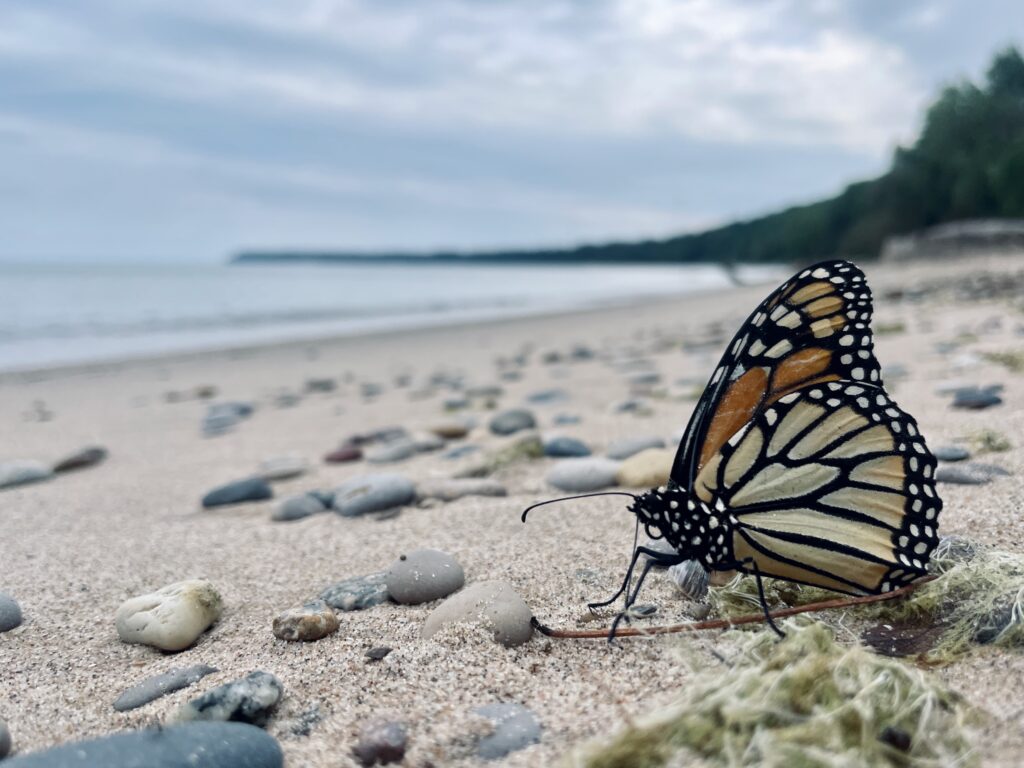
I didn’t grow up seeking the coast, but through times of personal and global uncertainty in this past year, I found solace on the lakefront. The horizon doesn’t need anything from me, and neither do the waves unless I bother them. They make good company.
Whenever I get comfortable on the beach, my attention turns to the sand, especially the lake rocks and beach glass. With eyes peeled for smoothness, sparkle, and novelty, my mind drifts wherever it needs, especially to thoughts in need of processing. While writing instructions for Beach Class, I tried to shape a natural progression, inviting memory, reflection, and space for the mind to flow.
The event took place at Klode Beach, one of my favorite places to go for a walk. I got to know the C21 team better during this event; they couldn’t be more lovely.
Crystal Quest
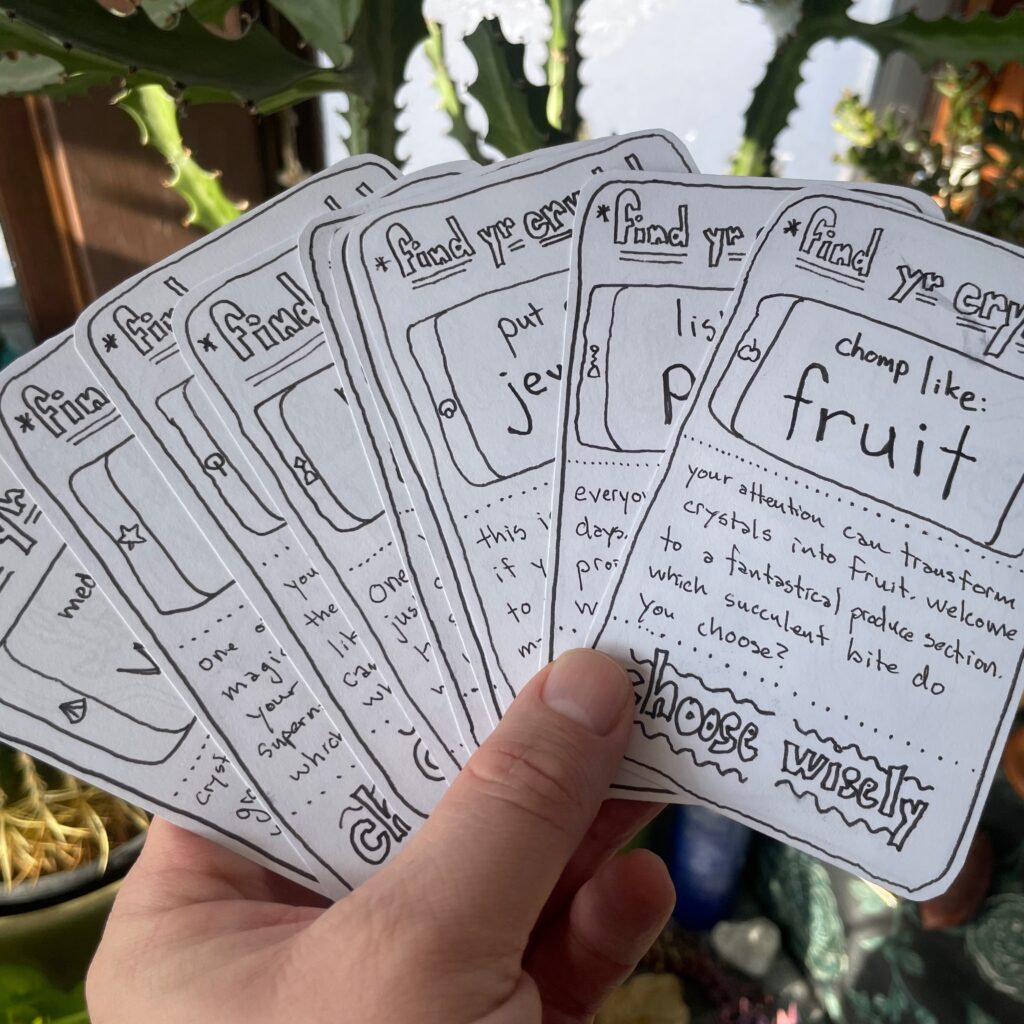
As it turns out, UW-Milwaukee has a world-class crystal, mineral, and fossil collection in its Thomas A. Greene Geological Museum. It’s tucked away in Lapham Hall, a science building, and when I stumbled on it for the first time, I fell head over heels. My mother had crystals in the house growing up, and I was always drawn to them. I’ve spent a lot of time sorting through the past lately, and the name for this activity came from an old computer game my brothers played when I was young.
I made a deck of cards for this attention experiment with imaginative prompts, inviting people to look closely at the crystals, and pay attention to what calls. The activity took on a playful and esoteric tone. I let myself have fun. I sought to offer folks an invitation into their own imagination, choosing enchantment from within, not sourced from an algorithm.
Our activity took place within UW-Milwaukee’s Darwin Day, a celebration of science on Valentine’s Day. Adding a dreamy ambiance to the room, amazing artist and friend Klassik created improvised soundscapes for our time in the museum.
Skyward Ho!
While my first two attention experiments were developed in part to loosen the powerful grip of the smartphone, the activities involved a fair amount of hunching. So for the final activity, I wanted to let the spine and body loose. The idea eventually clarified as: “honor sky with body.”
I am not a body person. I like to move, and I called upon an expert to help create the final attention experiment. I was thrilled that Yogi Matthew Lewis of Still Honey, whose class I’ve appreciated at Embody Yoga, agreed to collaborate. After conversations exploring potential, Matthew created a deconstructed sun salutation for the event, which I called a “sanctuary salutation.”
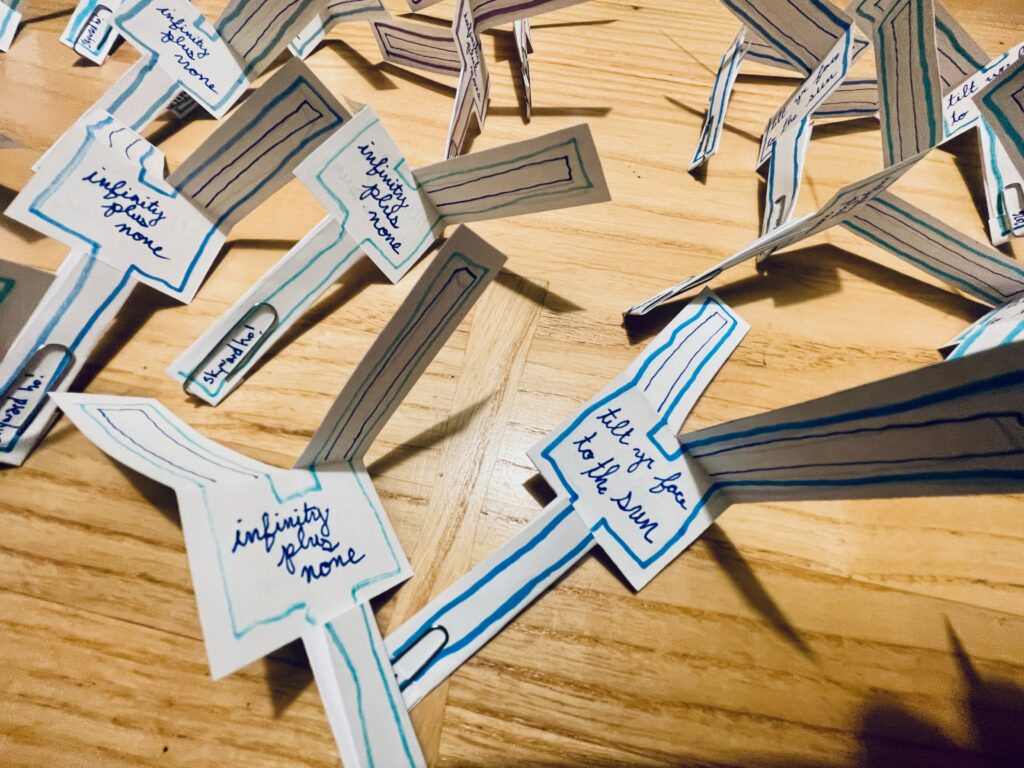
The attention experiment was located within Fondy Food Center’s Winter Farmers Market at The Table, so the yoga took place in a former church sanctuary among delicious food and kind people. As a takeaway gift, I made little paper helicopters. Because there was a balcony in the church space, I knew there was a place to fly them.
After my three attention experiments, I’m proud to say, the problem is solved. Attention crisis? No more. Through the combined powers of nature, imagination, whimsy, and…Oh, problem not solved? Okay. Well, at least we gave it the old college try.
Serious doesn’t need to mean grim and dour and driven. I feel tremendously grateful that I could take this work seriously. I love surrendering my attention to the world, and I’m drawn to those who do the same. It’s been painful to watch how my neighbors’ attention has been nibbled to the bone. In dire times, this work has helped me feel a different kind of hope.