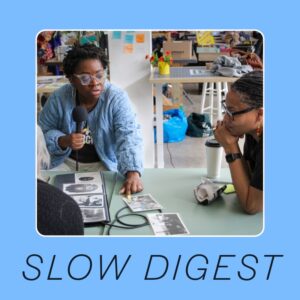
This week’s edition of Slow Digest was edited by by Managing Director Katie Waddell. C21 graduate fellows selected the featured interviews. Audio was edited by Graduate Fellow Yuchen Zhao.
From September 2025 to May 2026, C21’s Story Cart project introduced Milwaukeeans to practices of radical attention. Our team developed pop-up workshops throughout the city and recorded discussions with participants about their experiences to discover whether 21st-century people can unlearn the habits of fast-paced timing, rapid rewards, and scattered focus that hamper capacities for critical thinking and deep engagement within civil and social life.
Following the example of the Strother School of Radical Attention’s Attention Labs, C21 recruited three community Story Fellows—a licensed counselor, an artist-archivist-organizer, and a Milwaukee Renaissance man—to create attention workshops, which were carried out at various gathering spots. The Story Fellows made decisions about workshop content and formats, sometimes bringing in special guest artists and facilitators. These workshops revealed how deliberate, or redirected, attention can open pathways to new ways of noticing, interpreting, and connecting through sensation, questing, imagination, reflection, and memory. With phones tucked away, participants directed their attention inward, outward, and all around as they considered, and discussed on-record, the world beyond the screen.
Here are five of their stories.
Sensation
At the Haggerty Museum of Art’s Community Art & Wellness Retreat, we invited guests to take in the ambient sounds around them, then reflect on that experience, first through writing, then through conversation with Story Fellow Madeleine Doelker-Berlin. As a professional healer, participant Ronnie was uniquely attuned to the somatic experience of deep listening.
Click below to hear a clip from Madeleine Doelker-Berlin’s interview with Ronnie Jean Artero Frederick during the “Sound Bath of the Ordinary/The Listening” pop-up at the Haggerty Museum of Art on November 15, 2025.
Questing
At the Thomas A. Greene Geological Museum’s annual Darwin Day celebration, we invited visitors to engage with rocks and minerals through imagination and play. Visitors chose from a variety of “quests” in the form of prompt cards created by Story Fellow Adam Carr, each encouraging them to extend their curiosity toward whichever museum mineral struck their fancy. Some participants picked out crystals that would make a great podcast. Others sought out artifacts that looked like they might have a deep, dark secret. Participant and avid rock enthusiast, Elena, found a fluorescent fashion statement.
Click below to hear a clip from Adam Carr’s interview with Elena Calvagna during “Crystal Quest” at the Thomas A. Greene Geological Museum on February 14, 2026.
Reflection
At Havenwoods State Forest, we stepped out of the anthropocene’s blurred speed to walk in tune with the pace of nature on the first official day of spring. After the walk, we took time to reflect—first in writing, then in discussion with the whole group. Contributor-participant Harlem had a lot to say about Aries season, as well as the alignment of current events with the cosmos.
Click below to hear a clip from the sharing session following “(W)rites of Spring” at Havenwoods State Forest on March 21, 2026. The workshop was facilitated by Mia Rimmer and curated by Symphony Swan. Harlem Masimba is speaking in this clip.
Imagination
At Beet Street Fall Festival, the Cactus Club’s annual, all-ages block party, we invited guests to surrender their phones to us for 30 minutes, wander about, then return to our booth to talk about what they did (and how it felt) with Story Fellow Madeleine Doelker-Berlin. Without his phone, instead of relying on Google for answers, participant Chris enlisted strangers to help dream up an explanation for a pressing question.
Click below to hear a clip from Story Fellow Madeleine Doelker-Berlin’s interview with Chris Hege during “Open Attention Walk” at the Beet Street Fall Festival on October 4, 2025.
Memory
At THE CR8TV HOUSE, a community art-centered third space that provides a platform for Black and Brown artists, Story Fellow Symphony Swan led a workshop that invited participants to tap into memory by unearthing and documenting personal and collective stories as a way of building archives that reflect the full spectrum of the Black experience. The workshop focused on the celebration and reconciliation of family histories through archival photographs, artifacts, and other forms of ephemera. After the workshop, participants had the opportunity to share their memories one-on-one with C21 Graduate Fellows.
Click below to hear a clip from C21 Grad Fellow Jamee N. Pritchard’s interview with Blue Lotus after the “Memory Activation” workshop at CR8TV HOUSE on November 8, 2025.
Story Cart is a mobile story collection program that travels to community spaces and engages Milwaukeeans in conversations about their lived experiences. Our Story Fellows craft questions related to the current C21 research theme, record participant responses to those questions, and add them to our Story Cart digital archive (forthcoming).
Story Cart: Attention was inspired by the Strother School of Radical Attention, was supported by the Wisconsin Institute for Citizenship and Civil Dialogue, and was part of C21’s SLOW: The Pace of Being Human programming series.