This week’s edition of Slow Digest is adapted from More Than a Feeling: Performativity, Sincerity, and Sociality in the Art of the Affective Turn, a master’s thesis by Katie Waddell, Managing Director of C21, adapted for Slow Digest by Jamee Pritchard.
Learning to Love You More (LTLYM), an interactive web-based project by artists Harrell Fletcher and Miranda July ran from 2002 to 2009 and featured a series of participatory assignments open to any member of the public. The artists asked visitors to document and submit completed assignments, which ultimately became a series of crowd-sourced “reports” for display on the site. The assignments’ detailed and exacting instructions compelled participants to carry out tasks that asked them to engage with neighbors, strangers, objects, and public spaces in specific, directed ways. The tasks ranged from quick and simple, such as “Assignment #33: Braid someone’s hair,” to complex, time-consuming, and emotionally fraught, as with “Assignment #36: Grow a garden in an unexpected spot,” or “#31: Spend time with a dying person.” In the words of “Assignment #44: Make a ‘Learning to Love You More assignment,’” the tasks were intended to “bring people together and give them a new way to feel something.”
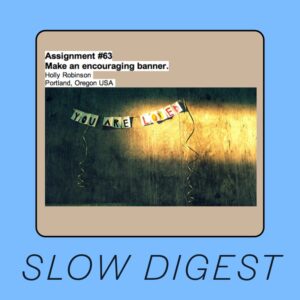
Consider, Assignment #63, for example, “Make an encouraging banner.” The description reads:
Think of something encouraging you often tell yourself. For example: Everything will be ok. Or: Don’t listen to them. Or: It’ll blow over. Now make a banner…Hang the banner in a place where you or someone else might need encouragement, for example, across your bathroom. Or between two trees so that you and your neighbors can receive encouragement from it. Or in a gas station.
Colorful, blocky, some tidily arranged, others borderline haphazard, the banners declare hopeful sentiments ranging from the defiant (“Riot!”) to the deliberately ambiguous (“the light! the glow!”), the cheeky posted over a toilet (“It will all come out okay.”), and the platitudinous (“Don’t give up.”) Individually, they convey an earnestness and sense of humor. Viewed en masse, as a series, the banners start to seem more desperate than encouraging, declaring, one after the other: “Someone will love you soon,” “You are not your paycheck,” “You have a spine!” “You still have both of your legs,” “One day you will be cool,” “You are not boring,” “You matter”… The “you” collectively addressed by the banners implies that if the banners are speech directed to both the participant (“you often tell yourself”) and a specific “someone else,” there must be a lot of lost and unhappy people wandering around the world. Thus, the banners, for all their cheery encouragement, divulge a wounded glumness.
Something emerges from Assignment #63’s apparent sincerity that undercuts its sweetness. Something like an incidental self-deprecating humor; an awareness of the absurdity of the whole exercise. Yet the website never capitulates to outright irony. This impulse is consistent with a phenomenon particular to contemporary literature, art, and in many cases, television and media called “New Sincerity.” It is best summarized as an aesthetic and conceptual set of strategies for recuperating connection and communication in a cultural moment imperiled by capitalist assimilation, postmodern fatalism, and the onset of rapid cultural change brought about by new technologies. Within the context and history of New Sincerity, LTLYM, in form, attempts to perform the sincere, and in so doing, sidesteps unresolvable questions of agency and posits sincere communication as a never-the-less possibility.
Fletcher and July insist that their intent with LTLYM was to “use the web and use the computer as a means to get people to leave their computer,” and engage with the world, and in so doing, break participants’ habits of seeing and relating to their immediate spheres. LTLYM is both a catalyst for action and a record of actions past in this regard. Many of the project’s assignments are intended to alter the perceived quality of a person, place, or thing by transforming the participant’s affective connection to it. In certain cases, this is brought about through durational exercises in which the participant must be attentive to and engaged with the object at hand. For the participant, the art exists as an event.
July discusses how the experience of engaging with the world begins with simple recognition. Many assignments that attempt to re-frame the mundane—“things being so familiar you don’t even see them”—start as exercises in looking, hearing, or notating. “Assignment #66: Make a field guide to your yard,” “#50: Take a flash photo under your bed,” and “#6: Make a poster of shadows,” all begin with an uncomplicated act of observation. In other assignments, the art event depends upon subject-object continuity, but instead of directing participants in acts of creative observation or making, Fletcher and July merely set parameters for the discovery of ready-made environments. The archive of reports has its own affective power, and Fletcher and July word their instructions carefully so that assignments prioritize creativity over technical prowess.
For more than a century, overt sentiment has carried cultural suspicion. What once signaled moral seriousness came to be associated with kitsch, manipulation, and emotional excess. Late twentieth-century art often responded with detachment, cultivating irony as a form of protection. To be sincere was to risk embarrassment. LTLYM refuses that protection. It does not defend sincerity in theory. It performs it. By issuing instructions, it scripts opportunities for connection without resolving whether that connection is pure, naïve, or compromised. The feeling happens first. The analysis comes later.
If LTLYM feels strangely prescient now, it is because we have since become fluent in another form of circulation: affect online. While social media is often lauded for its unprecedented ability to connect people and ideas, its primary means of social unification may be less as a community-builder or information-circulator than as an affective amplifier, enflaming global emotions by algorithmically pairing outrage with outrage or disgust with disgust. In its constant flow of moving and still images, truncated text, and emoticons, social technologies speak the language of expressions and impressions. With social media, affects turn into “affective contagion.”
We tend to describe the internet as an information network. But it functions just as powerfully as an emotional one. Feelings move quickly through digital systems, often faster than facts. A study in 2014 found that Facebook users’ posts about rainy weather influenced the emotional tone of posts by people in entirely different cities. Even those untouched by the storm registered its gloom. Emotional expression, once made public, does not stay local, and social media platforms are built to intensify this dynamic.
LTLYM operates within the same logic of circulation, but at a different pitch. Its “piggyback” assignments explicitly test whether emotion can travel between strangers. In Assignment #47, participants reenact a scene from a movie that made someone else cry. The reenactor does not know the original person. Yet they inhabit the scene, reproduce the gesture, restage the tears. Feeling migrates through imagination.
As hundreds of participants document vulnerable encounters, cherished objects, or handmade encouragement, the archive begins to function like a slow-moving emotional field. Each report resonates with others. Tenderness accumulates. Awkwardness echoes. The contagion is gentle.
In a digital culture increasingly organized around volatility, LTYM models a different experiment: What if we engineered not outrage, but care? What if circulation did not depend on spectacle, but on small, sincere acts repeated by strangers? The project does not claim to solve the problem of authenticity online. It simply demonstrates that emotion will spread either way. The question is what we ask it to carry.
References
“Harrell Fletcher and Miranda July on Learning to Love You More,” San Francisco Museum of Modern Art, accessed December 15, 2012, http://www.sfmoma.org/explore/multimedia/videos/423.
Lorenzo Coviello, Yunkyu Sohn, Adam D. I. Kramer, Cameron Marlow, Massimo Franceschetti, Nicholas A. Christakis, and James H. Fowler, “Detecting Emotional Contagion in Massive Social Networks,” PLoS ONE 9, no. 3 (2014).