This week’s edition of Slow Digest is written by C21 Graduate Fellow Jamee N. Pritchard.
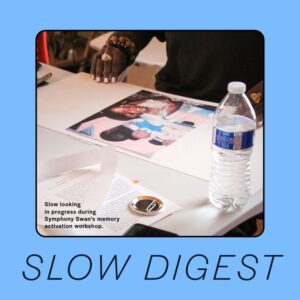
Symphony Swan, a C21 Story Fellow, hosted a memory activation workshop last November at CR8TV House, a community arts organization on Milwaukee’s North Side. Once Swan’s childhood home, the space has since been transformed into a site of community and belonging for Black and other historically marginalized artists. During the workshop, participants activated their memories through the practice of “slow looking,” intentionally observing family photographs in detail and documenting the emotions and connections that surfaced as they sat with their memories. We not only attended to the small details within our photographs but moved beyond their frames, recalling sensory experiences. Through slow looking, we guided our attention deliberately, remaining with these images until meaning and emotion surfaced.
Shari Tishman (2018) defines slow looking as taking the time to carefully observe more than meets the eye at first glance. It is a practice used in the fields of art, science, and museum education that asks viewers to cultivate sustained attention through noticing, interpreting, and reflecting over time. Rather than treating images as information to be consumed, slow looking positions them as sites of encounter. This framework disrupts dominant models of attention shaped by spectacle, where looking is less about encounter than extraction (Debord, 1983). In an attention economy governed by speed, saturation, and circulation, images are designed to be captured instantly and discarded just as quicky. Doomscrolling, swiping, and the chase for virality condense the act of looking into immediacy, leaving little room for lingering, interpretation, or care.
As this semester unfolds, upcoming episodes of the Center’s podcast, 6.5 Minutes With C21, feature conversations with artists and thinkers who invite us to practice sustained attention rather than immediate consumption. These conversations ask what it means to look – and be looked at – outside the demands of spectacle. Slow looking, after all, is not just a method of seeing, but a way of relating, activating memory, and experiencing the world with intention.
Mich Dillon is a Milwaukee-based sculptor whose work with wood, rope, and found elements transforms material histories into spaces of reflection and connection. His installations bind organic and manufactured forms in ways that prompt viewers to recognize layered narratives and consider how memory and identity coexist.
Nathaniel Stern is an interdisciplinary artist whose work spans interactive installations, digital media, sculpture, and ecological practice. His projects invite viewers to engage with environments and technologies through embodied participation, encouraging sustained attention to how perception, relation, and responsibility emerge through interaction rather than passive viewing.
Amal Azzam is an artist and educator whose work engages archives, material culture, and embodied histories to explore how memory and belonging are shaped through time and place. Her practice invites sustained attention to lived experience, particularly the ways histories are felt, carried, and remembered beyond what is immediately visible.
The memory activation workshop at CR8TV House reminded me of the significance of pausing and intentionally looking at what is right in front of us and beyond the frame of our individual lived experiences. Conversations with Dillon, Stern, and Azzam all offer an opportunity to practice that same attentiveness, engaging art, memory, and relation at a different pace. In a culture that rewards speed and immediacy, slow looking becomes a quiet but deliberate choice to linger, to reflect, and to remain open to meanings that only surface with time.
Works Referenced:
Debord, G. (1983). Society of the Spectacle. Black & Red.
Tishman, S. (2018). Slow Looking: The Art and Practice of Learning Through Observation. Routledge.
Recommended Reading:
Listening to Images by Tina Campt examines a method for engaging photographs of Black subjects by listening to their affective and emotional frequencies rather than focusing solely on what is visually apparent. Drawing on overlooked and often oppressive photographic archives, from ethnographic images to passport photos and mug shots, Campt attunes to the quiet registers of resistance, refusal, and futurity embedded within these images. Through the practice of listening, she reframes photography as a site of Black feminist survival and imagination, where even images created to control or dehumanize can carry traces of agency and possibility.
“In Our Glory: Photography and Black Life” (From Art on My Mind: Visual Politics) examines photography as a crucial site where Black people have historically asserted presence, dignity, and self-definition in the face of dehumanizing visual regimes. Through personal reflection and cultural analysis, hooks argues that Black-owned photographs, especially family and community images, function as counter archives that affirm everyday Black life, love, and interiority. She positions looking at and making photographs as an active, political practice through which Black subjects reclaim the right to see themselves with care, complexity, and agency.