This week’s edition of Slow Digest is written by Anna Mansson McGinty, Faculty in Geography and Women’s & Gender Studies and C21 Lead Faculty Advisor.
In November, I had the opportunity to participate in a very meaningful and engaging conversation with Milwaukee-based artist Amal Azzam, alongside C21 Graduate Fellow Jamee Pritchard, for an upcoming episode of 6.5 Minutes with…C21. Amal shared with us her experiences as a Muslim and Palestinian artist and her various art practices and projects with a focus on slow care and community building.
Azzam is an interdisciplinary artist working with multiple mediums such as found objects, photography, fiber, screen prints, and video projections. She is also the co-founder, together with Nayfa Naji, of the Muslim-owned art collective Fanana Banana (fanana is the Arabic word for “female artist”). Their vision for Fanana Banana is to create material and digital art spaces for Muslim, Middle Eastern and North African (MENA), and underserved artists in the Greater Milwaukee area. Since 2019, they have put on several art shows and exhibits.
Fanana Banana has also organized and sponsored a few critical murals in different spaces across the city of Milwaukee, highlighting artists and identities that have often found themselves on the margins, socially and politically. Two of those murals were created during the peak of the COVID-19 pandemic in 2020. One is the Black Lives Matter (BLM) mural at the intersection of North Avenue and Holton Street, right at the juncture of the Riverwest, Harambee, and Brewer’s Hill neighborhoods. The second mural, “Mutasaweeyah,” was designed by Amal at the Milwaukee County Courthouse. In warm and stunning colors, it depicts three figures that are intentionally simplified in facial detail and varied in skin tone to reflect the diversity of Milwaukee’s population. Surrounding the figures are, in Amal’s own words, “deconstructed Arabic letters that, when reassembled, spell ‘Mutasaweeyah,’ meaning ‘equal in importance.’ This fragmented arrangement invites viewers into a middle space of interpretation, where language, identity, and visibility intersect” (Mansson McGinty, Seymour-Jorn, and Sziarto, forthcoming).
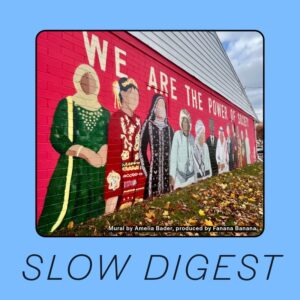
Fanana Banana’s most recent mural by artist Amelia Bader is on the east-facing wall of the popular Arabic grocery store, Amanah Food Market, on the busy South 13th Street in South Milwaukee. It is striking in its composition, colors, and message, “WE ARE THE POWER OF SOCIETY,” in the heart of a neighborhood where many Muslims live.
It is only a couple of blocks south from the Islamic Society of Milwaukee, the largest mosque in the state, which was founded in the early 1980s. The mural features twelve figures, seven women and five men, in culturally specific attire, representing the cultural, ethnic, and racial diversity of Muslims in the city, including Desi, Burmese, Yemeni, Palestinian, Somali, Afghan, Syrian, African American, Jordanian, Omani, and Tunisian on a bright red background. The African American figure is inspired by Malcom X and is the only one that represents an actual person (Whitehead, 2025). Similar to the BLM mural, at the very far right corner of the mural space, you find “Handala,” the character created by Palestinian cartoonist Naji al-Ali in 1969 that has become a salient symbol of Palestinian struggle and resilience in the face of deterritorialization and oppression.
During our conversation, Amal explained that the strength of Fanana Banana as an art organization and movement derives from its grassroots efforts and practices, rather than being driven by profit. This allows for flexibility and deliberate community building. The murals are only a few examples of how such community care can take place (and claim actual space) and evolve.
Stay tuned for the upcoming podcasts with artists Amal Azzam and Amelia Bader!
References
Mansson McGinty, Anna, Seymour-Jorn, Caroline, and Kristin Sziarto. Forthcoming. Muslims in Milwaukee: Placemaking, Identities, and Activism. Syracuse University Press (The Critical Arab American Studies Book Series).
Whitehead, Sandra. 2025. “In a New Mural, Milwaukee’s Muslim Community Sees Itself.” Wisconsin Muslim Journal. September 23.