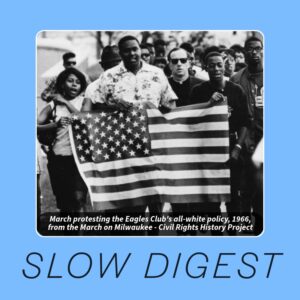
This week’s edition of Slow Digest is written by C21 Graduate Fellow Jamee N. Pritchard.
Every Saturday at the intersection of South 76th and Layton Avenue in Greenfield, Wisconsin, from 10 a.m. to noon, a group of 30 or more protesters line both sides of the street, waving signs that read: Honk if you love democracy, Save America, Hands off the law, and my personal favorite, Imagine being afraid of diversity but not dictatorship.
I honk every Saturday as I drive by, and each time, I’m struck by who’s standing there: mostly white protesters, nearly all well past 65 years old. In a political climate where divisiveness and racism feel routine, and where care and inclusion are increasingly framed as threats, there’s something both startling and hopeful about seeing our white elders use their bodies to defend democracy, diversity, and decency.
I say this as a Black woman living in a polarized America where my identity is often rendered political inside the very institutions where I study and work. Witnessing this kind of mobilization feels radical in its simplicity. It reminds me that community care doesn’t always look like what we expect. Sometimes, it looks like showing up, sign in hand, on a Saturday morning, insisting that freedom for all still matters.
These Saturday protests, called the Power to the People Rally, are organized through Indivisible Milwaukee, a group that describes itself as “a welcoming and collaborative group dedicated to supporting diverse communities as we fight against authoritarianism and for democracy.” Their presence is part of a much longer lineage of civic participation, engagement, and collective action that has defined Milwaukee’s history.
It is no surprise that Americans are mobilizing in this contemporary moment that sees government officials, especially those in the highest positions of power, eroding law. Historically, collective mobilization has always emerged in response to this slow unraveling of justice – from the labor movements of the early twentieth century to the civil rights marches that crossed the 16th Street Viaduct during Milwaukee’s fight for fair housing. The protests, organizing, and mutual aid we witness today are part of a continuum, each generation inheriting not only the fatigue of struggle but also the wisdom of sustained care. These are acts of what the Center for 21st Century Studies calls Slow Action, our upcoming theme for the 2026-2027 academic year. They are movements built through patience, reciprocity, and values-rooted consistency rather than urgency alone.
The Center asks: How might the practices, methodologies, histories, and theories of collective organizing across communities and institutions provide insight for building values-rooted systems and deliberate, actionable pathways that endure over time to support shared goals?
Milwaukee offers countless examples of these practices, past and present, that show how community care can take root and evolve. Below are a few local projects that embody the principles of slow action.
March on Milwaukee Civil Rights History Project
Hosted by the UWM Libraries and Archives Department, this digital collection brings together oral histories, photographs, and archival materials documenting the 1967-1968 fair housing marches. Activists’ testimonies, news footage, and community artifacts preserve the memory of sustained protest and the networks of care that held it together. This project reminds us that slow action often begins as documentation. The act of remembering and recording becomes a form of resistance in itself.
La Migra Watch
Organized by Comité Sin Fronteras, a project of Voces de la Frontera, La Migra Watch trains “community verifiers” who respond to hotline reports of raiding activities that violate the Fourth Amendment and threaten public safety. Verifiers confirm, document, and share information in real time, creating a collective safeguard rooted in mutual trust and vigilance. Their sustained monitoring shows how mobilization can become infrastructure, turning witnessing into a living system of care.
Death Café at MPL
A community conversation hosted by the Greater Milwaukee Death Doulas, Death Café offers a welcoming space for people of all ages to discuss issues of death and dying in thoughtful, supportive ways. Through open dialogue, participants reimagine grief and care as a collective ethic. Upcoming gatherings include October 25 at the Bay View Branch and November 4 at the East Branch Library.
Make a Difference Day
Coordinated by the Center for Student Experience & Talent, this annual volunteer day mobilizes teams across the city to help older adults prepare their homes and neighborhoods for winter. Scheduled for November 8, 2025 (9 a.m.–1 p.m.), the event transforms service into solidarity, modeling how small gestures accumulate into lasting community strength.
Mutual Aid Thursdays
Mutual Aid Thursdays create a regular space for collective support by sharing meals, trading study strategies, and sustaining accountability in self-care. Participants bring what they can: extra produce, books, or simply time. Meeting monthly throughout the fall, the series, organized by the College of Engagement & Professions, cultivates reciprocity and reminds us that care, in all its forms, is a shared resource.
Community Art & Wellness Retreat
Hosted by the Haggerty Museum of Art, the Community Art & Wellness Retreat invites participants to reflect on the powerful role art plays in our collective well-being. The half-day retreat (12:30–4:30 p.m.) features overlapping programs including a talk by installation artist Jan Tichy, guided artmaking and therapy sessions, contemplative dialogue, dance, sound healing, and attention activism with C21’s Story Cart. The retreat accompanies the exhibition No One Knows All It Takes, which explores how personal and collective trauma intersect with issues such as addiction, incarceration, immigration, and caregiving. Moving beyond individualized notions of self-care, this event highlights how creative practice can serve as both community care and slow action in motion.
Each of these efforts, whether rooted in archival preservation, protest, mutual aid, or creative practice, reveals that slow action is not passive. It is patient, persistent, and grounded in the everyday work of showing up for one another. In Milwaukee, that practice of care continues to evolve, sometimes with a honk on Layton Avenue, sometimes in a library archive, always in community.
| Image: “March protesting the Eagles Club’s all-white policy, James Groppi center, 1966”, March On Milwaukee Civil Rights History Project. University of Wisconsin-Milwaukee Libraries, accessed October 21, 2025, https://collections.lib.uwm.edu/digital/collection/march/id/659/rec/28. |