
Professor Portia Cobb launched her fall sabbatical with a month-long residency in Bahia, Brazil. The experience expanded her research, deepened her multidisciplinary practice, and strengthened her ties to a growing network of international artists and scholars.
Cobb was invited to Balaio Fantasma, an artists’ residency hosted by Professor Paola Barreto from the Federal University of Bahia (UFBA). During her stay, she led workshops and collaborations with arts and humanities students, local artists, and community members.
She also immersed herself in Bahia’s cultural landscape, visiting museums, artist studios, and community events that informed and broadened her creative lens.
“My return to Brazil has been in development since 2023, based on connections I established with Paola Barreto, who teaches arts and media at the university. We continue to work collaboratively,” Cobb stated. “The residency was a great immersive experience, and having a month-long stay made all the difference.”
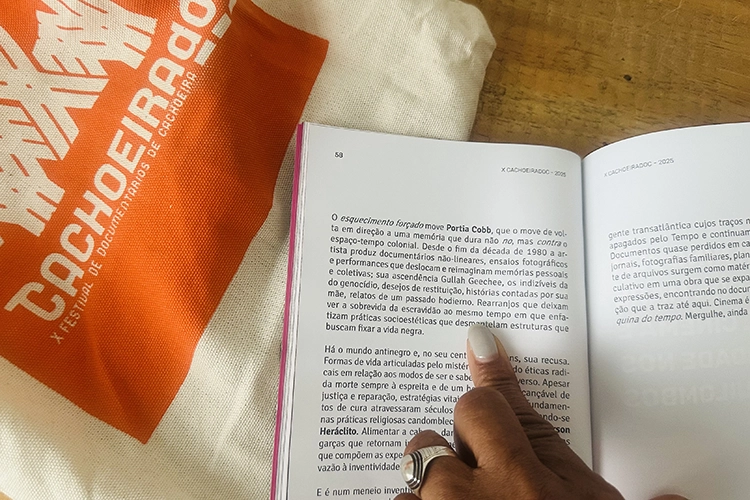
A featured performance artist and filmmaker at the Cachoeira Documentary Film Festival, Cobb premiered Performing Grace, an in-situ mixed-media performance staged in the historic railroad depot in Cachoeira’s town center.
The occasion was an opportunity to both share her work and explore new dimensions of what she refers to as “expanded cinema,” or cinema shaped through live performance.
“The most impactful part was the collaborative process and the reimagining of my work my for an unfamiliar audience in an unfamiliar space,” Cobb said. “I’ve taught film and video for 33 years, but I have had few opportunities to actualize it and actualize it as an extension of my cinematic practice.”
Cobb’s research also centers on identity, notions of home, and the critical examinations of forced forgetting. During her time in Bahia, Cobb felt a profound connection to aspects of cultural preservation, ancestral reverence, and continuums of these in artistic visual and performance practice.
“These images and experiences have a special appeal to tourists from across the globe and specifically to people descended from Africans trafficked across the Atlantic to the Americas,” Cobb explained. “Many from the Black diaspora are profoundly impacted when they meet these aspects of Bahian culture. It becomes an unexpected homecoming, a reflection of the familiar celebrated and preserved in the present.”
Bringing global connections to UWM
Cobb’s sabbatical also supports her longstanding commitment to global learning through Radical Cinema, a course she teaches on international cinematic movements and their social, political, and cultural contexts.
Her work in Brazil complements the study abroad program she helped spearhead, BLM: A Global Comparative Study, which has taken students to the U.K. and was proposed for Brazil but didn’t get enough enrollment.
“We’re always trying to get our students to see themselves in the mirror of other cultural landscapes,” Cobb stated. “I bring it into my classroom through the films I show and the discussion we have.”
This year’s iteration of the program, led by Assistant Professor Marquise Mays, will take interdisciplinary students from film & animation, global studies, and African and African diaspora studies to London to explore the Black British experience.
Cobb will join the program, continuing to expand the connections she has nurtured throughout her sabbatical and beyond.
Story by Payton Murphy ’27 (BFA Film)