Team of alumni and students launch online job networking app for artists
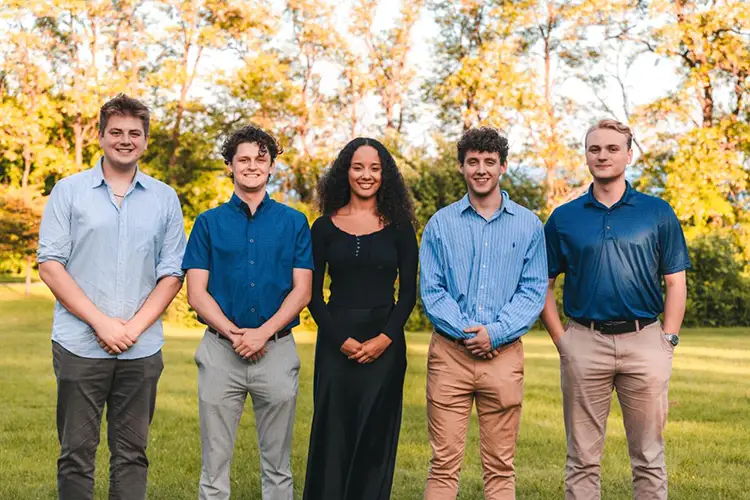
Recent PSOA graduates, one current student, and other colleagues in the Milwaukee area are making it easier for artists to find opportunities with their startup called ArtsConnect.
This project began in December 2022 on the UWM campus, when then-student Lilith Lenz (BA 2023, Music) noticed that her fellow music students wanted another resource to help find work in the arts.
Lenz, who is now ArtsConnect CEO, noticed that there are a variety of job opportunities available for arts students; what was lacking was a way to find them tailored to creatives.
“I know the struggles to find a job and feel confused about what to do,” said Lenz. “Often times Wisconsin students may think ‘Do I have to move to New York or LA to find work?’ But there are options out there. Knowing the options is really our core value.”
Lenz approached current UWM student Noah Welsh during a Community of Creative Arts meeting with the idea for a site that provided mentorship and connections for young artists. Welsh would become ArtsConnect’s Chief Creative Officer.
A mockup of the ArtsConnect app | Submitted graphic
Now, ArtsConnect is a resource for students that strives to inspire and empower creative minds by helping them build a network and find work opportunities in the arts. Lenz and Welsh now work alongside marketing director Richard Minten (BFA 2024, Film), Chief Financial Officer Alex Cox, and Chief Technology Officer Mitchell Allen.
“Our mission is really to give young creative talent the opportunity to grow and network,” said Lenz. “We want to give artists the opportunity to find jobs but also to showcase their talents.”
As a new startup, Lenz and the company are still seeking ways to expand ArtsConnect. Their most recent creative endeavor is the launch of their Pilot Program, which gives users first access to ArtsConnect functionality, including job opportunities, internships, and creative projects.
The mission of ArtsConnect is not currently driven by profiting off students eager to find jobs.
“The future of ArtsConnect is not just to make a lot of money,” said Lenz. “The future is to create a thriving environment for creative minds. We want students to not be scared of finding a job.”
Story by Jason McCullum ’25
Art & Design seniors reflect on their work in end of semester exhibitions
In December, Art & Design students took one last chance in the Fall semester to showcase their work to the campus community. Senior students got to display said work at the DVC Showcase and BA/BFA Exhibition, with both events offering a wide array of work born out of thoughtful and diverse creative research.
DVC Showcase
On Dec. 6, the Design & Visual Communications program presented “hereafter.” This showcase celebrated the hard work of DVC seniors who spent the last three months engaging with complex research projects about what our futures may look like.
Each student developed a “what if” statement that guided their research and artistic vision.
Alondra Arteaga focused her project on catastrophic and unpredictable weather and how it could foster a culture of intertwined connectivity. Arteaga and other students were encouraged to write lore for their projects, which led Arteaga to write about characters living through this extreme climate.
As an avid writer, Arteaga turned much of her writing and research into journal entries that were used as tactile in her project.
“I thought ‘What would I want the user to experience while they’re reading these things?’” said Arteaga. “It took a lot of trial and error and a lot of sketches.”
The work is centered on Arteaga’s desire to discuss climate justice in an empathetic way that felt immersive, something she feels is often lacking when discussing climate issues. She also had a strong desire to include aspects of her heritage in the piece, leading to lots of Spanish text being used in the final product.
“I have always had a very deep respect for the Earth,” said Arteaga. “Especially being Latina, I feel like whenever I go back home, it always feels like I’m connected to the Earth.”
Grace Zimmermann also centered her work on climate issues, creating a dystopian community in which seed manufacturers had to design a crop that could survive severe weather due to humans losing access to food and water.
“It was more so a warning that this is not a good future,” said Zimmermann. “I wanted the design to be unsettling and make the point that we can never replace nature.”
Zimmermann was inspired by her work on a farm that has involved interacting with customers who do not always understand why and how plants die. She sought to explore that theme with her work, describing this future as one of regression.
“Having [climate change] visually represented is one way that people can start to realize it,” said Zimmermann. “The main issue is that people just aren’t seeing it.”
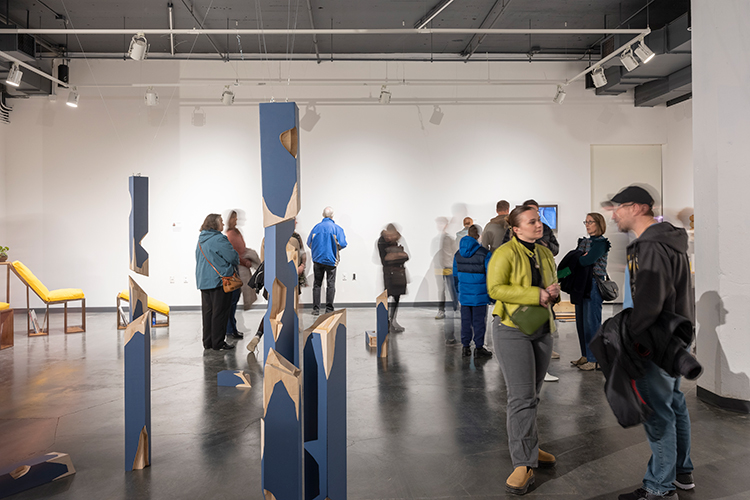
Attendees at DVC Showcase | Photo by Cameron Wise (BFA Film)
BA/BFA Showcase
Art & Design’s BA/BFA Exhibition happens twice a year and allows that semester’s graduating class to display art they worked on in their lead-up to graduation.
This group of seniors graduating this December explored a wide array of topics that covered students’ passions and interests outside of their artistic practice.
Madeline Prodoehl’s work documented her journey as a rock climber with a book full of stories, photos, and jewelry with prints from her climbing community.
One of the most important aspects of this piece for Prodoehl was the ability to showcase her love of the sport and community in a public setting.
“I feel like you don’t usually get to have people look at your work outside of class,” said Prodoehl. “Most of the people here make work very meaningful and personal to them. So being able to show the public that work and have it in the public’s eyes is really important and special.”
Kaleb Wendler focused on a similarly physical activity for his piece, documenting biking through Milwaukee on 35mm color film.
Attendees at BA/BFA Exhibition | Photo by Cameron Wise (BFA Film)
Wendler has been a bike messenger for his last two years of living in Milwaukee while also relying on biking as a go-to mode of transportation. He described it as a “huge part” of his life, prompting him to pursue a project that shows Milwaukee through his perspective.
“The project is to immerse the viewer in this experience to acknowledge their surroundings,” said Wendler. “Whether it’s people, buildings, shadows… Just all the things that make Milwaukee unique and the perspective that being on a bicycle gives that person.”
Pavonis Giron took a different approach, pursuing a series of sculptural and two-dimensional pieces that focus on “the vessel form as though they were artifacts found by a far-future civilization.”
Giron describes how the vessels changed without human influence, becoming their own species in a project that is aimed at scrutinizing gender and societal roles.
“Going into my senior semesters, I had become interested in material exploration and knew I wanted to pursue research into work that could degrade or be reconstituted after the life of the piece had passed,” said Giron. “It questions the stories we tell about ourselves, both on an individual level as well as a larger, societal one.”
Story by Jason McCullum ’25
Film alum’s life and work featured in Shepherd Express
Gabriella Cisneros (BFA 2018, Film) was recently featured in a Shepherd Express article discussing her work and career, including her latest film, 2024’s “Impermanence.”
The piece documents Cisneros’ origins in rural Wisconsin, which profoundly impacted her and her love of photography, describing to Shepherd Express how she would make documentaries of family vacations.
“I would film and take photos of stuff on family vacations, and then I would edit it in Windows Movie Maker into a documentary of our trip,” Cisneros said. “It was very thematic, I would pick out specific songs that would make sense with where we were.”
Since 2019, Cisneros has worked at Porchlight Book Company as a creative director. “Impermanence” is currently being submitted to film festivals.
To read more about Cisneros and her work, visit Shepherd Express.
Students reflect on exhibition and experience to use jewelry as a messaging device
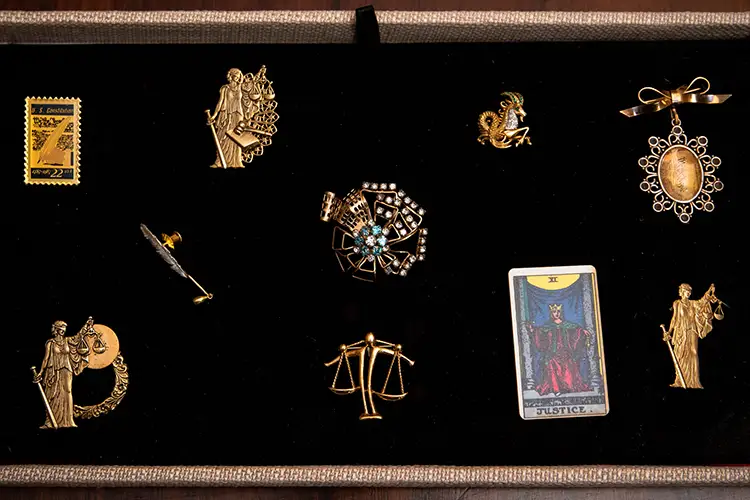
During the fall semester, the Jewelry & Metalsmithing program hosted “Jewelry Speaks: The Voice of the Jill Wine-Banks Pin Collection,” an exhibition centered on the elaborate pin collection of distinguished attorney, former Watergate prosecutor, and MSNBC Legal Analyst Jill Wine-Banks.
For nearly six weeks, this exhibition and archiving project featured works from Wine-Banks’ personal collection that she accumulated over a lifetime of work in the American political and legal landscape. In the weeks following the showcase, students and alums shared their reflections on what they took away from the exhibition.
Wine-Banks’ collection
Whether or not students were familiar with Wine-Banks’ multi-disciplinary work before “Jewelry Speaks,” many walked away from the exhibition with an appreciation of her collection.
“It was really fascinating to see her huge collection,” said senior Pavonis Giron. “She’s got vintage, highly collectible pieces… What is most meaningful for her is the meaning of these pieces. She’s really focused on what a piece says.”
Giron felt that Wine-Banks’ collection was distinctive in being primarily concerned with each piece as a symbol, often separating its meaning from its jewelry context.
Wine-Banks’ wide ranging collection is full of symbolic-pins that were worn on-air by Wine-Banks herself. These symbolic pins became a staple aspect of her on-air presentation.
Student and alum work
Having been involved in other exhibitions in the past, Giron noted “Jewelry Speaks” as a “unique group show,” given that it was primarily centered around the multitude of works Wine-Banks displayed. This deep and complex interaction with another individual’s work was gratifying for Giron, who felt it reinforced innovation in art.
“It allows you to feel a bit more comfortable in playing with unusual materials to see something that’s cherished,” said Giron. “It provides a renewed sense of creative freedom to use materials that are not archival and to be encouraged to play around with color and texture.”
A cross-functional exhibition, “Jewelry Speaks” also featured several student works, including one from Giron.
“It was kind of my opportunity to make something that was fun and had meaning,” said Giron.
Giron’s piece was a brooch made from a forged piece of non-polished silver with curves around it, which resulted in something they described as more offbeat.
Recent alums also got involved with “Jewelry Speaks,” including Lilly Luft and Gideon Herman who collaborated long-distance to create a book arts project.
“While at Peck, Gideon went through really intense fabrication work which came into play on this piece,” said Luft. “The piece is a solid silver object… we brought it up to 1400 degrees sixty times without remelting anything.”
When creating the piece, Luft described being encouraged to work with a variety of materials thanks to her PSOA education.
“Jewelry as a practice as taught at Peck is very cross-disciplinary,” said Luft. “It encourages dipping in and out of fine metalwork to get to know other materials.”
Luft and Herman were contacted directly by exhibition organizer and curator Erica Meier (Teaching Faculty II, Jewelry & Metalsmithing, Digital Fabrication & Design), whom they have stayed in touch with post-graduation. Luft said that the continued support from PSOA faculty as a recent graduate is “pretty incredible.”
“The program is pretty tight-knit,” said Luft. “The ability to keep in touch with someone… Knowing that the mentors I had in school are still available to give mentorship but are also just colleagues now. It makes a big difference.”
Meier worked alongside Special Collections director Max Yela to put this event together.
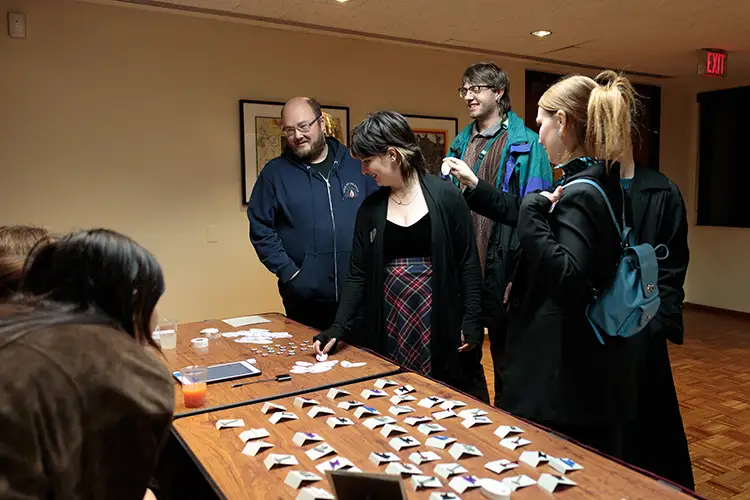
Students at Jewelry Speaks | Submitted photo
Current students’ first exhibition
In addition to the alums and upperclassmen who got to show work for “Jewelry Speaks,” several students who were enrolled in Introduction to Jewelry and Metalsmithing got to showcase their semester projects.
Despite not initially expecting to get involved, Sophomore Marlena Weghorn displayed her penny badge in the exhibition.
“It is really exciting to know I can actually present my work,” said Weghorn. “It was really great to see my work integrated with so many other student and professional pieces.”
Weghorn’s piece represented feminine sin as shown in various religious literature which fit perfectly into a portion of Wine-Banks’ collection.
“I knew I wanted to do something focused on femineity,” said Weghorn. “In the exhibition, there is a section of snakes and dragons. It just so happened that my piece fit perfectly in that category.”
Sophomore Sophie Rickert displayed her piece from the fall semester’s intro class, which was a penny badge with a silhouette of a woman enclosed.
One of Rickert’s main takeaways from the exhibition was learning more about Wine-Banks’ collection through Meier, who maintains a positive relationship with Wine-Banks.
“It was interesting to hear Erica’s relationship and how that developed with [Banks] knowing that Erica is who we’re directly associated with,” said Rickert. “We got to know her pin collection in-depth through Erica.”
Jill Wine-Banks attended the event’s opening reception in October, giving a public talk for students and attendees.
Story by Jason McCullum ’25
Fall 2024 Film Faculty Festival recap
Throughout the second half of 2024, several faculty members took their films across the country and abroad for a variety of film festivals and screenings.
Ballard had a busy Fall of screenings that took her from San Diego to Orlando and everywhere in between, as well as international screenings at Antimatter in Victoria, British Columbia, and Ribalta Experimental Film Festival in Vignola, Italy.
Notably, Ballard screened her work Heat Spells at CROSSROADS Film Festival in San Francisco. Her work was then featured in an article from 48hills, an independent San Francisco news outlet.
Ballard also screened work at the following film festivals: Otherwise Film Festival (San Diego, California), Peripheries Experimental Film and Video Festival (Chicago, Illinois), Engauge Experimental Film Festival (Seattle, Washington), TILT Movement on Film (Salt Lake City, Utah), Florida Film Festival (Orlando, Florida), Wide Open Experimental Film Festival (Oklahoma City, Oklahoma), and Experiments in Cinema v19.8 (Albuquerque, New Mexico).
Malmed had the following performances and solo exhibitions: My Incinerated Oracle Tune at Watershed Arts & Ecology (Chicago), My Arcane Dereliction Tune at The Lawn (Chicago), Togather To Gether at the National Museum of Mexican Art / Presented by the Chicago Humanities Festival (Chicago), Youou Arere Aa Lighght at Fox Den (Warren, ME).
Additionally, Malmed took part in the following group exhibitions: Yawn Sigh at Mayfield (Forest Park, IL), Chicago Underground Film Festival, Recognize That Your Name Is Already on Every Place You Place Your Feet at Patient Info (Chicago), Shades of at World of Variety (Chicago), Auto Spectacular at the National Museum of Mexican Art (Chicago), 69 for 69 at Side Street (Elgin, IL), Karaoke Night! at Troost Gardens with stop-gap projects (Kansas City).
McGuire’s short film Away 1973 was an official selection to screen in the highly prestigious Florence International Film Festival in Italy.
Grace Mitchell
Mitchell’s latest short film, The Year (Super 8, 2024) has recently begun screening nationally and abroad. Most recently, the film was screened at Light Matter Film Festival in Alfred, New York.
Mitchell also collaborated with filmmaker Sofia Theodore-Pierce for a film that will screen at the Wexner Center in March 2025. The filmmaking duo also attended a film residency at the Wexner Center in June and September 2024.
EDITOR’S NOTE: This list is as accurate and comprehensive as possible at the time of publication. If we missed a PSOA faculty member, please accept our apologies. Contact us and we’ll gladly update the article.
Story by Jason McCullum ’25
Mourning the loss of teaching professor Carl Bogner
We are deeply saddened by the passing of teaching professor and dear friend Carl Bogner, whose tenacious fight against cancer came to an end on Sunday.
In recent days, countless former students, colleagues, and friends have assembled in his honor at informal gatherings across Milwaukee, Chicago, and beyond—a testament to the vast influence and profound impact Carl had on individual lives and entire communities.
We share in mourning this loss, and we join, in spirit, each celebration of his incredible life.
Carl’s legacy at the UWM Peck School of the Arts and Department of Film, Video, Animation & New Genres is immeasurable. His contributions have shaped our lives, the lives of our students, and the broader world.
With unwavering passion, Carl directed the LGBT+ Film/Video Festival for over 20 years, curating an array of films to audiences and providing a platform for dialogue relating to understanding, making room for difference, acceptance, and inclusion. The festival ran for nearly 35 years on UWM’s campus and was revered as an institution in the community.
Although the festival celebrated its final run in 2020, Bogner continued to make a positive impact through the Queer Curatorial Fund, supporting student scholarships, screenings, travel to festivals and conferences, and curatorial activities in recognition of artistic excellence by LGBTQ+ artists and allies.
We are proud that Carl was honored last year by the Universities of Wisconsin with the Dr. P.B. Poorman Award for Outstanding Achievement on Behalf of LGBTQ+ People, and we are grateful that he continued to engage with our campus as recently as this month. Just weeks ago, Carl curated a special From the Archives screening for Experimental Tuesdays, a confluence of two series he founded at UWM.
Carl’s distinctive laugh, intellectual brilliance, deep empathy, incredible wit, and delight at all things creative will be missed tremendously and held onto dearly.
UWM Peck School of the Arts & Department of Film, Video, Animation & New Genres
Music Education student Bridget Koser recognized with Richard G. Gaarder Award
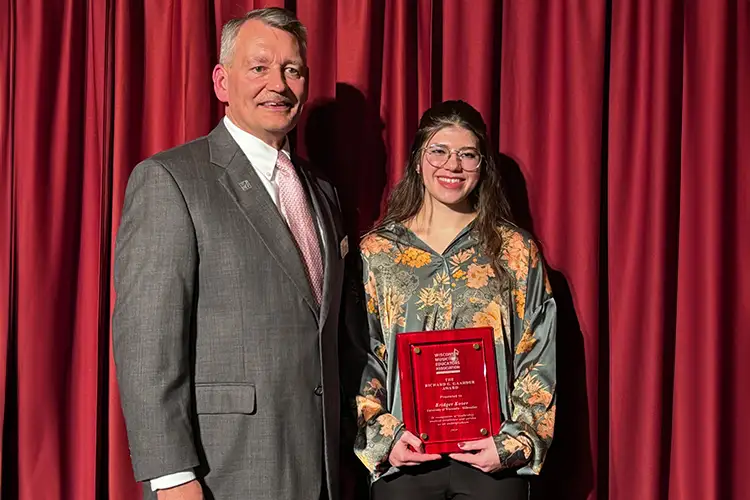
Music Education student, vocalist, and multi-instrumentalist Bridget Koser was awarded the Richard G. Gaarder Award at the 2024 Wisconsin Music Educators Association conference in Madison. The achievement recognizes excellence in leadership, musicianship, and service to the music education community.
The award honors the legacy of the former executive director of the Wisconsin School Music Association, Richard G. Gaarder, who is credited with laying the groundwork for music programs and education throughout Wisconsin.
“He did a lot of really great stuff,” said Koser. “Receiving that award is recognition of my goal to be a teacher and help inspire kids through music. The award is a reminder that I can do that.”
Koser received the award at a uniquely profound time in her education as Koser is finishing the first round of dual certification for music educators in Wisconsin.
In years past, aspiring music education students in Wisconsin would receive certification in either choral or instrumental. However, Koser is a self-described “guinea pig,” graduating in the first class of students who are certified in choral, instrumental, and general music instruction.
“Usually if I were just choral music ed, I would be doing practicum teachings in a choral setting,” said Koser. “Instead, I am learning all the instrument pedagogies.”
Upon graduation, Koser will be able to conduct band, choir, orchestra, and general music courses from grades K through 12.
While a diverse array of musical experiences allows Koser to be a multi-instrumentalist, her primary instrument is voice. She believes this will be beneficial to her future students, whether they are interested in becoming vocalists or not.
“As a vocalist, I rely so much on my ear and the ability to hear something and reproduce it,” said Koser. “That’s a side of music education that I think a lot of instrumentalists may overlook… When kids are able to hear or sing what they want to play, it adds a whole other level of cognition into what they’re doing.”
When reflecting on receiving the Gaarder award, Koser discussed her upbringing in Rhinelander, Wisconsin, where she attended a school with low-funded arts. This experience has driven her to enter the field of music education in hopes of helping children find inspiration through music.
“It makes me really sad because we have a lot of kids who are doing some pretty cool things in our community and they’re really great,” said Koser. “Growing up in a district that didn’t value the arts showed me that music ed is supposed to be encouraging and welcoming… We need more of that.”
Community is a highly important aspect of Koser’s life, heavily influencing her decision to attend the Peck School.
“That’s why I came here,” said Koser. “I saw that the music area is pretty tight knit… I really appreciate that faculty meets you where you’re at and work to help you grow and get better by giving you field experience.”
Koser enters her final stretch of education at Peck, planning to graduate in the Fall of 2025 upon completing her student teaching.
“I’m so grateful for everything, all the recognition that I’ve received both from the award and elsewhere; just all the opportunities that I’ve received at UWM… It’s incredible.”
Story by Jason McCullum ’25
New showcase celebrates interactive electronic music
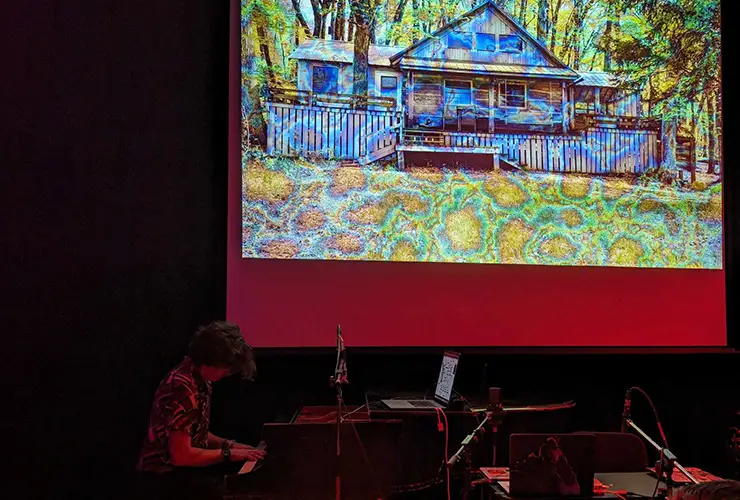
Students enrolled in Interactive Electronic Music classes will perform their final projects live at the third UW-MESS Interactive Electronic Music Showcase. In its early stages at PSOA, the UW-MESS program helps students fulfill an education focused on their passion for electronic music.
What is UW-MESS?
UW-MESS stands for University of Wisconsin-Milwaukee Electroacoustic Sound Studios and is the electronic portion of PSOA’s Music Composition and Technology BFA and Music Composition and Theory MM. The sequence of four courses is centered on electronic music creation, composition, and production.
Students work with the computer program Max MSP, which junior Calvin Smith-Skwierawski describes as “coding for musicians.” Smith-Skwierawski notes that these classes give students a wide vocabulary of how to create electronic music.
“Take a synthesizer… there are many components to it,” he said. “Within this program, you can recreate those components and create a synthesizer in an electronic program… It’s so unique and these classes break down the different components and ideas.”
What many may not understand about the discipline of electronic music is how an artist can still perform their work in a live setting. When students perform their electronic work, there is a strong element of improvisation and spontaneity that one may commonly expect with physical instruments.
“We have these ideas, but we’re improvising on the set,” said Smith-Skwierawski. “A lot of UW-MESS students do not use sheet music… we judge our pieces by time because it helps us understand what we want and lets us work without any restrictions.”
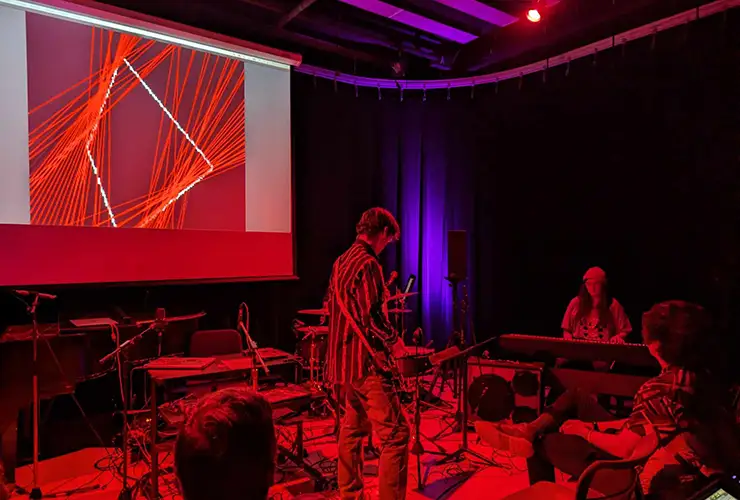
A student performs at a past UW-MESS Showcase. | Submitted photo
Mixing electronics with physical instruments
A lot of UW-MESS students possess expertise in a physical instrument family, which helps them with their electronic music creation.
Graduate student Colton Townsend, a long-time percussionist, describes the willingness of percussionists to experiment with sound as a driving force for his interest in electronic music.
“Percussionists are accustomed to trying new things and exploring new possibilities,” Townsend said. “That had a direct correlation into composing for me… I think about the physical act of music a lot when I compose, which goes well with electronics.”
At last year’s UW-MESS concert, Townsend performed a piece that resulted in breaking open a drum to pull a set of bells out of it. This led to experimentation in how to play the drum, the way the speakers surrounded the audience, and what electronic elements to include.
“If you can imagine a series of sounds, then you can make it in this program,” added senior Brodie Miller. “There are virtually no limitations to what you can create… You are not following a predetermined set of classical standards. There are endless possibilities.”
Why UW-MESS?
The electronic music program is an example of how PSOA’s Music Department offers students a modern approach to music education, whether they have physical instrument experience or not.
“I’ve always gravitated more towards creating a unique sound and mangling audio into something new,” said Miller. “I’ve always had a love and affinity for electronic music, so UW-MESS has been right up my alley.”
Miller was initially a computer science major which led well into his UW-MESS involvement. Electronic music became a way to explore the “scientific aspect” of music.
“There are a lot of academic papers and researchers by people like [Pierre] Schaeffer who kind of pioneered electronic music,” said Miller. “Teaching it also runs parallel to music because a lot of it is embedded in programming, but it still uses a lot of the basic knowledge of music theory.”
A student performs at a past UW-MESS Showcase. | Submitted photo
The performance aspect of UW-MESS
The inclusion of electronics in a student’s performance can help create sounds that may not be accessible through a physical instrument. For some, this helps set a scene and tell a story.
“This program has helped me enjoy electronic music more because you get to do more storytelling with electronics,” said Kyrstyna Jones, a junior.
Jones’ next piece, which she hopes to premiere next year, is meant to create the feeling of driving from Wisconsin to Minnesota using electronics to create sensations such as the time of day, the tiredness of the driver, and the excitement of of getting to visit a close friend.
“It’s going to be a vibraphone with electronics,” said Jones. “Electronics can help set the scene of what that long drive looks like.”
If you would like to see UW-MESS in concert, visit the PSOA Events Calendar for information on their December 12 showcase.
Story by Jason McCullum ’25
Student musicians focus on positive energy during a busy end to the semester
As the Fall semester winds down, many PSOA students have the opportunity to display their talents in public settings. For student musicians, this comes in the form of a whirlwind of concerts spanning nearly every evening during the final stretch of the semester.
With the stress of finals in full swing, now is a time for music students at the Peck School to come together and support one another, reminding themselves and their peers that music has the power to uplift, inspire and foster strong communal relationships.
Diego Duarte
Concert Chorale member Diego Duarte, a senior double majoring in music and business, is looking forward to the piece “America Will Be” during the ensemble’s December 7th concert because of its theme of unity during difficult times.
“The different languages, rhythms, time signatures, and voices in the performance highlight the diversity that we not only honor through this song but also celebrate on an everyday basis,” said Duarte.
In addition to the songs selected, ensembles support an encouraging environment in rehearsal. Duarte expressed the positive atmosphere that PSOA Choirs create ahead of a major performance, consciously keeping practice sessions enjoyable.
“At the beginning of each rehearsal, we always do vocal warm-ups,” said Duarte. “However, these warm-ups feel different to traditional warm-ups because we always prioritize making them fun, engaging, and effective.”
Nearing the end of the fall semester, some students may struggle to balance excitement and stress. To help with this, the music department strives to foster a strong community to keep students passionate about their upcoming performances.
Rayden Vaughan Montes
Cellist Rayden Vaughan Montes, also a senior, takes it upon himself to encourage fellow musicians in the Symphony Orchestra during the final moments before an end-of-semester performance.
“My main goal is to keep the energy positive and flowing,” said Montes. “The nerves before a performance can swallow people up while others embrace it and harness it on stage. Maintaining a positive and supportive attitude is key to any performance.”
From “Still I Rise” performed by Alta Voce to “Life is a Highway” performed by the Popular Music Ensemble, world premieres of new works composed by UWM students, and a whole lot more, audiences and performers alike have plenty to enjoy. Explore the busy music performance schedule by visiting the PSOA Events Calendar.
Story by Jason McCullum ’25
Panther Pale Ale features artwork by DVC student for a second year
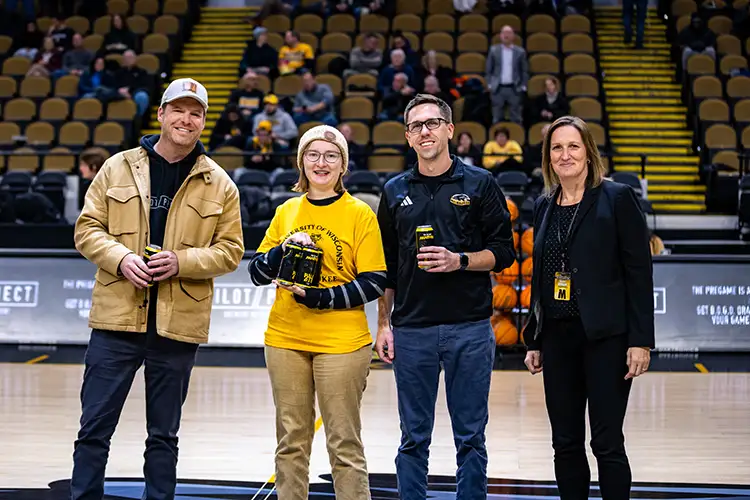
For the second consecutive year, Pilot Project Brewing, in conjunction with Milwaukee Athletics, is set to welcome its Panther beer this week – launched for the 2024-25 season with a new design.
The “Panther Pale Ale,” an American pale ale beer, will make its first appearance in a new can design this week to celebrate the multi-part collaboration in time for the holiday season.
An officially licensed product, the beer was first developed last year in partnership between Pilot Project Brewing, Craft Beverage Warehouse, Milwaukee Athletics, the UWM Peck School of the Arts, and CLC, the University’s trademark licensing company. Today marks the beginning of the second straight year of the multi-part collaboration.
The cans will make their debut and be available to the public for the first time at UWM Panther Arena for the men’s basketball contest against Cleveland State on December 5. The person who purchases the 100th can of Panther Pale Ale that evening at the game against the Vikings will win a $100 gift card to Pilot Project Brewing.
Fans and customers looking to purchase the product can now find it at Gasthaus (UWM Student Union), Ian’s Pizza North Avenue, Cheba Hut Eastside, Discount Liquor, Major Goolsby’s, and Downer Wine.
Director of Athletics Amanda Braun and General Manager for Milwaukee Panther Sports Properties Kristina Filipovic helped move the process to once again bring the concept to market, through the work that current Panther Athletics staff members and University leadership put into this concept to make it a reality.
“We are so excited for the debut of this year’s design, as well as the continued collaboration with campus partners and the Milwaukee business community on this project,” Braun said. “An especially important component of this campaign is the opportunity for UWM students to gain real-world design experience beyond the classroom and see their efforts come to life. Thank you to Pilot Project Brewing, Craft Beverage Warehouse, and UWM’s Peck School of the Arts for their partnership.”
A portion of the proceeds from the sale of the beer will be directed to student scholarships and other student-centered programming at UWM.
Michelle Markuson of Glendale, Wis., and a Design and Visual Communication BFA major with a certificate in Digital Fabrication & Design at UWM, created the artwork that was selected to appear on the product. Her winning design was one of numerous submissions made by UW-Milwaukee Peck School of the Arts students who worked their way through the approval process.
“Working on the Panther Pale Ale collaboration has been a profound experience as a student designer and a UWM Panther,” Markuson said. “From the folks at Pilot Project Brewing, who made the process straightforward, to the Craft Beverage Warehouse, who made my design possible, and Milwaukee Athletics for their vision. Everyone involved has such a strong passion. This passion was my main inspiration for the design, showing Milwaukee’s relentless strength. This collaboration between the school and our community attests that being a UWM Panther means you will be supported by your classmates, the staff, and our community. I hope that more cross-campus and community collaborations like this one will be in UWM’s future. For the MKE!”
The product will be available for purchase at UWM Panther Arena, Pilot Project Brewing and other select bars/restaurants and liquor stores in the greater Milwaukee area. Any retailers interested in carrying Panther Pale Ale should reach out to Sales@PilotProjectBrewing.com.
“It’s such a privilege to be involved in the UWM Panther Pale Ale project for a second year in a row,” Pilot Project Co-Founder and CEO Dan Abel said. “Pilot Project is a beverage incubator and exists to give creative opportunities to beverage creators; the fact that we get to work with students in the UWM Peck School of the Arts program and give back in a meaningful way really helps strengthen Pilot Project’s purpose. Plus, we have a great time doing it!”
Craft Beverage Warehouse is once again printing the cans and packaging for the product, one with a design that came directly from students at the UWM Peck School of the Arts, while CLC was involved with officially licensing the product and signing the agreement with Pilot to allow for the brand on the beer.
“Craft Beverage Warehouse (CBW) is once again excited to collaborate with Pilot Project and the University to bring Panther Pale Ale to life,” CBW President and Co-Founder Kyle Stephens said. “This collaboration is a unique experience for all parties, providing a real-life packaging development case to students at UWM’s Peck School of the Arts, whose students were provided with a design brief and executed a branding plan brought to them by CBW, Pilot Project, and the Milwaukee Athletic Department. Our whole team looks forward to continuing this partnership long into the future and enjoying a few Panther Pale Ales at future sporting and university events!”
Stephens, a UWM graduate, is thrilled to be a part of the collaboration once again.
Pilot Project Brewing is a brewery incubator & restaurant located in the Brewery District of Milwaukee, Wis., Pilot Project was launched as a collaborative and artistically curious space to help support talented brewers in an industry with exceptionally high barriers. Modeled after the music industry, Pilot serves as a launch pad for start-up breweries, offering assistance with recipe R&D, production scaling, marketing, distribution and more.
Faculty bring multi-faceted global partnership to new heights
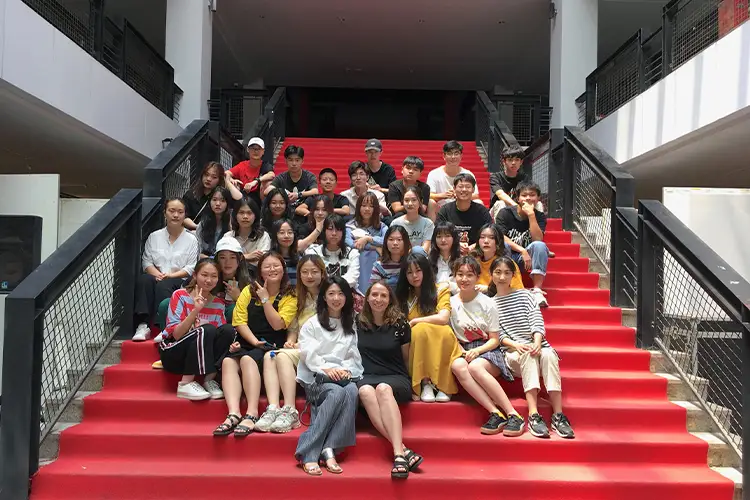
For many years, UWM has welcomed senior students from Hubei University of Technology (HBUT) in Wuhan, China, to complete their BA in Studio Arts at PSOA. This global partnership not only offers a unique degree pathway for HBUT students but has also proven to be a valuable opportunity for faculty.
Instructors preparing in Hubei
An important aspect of the cultural exchange is the time UWM faculty spend in China. Each summer, eight instructors travel overseas to teach three-week courses at HBUT.
“It’s a really beneficial experience for the instructors,” said James Charles (Teaching Faculty, Jewelry & Metalsmithing), one of the instructors who oversees the program. “It really helps educators learn, see, and understand how they are communicating. We take a lot for granted, speaking the same language… With students in China, you have to be much clearer.”
Through this experience, UWM instructors harness an understanding of how to communicate with Chinese students, skills they also transfer to their Milwaukee classrooms.
“It helps instructors deliver content in a much clearer, efficient way to our students when they come back,” said Charles. “When we are writing our syllabi or our assignments, our expectations are much clearer which is helpful for them.”
Following several years of virtual visits, instructors returned to in-person visits to China this summer. Among them was Wes Larsen (Assistant Professor, Design & Visual Communication), who led students through an experimental typography design course.
“Not only are [the students] practicing speaking, reading, and writing in English, but they’re also designing English language letterforms and thinking of the autonomy of typography,” said Larsen.
Despite the geographic difference, Larsen found that students had striking similarities.
“Once you find a groove, you realize ‘Oh, they’re just undergraduate students like the ones back in the U.S,’” said Larsen.
Cynthia Hayes (Teaching Faculty III, Painting & Drawing; Director, First Year Program) interacts with students at HBUT in Wuhan, China. | Submitted photo
Mary Roley (Lecturer, Sculpture) also visited Hubei. She spent the three-week program leading a workshop on sculpting functioning toys.
“Teaching online, I had no idea what tools or equipment were available to them,” said Roley. “In person, they got to use their woodshop and laser cutter that they had on hand. It was really fun!”
Following their experience learning the norms of another culture, instructors return to UWM even more prepared thanks to their time overseas.
“I come back to the classroom in Milwaukee refreshed from my experience abroad,” said Roley. “I also come back with a much more fine-tuned grasp on what I need to get across to my students and how. To create lifelong learners is what the college experience is all about.”
Hubei students to Milwaukee
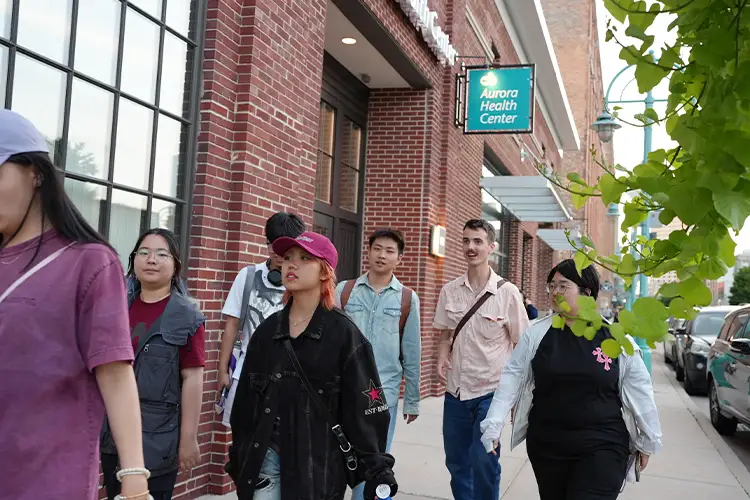
This summer, the program expanded and brought 11 HBUT students to visit Milwaukee for a two-week English and Art program.
During their time in Milwaukee, students were offered experiences and excursions that offered an insight into Western culture.
“The goal was to introduce more students to our programs and allow them to feel what it is like to be a student at UWM,” said program co-coordinator Cynthia Hayes (Teaching Faculty III, Painting & Drawing; Director, First Year Program), who guided students through their two-week program. “This program gives them time to plan ahead and really think about the reality of coming to UWM.”
Visiting HBUT students tour Milwaukee | Photo by Cameron Wise (BFA Film)
HBUT students took classes and workshops, including using state-of the-art 3D printing technology. They visited popular art destinations including the Milwaukee Art Museum, Villa Terrace, and the Art Institute of Chicago, the latter of which was part of an overnight Chicago trip that included an architectural boat tour.
HBUT students interacted with one another and their instructors for most activities but also met other international UWM students in an English language course.
UWM and PSOA hope that these students will return to Milwaukee for their senior year.
Story by Jason McCullum ’25
Arts ambassador Josh Thone to compete in national vocal competition
PSOA Theater student and Arts Ambassador Josh Thone is competing this weekend in the American Pops Orchestra (APO) NextGen National Vocal Competition Semi-Finals.
Thone is one of 25 students competing out of 240 submissions. Viewers can watch Thone’s performance this Sunday, Dec. 1st, and vote virtually for Thone to advance to the live finals.
About APO NextGen
Thone previously competed in the National High School Theater Awards, more commonly known as the Jimmy Awards. Through this experience, he discovered APO. Their mission is to find the voices of tomorrow through the usage of pre-1970s music.
“The conductor is known for taking older songs and reviving them,” said Thone. “That’s all my career has been so far… It’s why I love musical theatre and music in general, to take older stuff and put it in a newer life.”
For the pre-recorded semi-finals, Thone will perform “Flesh Failures/Let the Sunshine In” from the musical Hair. Thone plans to take the hopeful song and innovate it for a modern audience.
“Having that minute to share my hopes for the 2024 version of this society, you never know who could be impacted by those words,” said Thone. “As long as people feel something in their heart, that’s what I value the most with this performance.”
Thone has already advanced his performance craft thanks to APO. In addition to receiving a professional backing track and backdrop from APO, he also got to participate in a virtual workshop with Nic Rouleau, an accomplished actor who most recently played the lead role in the Broadway production of “The Book of Mormon.”
Photo by Cameron Wise (BFA Film)
Thone’s PSOA experience and representing Milwaukee
Following the semi-finals, ten performers will be selected for the live finals at the Lincoln Center in New York City on Jan. 19, 2025.
“Performing with the American Pops would be insane,” said Thone. “It is so cool to say we get opportunities like this through Milwaukee and through Peck. I wouldn’t have been able to even get to the semi-finals without the support of the community. Literally would not have been possible.”
Representing PSOA and the Milwaukee arts community is something Thone promotes often.
“Genuinely the school and the city have shaped my life in a way I didn’t expect,” said Thone. “I have so much love in my heart for the faculty and the people in this tight-knit community… Success forever will and continues to come out of this program.”
Since arriving at PSOA, Thone has acted in several on-campus productions, recently playing a lead role in Bright Star. When preparing for his APO performance, Thone reflected on his work in Bright Star, noting how it helped him remain authentic.
“Authenticity is something this show taught me,” said Thone. “We were given total creative control to be ourselves on stage… At the end of the day, it’s not just the art we are making but it’s about the humans that we are.”
Whether or not Thone advances to the finals, he has expressed gratitude for the APO experience.
“There’s such a privilege to what we’re doing here,” said Thone. “At the end of the day, this experience has already taught me so much about my ability to be authentic.”
The APO NextGen Semi-Finals will occur virtually this Sunday, Dec. 1st at 1 p.m. CST. If you would like to watch Josh Thone compete, RSVP using the Eventbrite link.
Story by Jason McCullum ’25
Dr. Newman named Dean following national search
Dr. Winifred (Elysse) Newman has been named Dean of the College of the Arts and Architecture, effective June 2, 2025.
Dr. Newman comes to UWM from Clemson University where she serves as the Associate Dean for Research and Faculty Affairs, Mickel Professor of Architecture, and Director of the Institute for Materials, Systems, and Environments in the College of Architecture, Art, and Construction. Previously, she was Head of the Department of Architecture at the University of Arkansas, and Director of Advanced Studies at Florida International University (FIU).
“Dr. Newman’s deep understanding of the performing arts, visual arts, architecture, and urban planning make her an ideal choice for our college,” said Kevin Hartman, Interim Dean of the College of the Arts & Architecture. “Under her leadership, I am confident the Peck School of the Arts and the School of Architecture & Urban Planning will continue to flourish and grow together.”
Dr. Newman has maintained an academic career as a researcher, historian, and theorist. She received $18 million in NSF and other funding to study spatial perception and neuroaesthetics with active research in neuroscience and architecture, data visualization, STEM education, and histories of technology and science.
Dr. Newman completed her PhD in Architecture, Landscape Architecture, Planning, and Urban Design, MPhil, and MArch at Harvard University. She has a BArch and a BS in History from the University of Texas at Austin and was a candidate for a BFA in Music Theory and Composition.
The College of the Arts and Architecture, which comprises the School of Architecture and Urban Planning and the Peck School of the Arts, formed in 2023 as a key component of UWM’s 2030 Action Plan. The college offers a wide range of academic programs and initiatives through the Departments of Architecture, Art & Design, Dance, Film & Animation, Music, Theatre, and Urban Planning.
Theater lecturer to direct several productions in 2024-25 season
Marcella Kearns (Lecturer, Acting) is preparing for a busy remainder of the 2024-25 theater season with three different productions, both in and out of Wisconsin.
From Dec. 6 until Dec. 15, Kearns will direct a production of Shakespeare’s The Tempest at Milwaukee’s First Stage, which is a Young Company Performance Project.
In 2025, Kearns will present another work by Shakespeare, directing Henry IV from Feb. 3 through April 18 at the Utah Shakespeare Festival in Cedar City, Utah. Finally, from May 2 until May 11, Kearns’ production of Dawn King’s The Trials will play at the Children’s Theatre of Madison.
Senior dance students present new choreographic works in New Dancemakers: Emanation
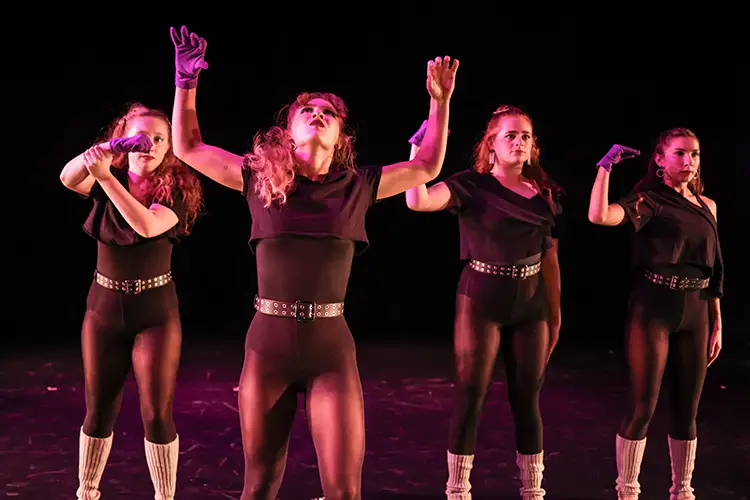
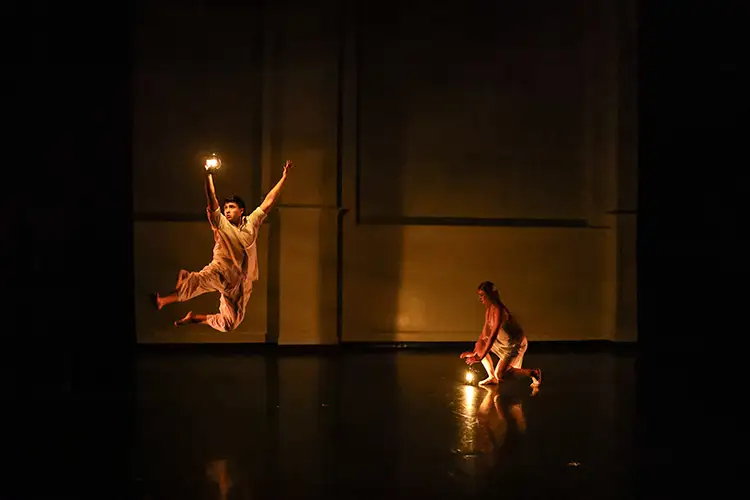
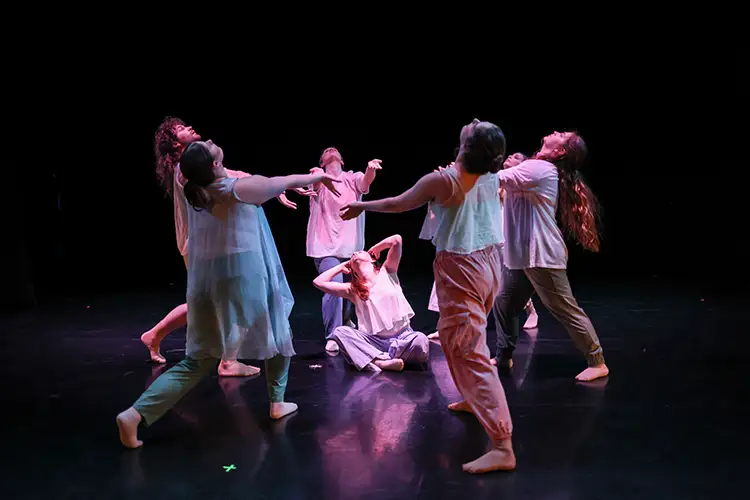
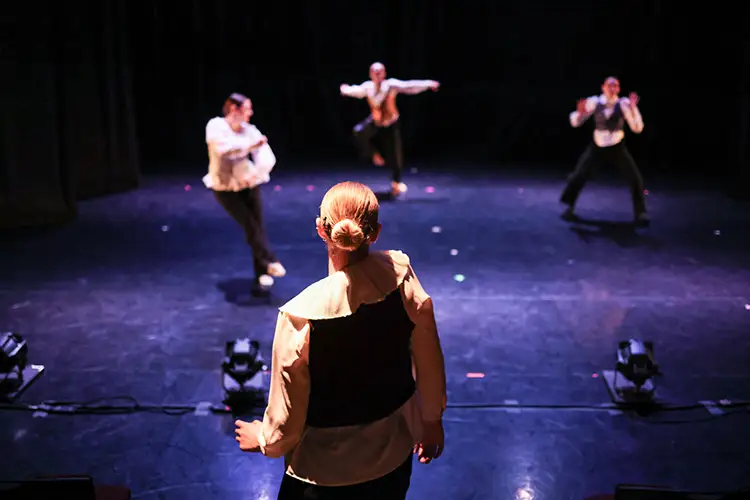
A wide variety of original pieces will premiere at “New Dancemakers: Emanation,” a night of deeply engaging work choreographed by senior dance students at PSOA. “Emanation” marks a major point in senior dance students’ capstone projects, showcasing the skills they have developed in their undergraduate education.
Creative skills
Across ten distinct works, “Emanation” will present all that students have learned in their dance studies. One concept that will be especially noticeable is how the UWM Department of Dance is on the cutting edge of dance by inspiring students to move beyond traditional styles.
Charlotte Reynolds
One student who benefited from this exploration is Charlotte Reynolds. Her piece “80HD” frames people with ADHD through the lens of a 1980s, three-level video game. Noting how her creativity has grown since studying at PSOA, Reynolds felt compelled to fuse different dance styles to fully express herself and her art.
“Dance isn’t just about styles, anymore,” said Reynolds. “With the piece I’ve created this year… it’s like a fusion. It’s my artistry and my style. I feel like PSOA has taught me to open up my vision and mind to the different possibilities of dance and art.”
Reynolds also described feeling that she presents her well-rounded set of skills by merging different dance methods and techniques.
“Moving away from the traditional breakdown has definitely been a part of my journey at UWM,” said Reynolds. “Throughout my time, I’ve learned that I don’t just need to be one thing, I can do many things.”
Maya Hirsig-Smith
Another individual who benefited from a PSOA’s exploration of new styles of dance is Maya Hirsig-Smith.
“Teachers here have really opened my mind to freely expressing myself,” said Hirsig-Smith. “This dance department is really open to trying new things.”
At “Emanation,” Hirsig-Smith will present her piece “La beauté est en chacun de nous,” which explores how humans can feel beautiful and sexy in their own bodies without being sexualized. While the piece explores the positives and negatives, it aims to highlight the confident side of someone showing off their talents for their own pleasure.
Soft skills
Hirsig-Smith credited the foundational skills she picked up in her early composition and improv-based classes at PSOA as helping her generate ideas to complete her piece.
“The way a lot of people get writer’s block, we get dancer’s block,” said Hirsig-Smith. “I had a lot of that during this process, but I went back to my core skills a lot. I thought, ‘What have I done in the past that maybe I can use again?’”
Hirsig-Smith found ways to draw from past work while ensuring that she was “switching it up” to stay original and creative.
Lia Smith-Redmann
Another student presenting original choreography is Lia Smith-Redmann, debuting her piece “Americana: Labor Union,” which tells the story of the “unattainable” American dream and criticizes the ideology of working oneself to death.
“It’s a letter of respect to my community,” said Smith-Redmann. “It’s in honor of the working class and all of the labor strikes that have happened recently.”
Smith-Redmann said that the soft skills she developed at PSOA proved valuable in the creation of her piece.
“As a dancer and choreographer, you’re picking up technical and artistic skills, and learning how to build off your own interests and repertoire,” said Smith-Redmann. “Skills like how to work with people and respect dancer’s bodies… Those soft skills have been really important to my process.”
Through her work, Smith-Redmann fosters a collaborative space for her eight dancers, ensuring everyone feels respected and fulfilled.
Collaboration skills
In the New Dancemakers program, dancers receive weekly feedback from a diverse panel of experts across Milwaukee’s dance community.
“Cross-pollinating between dance and other fields is not only important to me personally, but on an industry level is really important,” said Smith-Redmann. “PSOA really invests a lot of time and energy into you as an artist… They’re really zeroing in on you, your craft, and what you want to say.”
Megan Holzhauer
Fellow student Megan Holzhauer also found the collaborative aspect of these weekly check-ins to be extremely valuable while creating her work, “Behind That Gleam.”
“I feel like we’re all a team and we all have each other’s backs,” said Holzhauer. “It’s great to be able to go to everybody and ask for advice and feedback… It’s great to get a fresh perspective from a diverse panel.”
Holzhauer’s piece centers on perfectionism among athletes. While she describes how perfectionism can help one excel, it also can overwhelm one’s daily existence.
“Perfectionism is very idealized,” said Holzhauer. “I really wanted to not only help individuals learn how to excel in a healthy way but also maintain a better well-being and overall experience in sports.”
Holzhauer has been sitting on her topic throughout her education, which has made the creation of her piece an exciting and impactful endeavor.
“This has felt like an accumulation of all four years,” said Holzhauer. “I honestly feel like I’ve had my New Dancemakers topic since freshmen year… There’s so much excitement around it.”
Reflection from Maria
Maria Gillespie (Professor, Dance; Graduate Program Director, Dance) is the artistic director for New Dancemakers and has worked alongside these students throughout their education at the Peck School.
As is the case for many dance faculty members, getting to see their students enter this final stage of their education is a special occurrence.
“Watching these seniors grow into singular artists with powerful motivation and deep care for their craft is by far the most rewarding experience of our work here in the Department of Dance,” said Gillespie. “These ten choreographers show all of us what embodied patience, rigor, empathy, and tenderness can become – really gorgeous artworks that glow!”
Gillespie has also noted how “Emanation” has been a labor of love and passion for dance students.
“The choreographers chose the title ‘Emanation’ because it unifies their unique paths and visions, describing how the knowledge and experiences gained here at UWM radiate through their dancing and future paths,” said Gillespie.
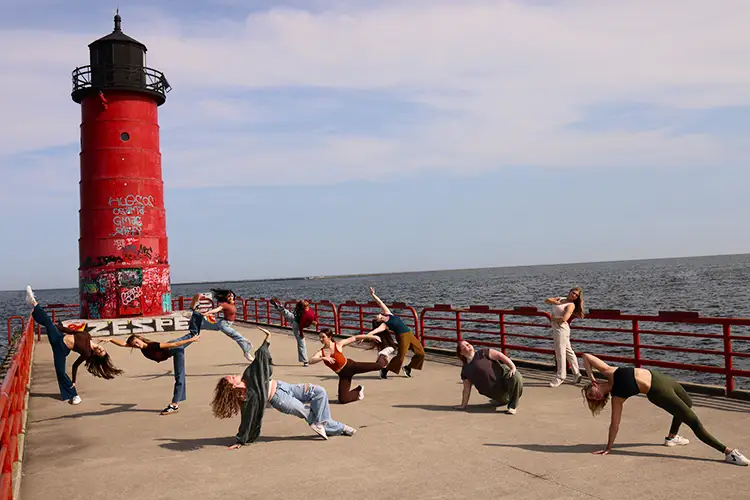
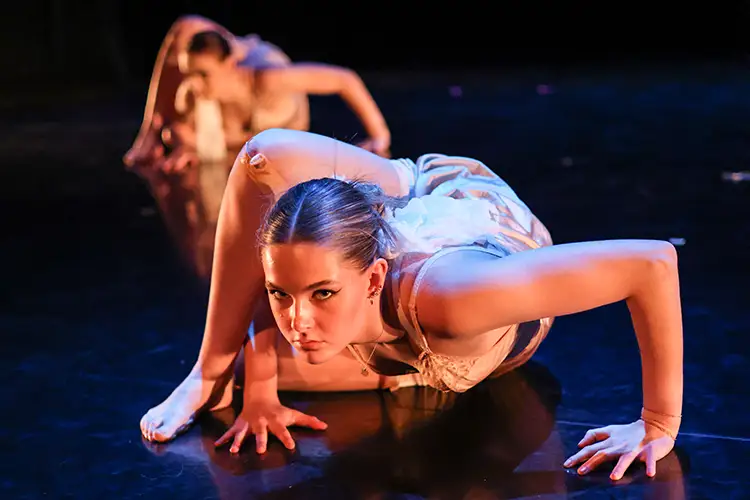
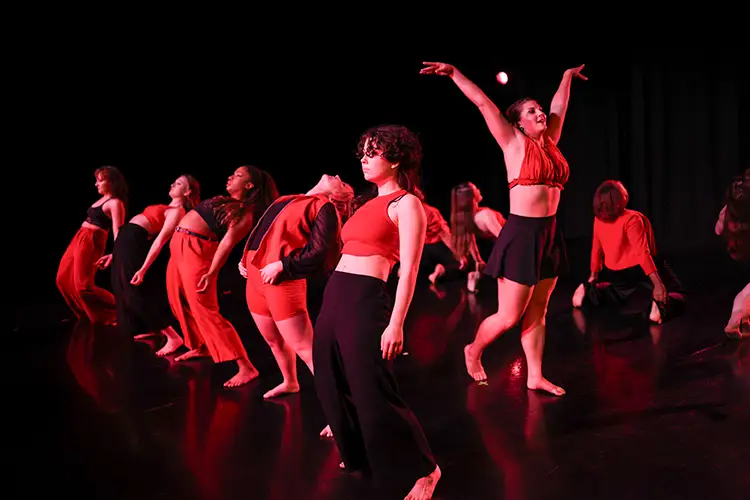
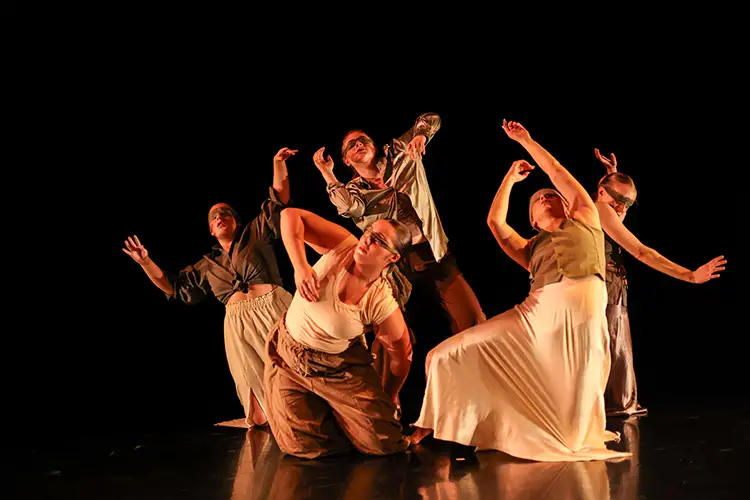
Production photos from “New Dancemakers: Emanation” | Photos by Christal WagnerProduction photos from “New Dancemakers: Emanation” | Photos by Christal WagnerProduction photos from “New Dancemakers: Emanation” | Photos by Christal WagnerProduction photos from “New Dancemakers: Emanation” | Photos by Christal WagnerProduction photos from “New Dancemakers: Emanation” | Photos by Christal WagnerProduction photos from “New Dancemakers: Emanation” | Photos by Christal WagnerProduction photos from “New Dancemakers: Emanation” | Photos by Christal WagnerProduction photos from “New Dancemakers: Emanation” | Photos by Christal WagnerProduction photos from “New Dancemakers: Emanation” | Photos by Christal Wagner
“New Dancemakers: Emanation” runs Nov. 20-23, 2024, at Studio 254 in Mitchell Hall. For more information and tickets, visit the PSOA events calendar.