Current guitar student earns international festival spots this summer
Guitar performance and music education student Annika Nelson is the recipient of multiple scholarships, which allow her to attend the Volterra Project Guitar Festival in Italy and the Brevard Music Center Summer Institute in North Carolina over the summer.
Nelson’s talent and skill have opened doors for her to perform internationally with renowned artists and other skilled musicians.
Theatre student Josh Thone competes as top ten finalist in national vocal competition in New York City
Theatre student and PSOA Arts Ambassador Josh Thone took to the Lincoln Center in New York City to compete in the American Pops Orchestra (APO) NextGen National Vocal Competition Finals. His performance was the culmination of a successful competition period with APO.
Thone’s weekend in New York
Out of 250 applicants, Thone was among only ten students selected to perform in the competition in January 2025. The performance took place at the Lincoln Center and was livestreamed to thousands watching online.
“It was very much a pinch me moment,” said Thone. “To realize that I was actually landing and on my way to perform in New York City was something that I didn’t really fathom when we first landed.”
As an arts ambassador, Thone has often shown his appreciation for the skills and abilities he has developed during his time at PSOA. This was apparent during his competition preparation.
He selected two differing numbers, the up-tempo “There’s No Business Like Show Business” and the ballad “You Made Me Love You.” Thone utilized experience from his PSOA education to ensure that he performed renditions that were authentic to the original numbers yet true to Thone’s showmanship.
“I was able to infuse what PSOA taught me, which is finding authenticity in existing works and fusing that with the American Pops,” said Thone.
The day prior to the finals, Thone took part in intensive rehearsals at the legendary Boulevard Carol Studios.
In addition to preparations with the APO band, Thone and his fellow finalists took masterclasses. Thone’s standout memory was working with Tony-nominated actress Kate Baldwin, who is a graduate of Shorewood High School, just outside of Milwaukee.
Thone described that, while Baldwin is not a UWM– alum, her ties to Milwaukee are a strong representation of the “unique tight-knit community” that is fostered throughout the greater Milwaukee arts scene.
Thone’s PSOA education
Performing in New York City, specifically at the Lincoln Center, is a career-changing moment for any artist, especially someone as young as Thone. While his musicality and personality took him to said stage, he is appreciative of the confidence and experience he has gained at UWM.
“Any of that insecurity that one may have on a New York City stage all just flew by just because it was truly an experience that I didn’t want to take for granted and PSOA set me up to truly have success,” said Thone.
According to Thone, PSOA’s approach to making students performance ready was a defining aspect of his success with APO.
“You’re not set up to be some cookie cutter Broadway-bot mentality,” said Thone. “You’re trained to embrace who you are… that’s what art is. It’s bringing your voice and your stories and storytelling to a new generation… That’s something PSOA taught me that definitely helped me on my performance day.”
Despite the surreal whirlwind in New York City, he quickly adjusted back to school life, with spring classes beginning only two days after his APO performance. As a full-time student, Thone did not feel burdened to return to his studies, instead viewing it as a positive continuation of the work and experience he had while in New York.
“Some would go back to school and be sad,” said Thone. “But PSOA sets up that professional environment where that authenticity, that uniqueness, and being able to celebrate that translated so well into my studies.”
Story by Jason McCullum ’25
Film alum receives Excellence in Undergraduate Teaching Award from Northern Illinois University
As an associate professor of Media Studies in NIU’s Communication’s Department, Caspersen was honored for his community filmmaking efforts and work with students, as well as his meaningful integration of other art forms and departments into his courses.
Art alum’s nature-inspired artwork featured in Chicago Tribune
Art alum Laura Lynne (BFA 2021, Painting & Drawing) was recently featured in a Chicago Tribune article featuring her Midwest nature-inspired curriculum. Over the past four years, Lynne has developed this curriculum and has explored themes such as wetland art, monarch butterfly shadow puppets, nature in the city, and more.
To read more about Lynne and her work, visit the Chicago Tribune.
Sean Kafer talks with Wisconsin Public Radio about student-produced Brady Street documentary
Sean Kafer (Teaching Faculty II, FVANG; Program Director, docUWM) spoke to Wisconsin Public Radio about his new documentary, “Brady Street: A Portrait of a Neighborhood.”
The project was conceived to get students out into the community and to honor the area’s rich, multi-cultural history. Over the last few years, more than 80 students participated in the production, taking on tasks such as interviewing Brady Street residents, doing historical research, and documenting narratives.
“Because it’s so condensed and there’s so much variety of things to do in this neighborhood, people just know each other,” says Kafer in the article. “There’s that warmth and community that you just really feel.”
Performances by theatre students inspire The Todd Allbaugh Show to devote an episode to UW-Milwaukee
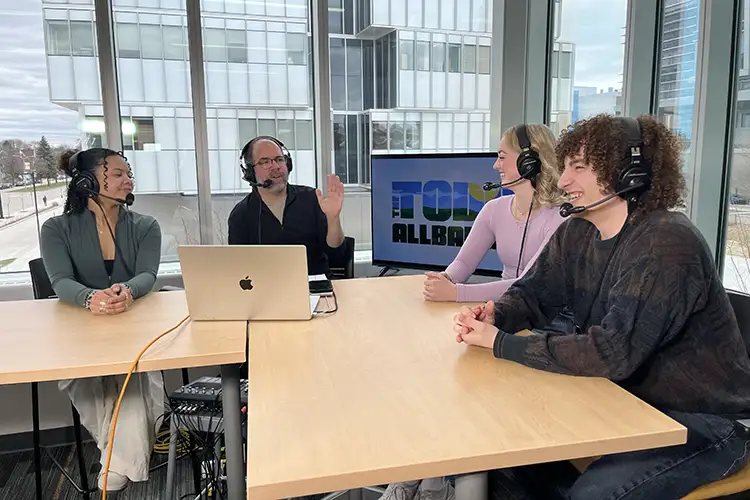
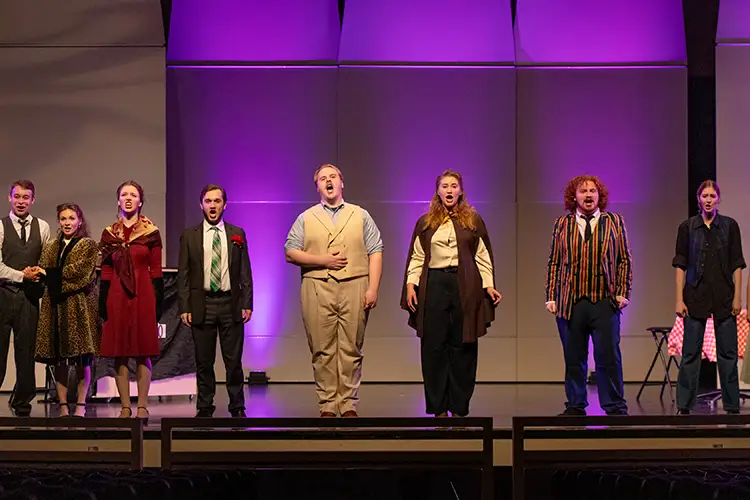
Wisconsin-based radio program The Todd Allbaugh Show featured theatre students Abby McBee, Alyna Williams, and Lucas Drube to talk about the musical theatre program and their experiences with the recent UWM production of “Dames at Sea.”
According to the host, the students’ performances were so impressive, he was inspired to bring the show to Milwaukee. The episode, “What Makes Wisconsin Great: UW-Milwaukee,” was taped on campus.
“I hope that it doesn’t get lost to our viewers and listeners what you all are doing in the arts and musical theater,” Allbaugh said. “In these dividing times, I think you all provide us an experience where we can get off of these things … and we experience something together.”
Three music students share what excites them most about performing in Mozart opera
This weekend, the UWM Music Department will present Mozart’s Le Nozze Di Figaro (edited by Ludwig Finscher)at the Zelazo Center’s Bader Hall. With a wide array of student performers and live accompaniment by UWM’s Symphony Orchestra, there is a lot for audiences to be excited about.
A dream role
Portraying Conte di Almaviva, one of the opera’s defining roles, is second-year master’s student Chris Hinrichs. He describes this as a “dream role” of his.
Hinrichs’ first opera during his undergrad was Le Nozze Di Figaro where he was a member of the chorus. When he saw his friend perform the show’s third act aria as Conte, Hinrichs knew he wanted to play the role himself someday.
“I was like ‘Oh my god, this is beautiful,’” said Hinrichs. “I decided that if I get the chance to do this, I would absolutely love to… It’s been a lot of fun to get to sing this music that I’ve wanted to sing for such a long time.”
Hinrichs describes his role as the primary antagonist, which was challenging for him as an actor. However, his research and education at PSOA helped ensure he was performance-ready.
Chris Hinrichs performs as Conte di Almaviva | Photo by Mark Frohna
“I’ve never sung a principal role with an orchestra before,” said Hinrichs. “Without Dr. Agulay, I don’t think I could do this technically. It’s been vocally demanding, and he’s helped ensure I pace myself and work with a full cast properly.”
To him, performing a dream role early in his career shows how special the PSOA community is.
“It feels really rewarding,” said Hinrichs. “I don’t see the same kind of outreach opportunities I’ve seen here, where we’re working with companies like Florentine Opera… There’s a level of community I see here that is really exciting.”
A modern spin with classic elements
Throughout his preparations, Hinrichs has been working to adapt his period-piece role to a director on a movie set, fitting with PSOA’s twist of setting Le Nozze Di Figaro in 1940s Hollywood.
Fellow master’s student Alexandra Smith, who plays Hinrichs’ on-stage wife, La Contessa, also saw the nature of her role change. In PSOA’s staging, La Contessa is a major Hollywood actress. Throughout this process, Smith researched Norma Desmond and other classic Hollywood actors to mimic their traits and behaviors on stage.
“I was studying a lot of hand gestures and eye movements,” said Smith. “Costumes majorly helped with this. Once you start to look like a character, it can feel much easier to play them.”
Despite the updated timeline, this production still embodies the characteristics that are expected of a classic opera.
Something that stood out to Smith in preparation is the increased power that UWM’s Symphony Orchestr brings to the experience.
“You feel like freaking Pavarotti,” said Smith. “It’s this team effort between you, the strings, and the conductor… It feels huge. It’s so much more professional and earthy when you have strings underneath you.”
Alexandra Smith performs as La Contessa | Photo by Mark Frohna
With this comes the need for increased stamina while performing, which Smith felt she needed to work on throughout the semester. With the help of Aaron Agulay (Assistant Professor and Area Head, Voice & Opera), Smith rose to the occasion.
“Having Dr. Agulay and his pedagogical approaches has helped a lot,” said Smith. “I have lot more stamina in my singing since coming [to the Peck School].”
The importance of opera
Music Education junior Megan Schneider, who plays Cherubino, also found the collaboration with the orchestra to be a standout part of what she considers Mozart’s “defining work.”
“It feels like a bigger deal,” said Schneider. “The change of space, the different director, adding orchestra. Everything all culminating to this opera makes it more grand and exciting.”
Working in the operatic space has become an important part of Schneider’s education.
Schneider did not receive access to operatic works while in high school, participating in her first opera during her first year at PSOA on the advice of Shallece Peters (Lecturer, Voice). Now, Schneider has recognized the importance of the art form, hoping to pass it on to her students as she begins her career in education.
“Since doing this opera and other smaller operas, it’s come to my knowledge how truly vast and great it is,” said Schneider. “It definitely should not be missed when it comes to teaching music.”
Megan Schneider performs as Cherubino | Photo by Mark Frohna
Schneider also hopes to teach her future students the importance of research when preparing for a major performance.
One of Schneider’s major pieces in Le Nozze Di Figaro was one she had learned previously. However, she found it necessary to reexamine the piece with a new perspective to fully develop her character.
“You can’t just look at words on a page and understand exactly who they are,” said Schneider. “You need to be able to not only create the character from what others have done but also with how it’s written and how you personally connect with your character.”
Le Nozze Di Figaro is at the Zelazo Center for two performances on April 4 & 5. For tickets and more info, visit the PSOA Events Calendar.
Story by Jason McCullum ’25
Assistant Professor Jesse Malmed presents variety of works this spring
Jesse Malmed (Assistant Professor, Film, Video, Animation, and New Genres) has been in the midst of a busy spring, presenting a variety of works.
Malmed premiered two new archival photo projects as part of The Chicago Cluster exhibition “Don’t Make Photographs, Think Them” from March 28–April 27. These projects consist of an animation installation and a series of custom-made view master slides.
Also in Chicago, Malmed gave a new performance titled “My Acceleration Diner Time” as part of Lecture as Form: General Readings on March 29. He also presented a new collaborative performance with Alee Peoples on April 7 at the Gene Siskel Film Center
Elsewhere, Malmed’s artist books are on display at FOLD, an exhibition and reading room at stop-gap project in Columbia, Missouri, which is running from April 4 to May 2.
Behind the scenes with assistant directors of “The Ballad of Maria Marten”
The UWM Department of Theatre’s next production, “The Ballad of Maria Marten,” opens this week and was directed by Robin Mello (Professor, Theatre). During the production, Mello was assisted by Elizabeth Riley and Ambrose Schulte, both juniors, who served as Assistant Directors. This experience included Mello connecting her student directors with Beth Flintoff, the playwright.
Hands-on experience for aspiring directors
Riley and Schulteare are aspiring directors who came to PSOA with a love for theatre. Collaborating with one another and Mello on “Ballad” proved to be a valuable experience and a positive steppingstone in their early careers.
Elizabeth Riley, a Theatre Practices major, once had dreams of being a performer but transitioned into directing upon finding that her true artistic passion is directing. The shift was validated at PSOA, where she got to shadow the directing side of other productions.
Riley’s love of collaboration in the theatre-making space has been a driving force in her desire to direct.
“One big thing about being a theatremaker is that there’s no room or time to be a solo act,” said Riley. “Being a director is often misunderstood as some sort of god in the theatre… The director’s job is to find a common vision among everyone involved in the production and turn it into a reality.”
Riley shadowed PSOA’s Fall 2023 production of “The Moors” and directed a piece for the New Play Festival in Spring 2024. While both opportunities paved the way for Riley’s work on “Ballad,” she said taking Ralph Janes’ (Teaching Faculty III, Theatre Education & Directing) directing class proved essential in her directing career.
“Working with Ralph transformed my mind as to how I see balance on the stage and how I interact with actors,” said Riley. “I had never thought about how theatre is a sculpture that you need to carefully form so that it makes sense in the audience’s mind.”
Schulte, also a Theatre Practices major, agreed that Janes’ directing class furthered their desire to pursue directing.
“It was really valuable to experience in that class how so much of theatre is what you experiment and try within the moment,” said Schulte. “What you’re doing with these people in that live space is living and breathing… That was really good to apply to this experience.”
Meeting with the playwright
Throughout the production of “Ballad,” Mello ensured that Riley and Schulte were well-researched and prepared, especially given the mature subject matter and 1800s timeline that are essential to the show.
The highlight of the research and planning process came when Riley and Schulte got to sit down with playwright Beth Flintoff. Both students described how this experience was not only personally fulfilling but ensured that they pursued this piece respectfully and accurately.
“So much of what a lot of people focus on when doing a play is ensuring your intent aligns with the playwright,” said Schulte. “Talking to [Beth] reaffirmed that we are on the right path and carefully handling the narrative.”
The experience of discussing the play with Flintoff was an essential part of Riley and Schulte’s creative process, further understanding the nuances of the play’s story.
For example, the main antagonist is discussed by characters but never shown on stage. She discussed this decision with Riley and Schulte, giving greater context into her creative process. Flintoff spoke of her time spent in the village of Polstead, where the events of the play occurred.
The insight not only positively influenced their work on the show but also helped them feel more connected to the individual whose work the show portrays.
“Talking with [Beth] showed just how genuine of a person and writer she is,” said Riley. “Some art that centers around tough subjects can feel insensitive… So, meeting the creative force and realizing she was doing it as a love story to the character showed how genuine she is.”
The three-person directing team fostered a strong collaborative relationship. While Mello is the most experienced director of the bunch, she was still open and accepting of the ideas that her student colleagues presented.
Riley and Schulte described how the three directors were able to “build off each other well,” ensuring that all ideas were heard and considered.
“I appreciate that if you have an idea that Robin is not immediately on board with, she will hear you out and let you defend your ideas,” said Schulte. “Getting the chance to play with other people’s ideas has been important.”
“The Ballad of Maria Marten” is on stage at Kenilworth Five-0-Eight and runs through April 6. For tickets and more info, visit the PSOA Event Calendar.
Story by Jason McCullum ’25
Master’s clarinet student performs Bitsch selection with UWM Symphony
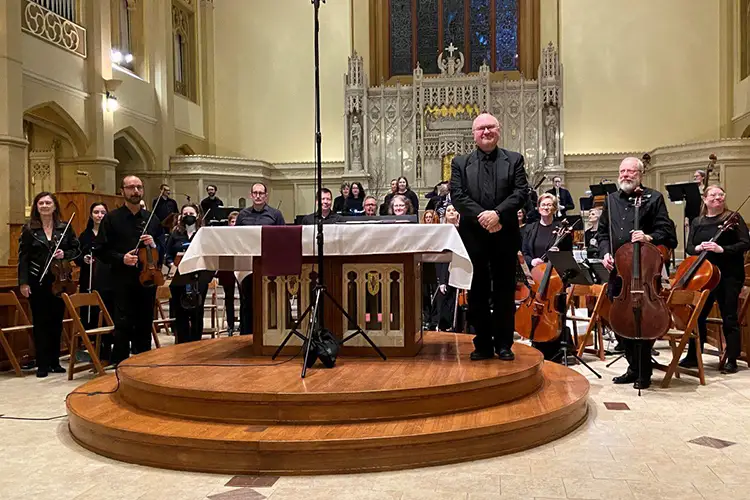
Last month, the UWM Symphony Orchestra performed in the Zelazo Center featuring clarinetist and first year master’s student Mauricio Franco. This concert served as the culmination of Franco’s achievement in the 2024-25 Concerto Competition held at the Peck School.
Concerto Competition
The Concerto Competition was a one-round competition with ten of PSOA’s greatest classical music minds competing for a solo performance at the Symphony Orchestra’s winter concert. As opposed to some other competitions that present contestants with a strict repertoire, Franco and his fellow competitors selected works themselves.
“I felt like I had a lot of freedom to choose something that was a bit more creative,” said Franco.
Franco performed alongside a piano accompanist for a panel of three judges, including the conductor of Milwaukee’s Festival City Symphony.
The experience for Franco was a “nice change of pace” compared to other auditions as he was able to interact with and watch the judges’ reactions in real time.
Following the audition process, Franco said he was “shocked” to find out that he had won and set sights on his preparations for the eventual concert. Franco prepared alongside his instructor Todd Levy.
“He’s probably been the most beneficial relationship I’ve made at school,” said Franco. “What he’s presented to me has been an entire world of the instrument and artistry that I didn’t know before.”
While Franco feels that skilled musicians such as himself should bring a set of skills into their university studies, he often cannot help but be amazed at Levy’s guidance and skillset.
“There’s a certain level of experience you feel like you should have,” said Franco. “But sometimes I feel like a kid in a candy store… The amount that I can learn is really amazing.”
February concert
For the eventual concert, Franco selected Marcel Bitsch’s Concertino for Bassoon (transcribed for bass clarinet) for the symphony to perform.
Franco selected this piece to expand the UWM Symphony’s repertoire, looking to break away from “mainstream” classical music.
“The UWM Symphony is fairly mainstream, most often,” said Franco. “You’re looking at composers like Brahms, Mozart, Beethoven… A shift into this kind of repertoire really stretched the ensemble.”
The intricacies of the piece not only stretched the ensemble but were also meant to expand the audience’s musical vocabulary both through the composition of the piece and Franco’s performance.
“I really looked into trying to delve into the colors and changing the sound of the instrument as much as possible,” said Franco. “I just wanted to feel like I’m stretching the possibilities of what I’m presenting to the audience.”
The concert, which also featured Brahms’ Serenade No. 1 in D Major and Weber’s Oberon Overture, among other selections, was conducted by Dr. Jun Kim (Associate Professor, Instrumental Conducting Director, Orchestral Activities, Symphony Orchestra, University Community Orchestra).
In preparing himself and the ensemble for the winter concert, Franco got the opportunity to work closely with Dr. Kim. Throughout this process, Kim and Franco collaborated to ensure success for the symphony, an experience that Franco felt was positive.
“I feel super comfortable in our collaboration, and I think that’s shone through to create a great musical experience,” said Franco.
Upon reflecting on the performance, Franco noted the success of the concert.
“The concerto was an unprecedented success, and the encore that followed was positively received as a calm, reflective ending to an exciting and unique performance,” said Franco.
Story by Jason McCullum ’25
docUWM’s “Brady Street” documentary previewed on WISN
“Brady Street: A Portrait of a Neighborhood,” a documentary feature created as part of UWM’s documentary film program docUWM was recently featured in a WISN article.
Sean Kafer (Teaching Faculty II; Program Director, docUWM) enlisted the help of students to film and create the documentary. Kafer, along with PSOA students Fantasia Coleman and Emanuel Zander, joined the WISN team ahead of the film’s premiere to offer a preview.
To learn more about “Brady Street: A Portrait of a Neighborhood” and docUWM, visit WISN.
Master of Music alum and conductor of Concord Chamber Orchestra featured in Shepherd Express
Jamin Hoffman (MM 1990, Music) was recently featured in a Shepherd Express highlighting his work with the Concord Chamber Orchestra in Milwaukee.
Hoffman joined the orchestra in 1989 as a French horn player before putting his instrument aside to become conductor in 2004. In the Shepherd Express feature, Hoffman noted the importance of “camaraderie and joy in celebrating music together” as an important aspect of the Concord Chamber Orchestra.
To read more about Hoffman and the Concord Chamber Orchestra, visit Shepherd Express.
Film alum and indie film producer speaks at SXSW
On March 9, alum Kurt Ravenwood (BFA 2011, Film) spoke on a panel at media festival SXSW in Austin, Texas. Ravenwood discussed pursuing film production outside of New York and Los Angeles.
Ravenwood was one of the minds behind 2024’s “Hundreds of Beavers,” one of the year’s most popular and successful independent films. He is also a partner at SRH Marketing (Milwaukee) and an independent film producer.
Theater department’s production of “Dames at Sea” reviewed by Shepherd Express
Shepherd Express recently published a positive review of the PSOA Theatre Department’s production of “Dames at Sea.”
“The entire ensemble, save the sailors in their trademarked blue uniforms, was decked out in vibrant colors, each new piece in which they came out on stage showcasing yet another original design,” wrote Natalie Murray in her Shepherd Express review. “The costume team kept each individual looking individual while establishing a cohesion befitting that of a Broadway ensemble.”
What it takes to create a ‘cavalcade’ of quick changes in “Dames at Sea”
Peck School of the Arts’ next theatre production, “Dames at Sea,” a pastiche on 1930s musicals, opens this Wednesday. The show is notable for its slew of quick changes that give students an experience that reflects professional theatre.
The process of quick changes
A quick change is when a character changes from one costume to another, typically between 30 seconds to a minute. In “Dames at Sea,” theatre students have been challenged to complete several quick changes, some in fewer than 20 seconds.
“We do quick changes a lot,” said Jason Orlenko (Assistant Professor, Costume Design). “Out in the professional world, they happen a lot in musical theatre… If you go out in the industry, you are going to have a lot of changes.”
Throughout the process of preparing costumes for the show, Orlenko and his long-time collaborator Dana Rochester (Teaching Faculty II & Area Head, Costumes & Stage Makeup), alongside their team of student costumers, have experimented with a variety of quick-change materials, including snaps, zippers, and magnets.
Student dresser works on “Dames at Sea” costume | Photo by Cameron Wise (BFA Film)
For example, Orlenko decided to sew a pair of shorts and a top together with a large zipper in the back. This allows the actor to walk into their costume as the wardrobe crew zips it up seamlessly.
“When designing things, I try to think about where those quick changes are going to happen and how I can design the costumes to accommodate that,” said Orlenko.
Quick changes are done throughout “Dames at Sea,” but many of them come near the end of the show, when the three female leads do what Orlenko describes as a “cavalcade of quick changes.”
The collaboration of quick changes
Alyna Williams | Photo by Brick D. Kyle
Sophomore Alyna Williams plays the head chorus member, Joan, in what is her first collegiate-level theatre production. Williams has great love and admiration for the process of quick changes, in part because of the collaboration that is necessary to do them properly.
“Quick changes are one of my favorite parts of costuming,” said Williams. “I think it’s amazing that costume and stage craft students can help us because not many programs do that.”
Williams describes how collaboration is achieved by communicating closely with the crew, something that she does both on and off stage to foster a positive environment.
“I believe in not having a divide between the actors and the tech crew,” said Williams. “It is important to build those connections because these are the people who are going to be consistently helping you… You want to make sure you are communicating and collaborating.”
Abby McBee | Photo by Brick D. Kyle
Senior Abby McBee similarly communicates with the wardrobe crew to ensure they receive the respect and recognition they deserve.
While dressers stay out of the spotlight, they are essential to the quick change process. McBee understands this as her character, Mona Kent, has six costumes and eight quick changes.
“A lot of these costumes were hand-made for the show, which gives students in the costume department such great experience,” said McBee. “I think Peck does a really good job at making it a good environment rather than an extremely stressful one.”
Actor mentality for quick changes
Quick changes can be stressful for actors and dressers.
“As an actor, if we start to panic then it can go downhill,” said McBee. “I feel like it can pull you out of the show mentality. I find it important to stay focused on the scene while also being present in what is happening backstage.”
Senior Sophia Roth encourages a calm atmosphere backstage, understanding that it is important to stay in the moment of live theatre.
Sophia Roth | Photo by Brick D. Kyle
“Quick changes can get really stressful,” said Roth. “The main thing is knowing that live theatre is live for a reason. Things happen and it all will come together in the end… For me it is really about staying in character, staying calm, and letting the costumers do their work.”
In “Dames at Sea,” Roth plays Ruby, a small-town girl from Utah who comes to New York with Broadway dreams.
Roth’s quick changes in “Dames at Sea” are full circle to her stage debut. At nine years old, Roth was in “Mary Poppins” and saw quick changes for the first time, something she remembers fondly to this day.
“I was backstage, and I remember seeing the process of [Mary] getting changed,” said Roth. “I was absolutely enamored… Being able to experience that myself backstage feels very professional and very Broadway.”
Roth’s memories are just one example of the magic that quick changes bring to the experience of live theatre.
“Dames at Sea” opens on March 5, 2025, and runs through March 9, 2025, at the Mainstage Theatre. For more information and tickets, visit the PSOA events calendar.