Future FVANG student named emerging artist by local publication
Ben McMillen, a senior student at White Bear Area High School entering PSOA’s Department of Film, Video, Animation & New Genres this fall, was recently featured as an emerging artist by Press Pubs.
In the article written by Logan Gion, McMillen speaks on his preparation and dedication to pursue his dreams of directing. He also shares how theatre helped him get to where he is today.
“As I go into a career doing this sort of thing, it’ll be a lot of help to get this early experience,” McMillen said.
UWM alum Sarah Tramonte (BFA 2017, Art) spoke with Sandy Reitman from the Shepherd Express about her new start-up business, Tramonte Food & Styling Co.
Tramonte Food & Styling Co. offers a wide range of services, including recipe tasting, in-studio food product photography, restaurant food photography, food styling, cookbook photography, menu planning, and private dining.
“I went to UW-Milwaukee for graphic design and minored in photography. For my senior showcase project, I developed my cookbook,” Tramonte says. “Thinking this would be the perfect piece to exhibit photography and design, I quickly fell in love with the food aspect of the project.”
Shepherd Express previews “A Room Shaped Story” produced by Dance lecturer and alums
Dan Schuchart (Teaching Faculty III, Dance; BFA 2004, Art) is working with PSOA alumni and Wild Space Dance Company members Kaetlyn Altmann (BFA 2019, Dance) and Ashley Ray Garcia (BFA 2022, Dance) to produce “A Room Shaped Story,” a multi-narrative piece about transitions through time and space and the connection between mind and body.
In the article written by John Schneider for Shepherd Express, Schuchart speaks on the motivation and collaborative work for the show.
“Ashley would start something, I would pick it up and work on it, and Katelyn would take it and continue it, maybe build a beginning or fill in a middle,” said Schuchart. “We’d pass it between the three of us, so it has different voices, different intonations and emphasizes.”
“A Room Shaped Story” will run from April 18-19 at the Broadway Theatre Center’s Studio Theater.
Broadway World: New play by theatre alum set to premiere at Br!NK New Play Festival
Emmy-nominated writer Maria Pretzl (BFA 2014, Film; BA 2014, Theater Studies) will have her play, “Naked Tuesday,” featured at Renaissance Theaterworks’ eleventh annual Br!NK New Play Festival.
The story follows the exploits of a writer, an actor, and a writer’s assistant as they are forced to share an apartment in New York City. The performance is directed by Jess Yates.
“Naked Tuesday” will premiere at the Br!NK New Play Festival on May 17. To learn more, visit the article written by A.A. Cristi for Broadway World.
Shepherd Express provides an in-depth perspective on MFA Exhibition
Art & Design MFA 2025 graduate students Mich Dillon, Howard Leu, Tanner MacArthur, Andrew McConville (BA 2013, Art), William Justice “Bucko Crooks” Mueller II, and Rachel Sanders exhibited work in “Shape and Shadow,” a showcase of talent and effort that blends academia and art. Each artist’s work takes on personal narratives and perspectives in their own respective medium and style.
Shane McAdams for Shepherd Express provides an in-depth perspective on the processes and motivations behind each individual artist’s work, calling the exhibition a reminder “of the potential of academic nurture to prepare students for the real world.”
Outside the Bachs, co-founded by music alum, surpasses $10 million in client revenue
Outside The Bachs, a music studio development company owned by UWM PSOA alum Kelly Riordan (BA, 2017, Music: Clarinet Performance) and business partner, Isak Peterson (BA, 2015, Economics), announced that their business has surpassed $10 million in client revenue.
Riordan and Peterson founded the company in 2021 with the goal of educating private music teachers on how to successfully run a lesson studio business. Since its creation, Outside the Bachs has reportedly supported over 500 private studio owners with professional services, business strategy, marketing, and enrollment systems.
Student-run MUFF gives film students experience in the business of the arts
The UWM Department of Film, Video, Animation & New Genres will present the Milwaukee Underground Film Festival (MUFF) this week. One of PSOA’s most popular courses in the film program, MUFF is a student-run film festival devoted to screening independent, artist-driven films.
Not only does MUFF provide an opportunity for filmmakers to gain exposure in the Milwaukee film community, but it also offers students experience in the business side of the arts.
The business of the arts
MUFF is offered to film students as a three-credit, twice-weekly course that satisfies their requirement to obtain an internship or another form of community engagement during their time at PSOA. Many students are drawn to take MUFF as it provides practical, hands-on exposure into running a film festival.
“It doesn’t really feel like a class,” said senior student Sophia Stezala, who is minoring in film. “It feels like I’m clocking into a job, but in a good way.”
Student organizers are divided into three teams: community outreach, film screening and selection, and design and marketing.
Stezala is part of the community outreach team, working alongside senior film major Anders Waage. Both took MUFF out of a desire to learn more about the production and business-oriented aspects of the film industry.
“I thought it would be really interesting to have experience from the inside to see how a festival is built up,” said Waage. “I wanted to get a feel for how to present films professionally.”
The community outreach team tackled the logistical aspects of running a festival, including securing new locations and sponsors. Other teams took on tasks such as logo and website design, film lineup curation, and more.
No matter the task, MUFF gives students a special opportunity to not only learn about the business side of the arts but to work practically, enhancing their learning.
“I can learn all day about how to use a camera but if I’m not there actually using it, then I’m not fully learning,” said Stezala. “The ins and outs of running a festival cannot be taught without actually doing it.”
Something that goes into ensuring the success of a yearly film festival is creating a distinct product from years past. Because of that, the MUFF team worked to develop a theme for this year’s festival that reflects the time artists are creating work.
“The identity of the film festival takes on the collective identity of our filmmakers and the time period,” said Stezala.
The result for MUFF 2025 is a theme that reflects modern cyber threats, including AI and new technology.
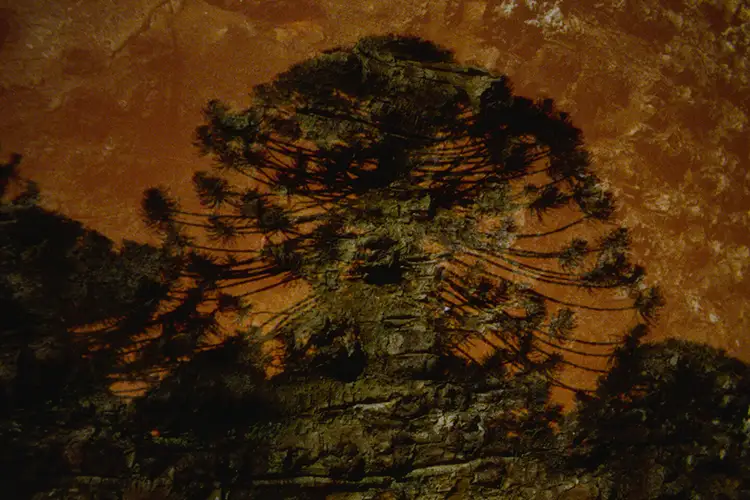
Still from Archipelago of Earthen Bones – To Bunya by Malena Szlam
The MUFF mission
MUFF falls during a busy for the Milwaukee film community. To carve out its own distinctive space for film offerings, MUFF selects films that reflect PSOA’s commitment to producing experimental, artist-driven cinema.
“We offer opportunity to artists that do not always get that kind of platform to showcase their work,” said Waage.
MUFF selection is typically made up of non-narrative work aimed at celebrating new artistic forms and amplifying unheard voices.
The collaborative environment necessary to produce MUFF also helps reflect PSOA’s values, as the MUFF student body works with one another to ensure the festival is produced as professionally as possible.
“A big part of the artistic community is collaboration,” said Waage. “Being a part of that collaboration to help other people present their work and see how impactful that can be is really valuable.”
Still from Eurydice in the Underworld by Felicity Palma
Milwaukee Underground Film Festival runs through April 19. Visit the PSOA Events Calendar for more information.
PSOA professor and alums receive 2025 Civic Music MKE awards
Civic Music Milwaukee has announced its 2025 award recipients, and there are several honorees with ties to the Peck School of the Arts. Timothy Klabunde and Dr. Zachary Durlam will receive Citizen Awards, while Trinny Schumann and Cassie Wilson were recipients of the organization’s Education Awards.
Citizen Awards
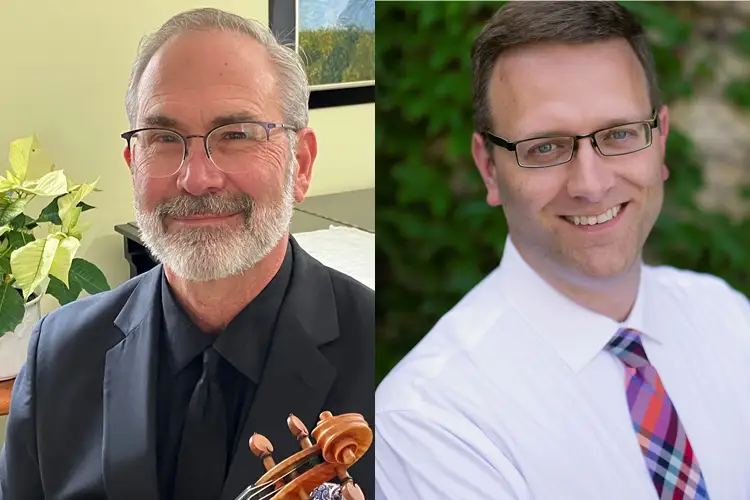
Timothy Klabunde, who studied violin at UWM, will receive the Lifetime Achievement in Music award. After 44 years, Timothy retired from the Milwaukee Symphony Orchestra, where he served in both violin sections and finally as Assistant Principal Second Violinist. He began his full-time employment there at the age of 23.
Additional accolades include holding the title of Concertmaster for the Milwaukee Ballet Orchestra, being a soloist for the Milwaukee Chamber Orchestra, and being a member of the teaching staff for Cardinal Stritch University.
He spends his retirement mentoring and advocating for young musicians in the Milwaukee area programs he has helped create. A Milwaukee native, Klabunde attended UWM in the 1970s, taking up violin and studying under the members of UWM’s Fine Arts Quartet.
Dr. Zachary Durlam (Associate Professor, Choral Conducting; Director, UWM Choral Activities) will receive a Distinguished Citizen Award as a professional in the arts. Durlam serves as UWM’s Choral Activities Director, director for the Master Singers of Milwaukee, choir director for Grace Lutheran Church in Grafton, and former president of the Wisconsin Choral Directors Association (WCDA).
Under his direction, UWM’s Concert Chorale has been spotlighted at numerous conferences. Along with this, his direction has also led to the Concert Chorale performing with Italian vocalist Andrea Bocelli on his 2021 “Believe” tour and UK rock band The Rolling Stones at Summerfest in 2015.
Klabunde and Durlam will receive their awards on May 7 at Live at the Ivy, a free community event showcasing musicians and community leaders from around Milwaukee at the Ivy House in Walker’s Point. All proceeds from the event go towards Civic Music MKE’s youth programming. To read their full biographies, visit Civic Music MKE.
Education Awards
Trinny Schumann
Choral director Trinny Schumann (MM 2014, Music) is honored as the 2025 recipient of the Music Teacher of the Year award. Schumann received her BA in music from Carthage College, going on to receive her master’s in music from UWM in 2014. After her time at UWM, she became the Choral Director at Nicolet High School, as well as the advisor for Nicolet High’s Tri-M Music Honors Society and the Music Director for North Shore Congregational Church.
In her pursuit to bring music into community spaces, Schumann founded Dominican High School’s North Shore Catholic Music Festival and Nicolet High School’s North Shore Vocal Arts Day. She is an active member of the Wisconsin Music Educators Association, where she continues to connect music to the community.
Cassie Wilson
Cassie Wilson (BFA 2006, Music Education) is a lifelong lover of music and the recipient of the General Music Instructor Certificate. After graduating from Peck School of the Arts in 2006 with a BA in Music Education, she went on to teach music in Cedarburg, WI.
After eighteen years, Wilson still has a passion for what she does and for working with students. She currently teaches over 400 students at Thorson Elementary School. In her free time, Wilson pursues her love of musical theater by holding the title of Youth Music Director for the Falls Patio Players in Menomonee Falls, WI.
Schumann and Wilson were honored on March 9 at the 2025 Educator Awards Reception and Presentation. To read their full biographies, visit Civic Music MKE.
Founded in 1918, Civic Music Milwaukee is a community arts organization that serves musicians in the greater Milwaukee area by providing resources such as scholarships, performance opportunities, award programs, and coaching opportunities to the community. For the past nine years, the organization has been led by Executive Director Nancy Herro ‘80, who earned her BA in Music Education from UWM.
Story by Payton Murphy ’27
Current guitar student earns international festival spots this summer
Guitar performance and music education student Annika Nelson is the recipient of multiple scholarships, which allow her to attend the Volterra Project Guitar Festival in Italy and the Brevard Music Center Summer Institute in North Carolina over the summer.
Nelson’s talent and skill have opened doors for her to perform internationally with renowned artists and other skilled musicians.
Theatre student Josh Thone competes as top ten finalist in national vocal competition in New York City
Theatre student and PSOA Arts Ambassador Josh Thone took to the Lincoln Center in New York City to compete in the American Pops Orchestra (APO) NextGen National Vocal Competition Finals. His performance was the culmination of a successful competition period with APO.
Thone’s weekend in New York
Out of 250 applicants, Thone was among only ten students selected to perform in the competition in January 2025. The performance took place at the Lincoln Center and was livestreamed to thousands watching online.
“It was very much a pinch me moment,” said Thone. “To realize that I was actually landing and on my way to perform in New York City was something that I didn’t really fathom when we first landed.”
As an arts ambassador, Thone has often shown his appreciation for the skills and abilities he has developed during his time at PSOA. This was apparent during his competition preparation.
He selected two differing numbers, the up-tempo “There’s No Business Like Show Business” and the ballad “You Made Me Love You.” Thone utilized experience from his PSOA education to ensure that he performed renditions that were authentic to the original numbers yet true to Thone’s showmanship.
“I was able to infuse what PSOA taught me, which is finding authenticity in existing works and fusing that with the American Pops,” said Thone.
The day prior to the finals, Thone took part in intensive rehearsals at the legendary Boulevard Carol Studios.
In addition to preparations with the APO band, Thone and his fellow finalists took masterclasses. Thone’s standout memory was working with Tony-nominated actress Kate Baldwin, who is a graduate of Shorewood High School, just outside of Milwaukee.
Thone described that, while Baldwin is not a UWM– alum, her ties to Milwaukee are a strong representation of the “unique tight-knit community” that is fostered throughout the greater Milwaukee arts scene.
Thone’s PSOA education
Performing in New York City, specifically at the Lincoln Center, is a career-changing moment for any artist, especially someone as young as Thone. While his musicality and personality took him to said stage, he is appreciative of the confidence and experience he has gained at UWM.
“Any of that insecurity that one may have on a New York City stage all just flew by just because it was truly an experience that I didn’t want to take for granted and PSOA set me up to truly have success,” said Thone.
According to Thone, PSOA’s approach to making students performance ready was a defining aspect of his success with APO.
“You’re not set up to be some cookie cutter Broadway-bot mentality,” said Thone. “You’re trained to embrace who you are… that’s what art is. It’s bringing your voice and your stories and storytelling to a new generation… That’s something PSOA taught me that definitely helped me on my performance day.”
Despite the surreal whirlwind in New York City, he quickly adjusted back to school life, with spring classes beginning only two days after his APO performance. As a full-time student, Thone did not feel burdened to return to his studies, instead viewing it as a positive continuation of the work and experience he had while in New York.
“Some would go back to school and be sad,” said Thone. “But PSOA sets up that professional environment where that authenticity, that uniqueness, and being able to celebrate that translated so well into my studies.”
Story by Jason McCullum ’25
Film alum receives Excellence in Undergraduate Teaching Award from Northern Illinois University
As an associate professor of Media Studies in NIU’s Communication’s Department, Caspersen was honored for his community filmmaking efforts and work with students, as well as his meaningful integration of other art forms and departments into his courses.
Art alum’s nature-inspired artwork featured in Chicago Tribune
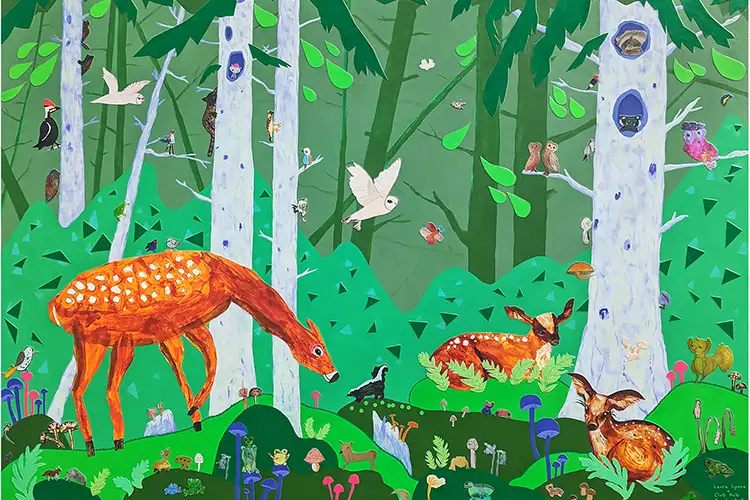
Art alum Laura Lynne (BFA 2021, Painting & Drawing) was recently featured in a Chicago Tribune article featuring her Midwest nature-inspired curriculum. Over the past four years, Lynne has developed this curriculum and has explored themes such as wetland art, monarch butterfly shadow puppets, nature in the city, and more.
To read more about Lynne and her work, visit the Chicago Tribune.
Sean Kafer talks with Wisconsin Public Radio about student-produced Brady Street documentary
Sean Kafer (Teaching Faculty II, FVANG; Program Director, docUWM) spoke to Wisconsin Public Radio about his new documentary, “Brady Street: A Portrait of a Neighborhood.”
The project was conceived to get students out into the community and to honor the area’s rich, multi-cultural history. Over the last few years, more than 80 students participated in the production, taking on tasks such as interviewing Brady Street residents, doing historical research, and documenting narratives.
“Because it’s so condensed and there’s so much variety of things to do in this neighborhood, people just know each other,” says Kafer in the article. “There’s that warmth and community that you just really feel.”
Performances by theatre students inspire The Todd Allbaugh Show to devote an episode to UW-Milwaukee
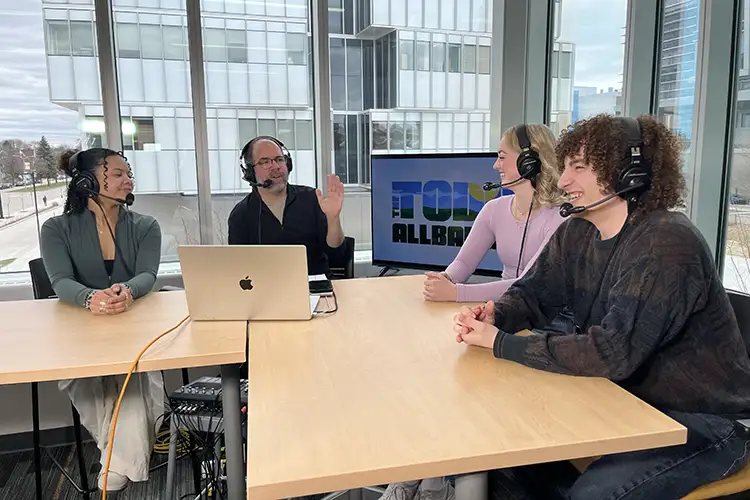
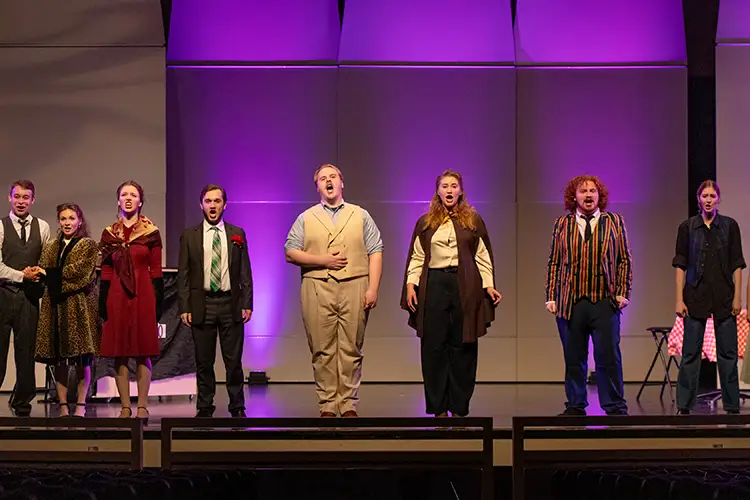
Wisconsin-based radio program The Todd Allbaugh Show featured theatre students Abby McBee, Alyna Williams, and Lucas Drube to talk about the musical theatre program and their experiences with the recent UWM production of “Dames at Sea.”
According to the host, the students’ performances were so impressive, he was inspired to bring the show to Milwaukee. The episode, “What Makes Wisconsin Great: UW-Milwaukee,” was taped on campus.
“I hope that it doesn’t get lost to our viewers and listeners what you all are doing in the arts and musical theater,” Allbaugh said. “In these dividing times, I think you all provide us an experience where we can get off of these things … and we experience something together.”
Three music students share what excites them most about performing in Mozart opera
This weekend, the UWM Music Department will present Mozart’s Le Nozze Di Figaro (edited by Ludwig Finscher)at the Zelazo Center’s Bader Hall. With a wide array of student performers and live accompaniment by UWM’s Symphony Orchestra, there is a lot for audiences to be excited about.
A dream role
Portraying Conte di Almaviva, one of the opera’s defining roles, is second-year master’s student Chris Hinrichs. He describes this as a “dream role” of his.
Hinrichs’ first opera during his undergrad was Le Nozze Di Figaro where he was a member of the chorus. When he saw his friend perform the show’s third act aria as Conte, Hinrichs knew he wanted to play the role himself someday.
“I was like ‘Oh my god, this is beautiful,’” said Hinrichs. “I decided that if I get the chance to do this, I would absolutely love to… It’s been a lot of fun to get to sing this music that I’ve wanted to sing for such a long time.”
Hinrichs describes his role as the primary antagonist, which was challenging for him as an actor. However, his research and education at PSOA helped ensure he was performance-ready.
Chris Hinrichs performs as Conte di Almaviva | Photo by Mark Frohna
“I’ve never sung a principal role with an orchestra before,” said Hinrichs. “Without Dr. Agulay, I don’t think I could do this technically. It’s been vocally demanding, and he’s helped ensure I pace myself and work with a full cast properly.”
To him, performing a dream role early in his career shows how special the PSOA community is.
“It feels really rewarding,” said Hinrichs. “I don’t see the same kind of outreach opportunities I’ve seen here, where we’re working with companies like Florentine Opera… There’s a level of community I see here that is really exciting.”
A modern spin with classic elements
Throughout his preparations, Hinrichs has been working to adapt his period-piece role to a director on a movie set, fitting with PSOA’s twist of setting Le Nozze Di Figaro in 1940s Hollywood.
Fellow master’s student Alexandra Smith, who plays Hinrichs’ on-stage wife, La Contessa, also saw the nature of her role change. In PSOA’s staging, La Contessa is a major Hollywood actress. Throughout this process, Smith researched Norma Desmond and other classic Hollywood actors to mimic their traits and behaviors on stage.
“I was studying a lot of hand gestures and eye movements,” said Smith. “Costumes majorly helped with this. Once you start to look like a character, it can feel much easier to play them.”
Despite the updated timeline, this production still embodies the characteristics that are expected of a classic opera.
Something that stood out to Smith in preparation is the increased power that UWM’s Symphony Orchestr brings to the experience.
“You feel like freaking Pavarotti,” said Smith. “It’s this team effort between you, the strings, and the conductor… It feels huge. It’s so much more professional and earthy when you have strings underneath you.”
Alexandra Smith performs as La Contessa | Photo by Mark Frohna
With this comes the need for increased stamina while performing, which Smith felt she needed to work on throughout the semester. With the help of Aaron Agulay (Assistant Professor and Area Head, Voice & Opera), Smith rose to the occasion.
“Having Dr. Agulay and his pedagogical approaches has helped a lot,” said Smith. “I have lot more stamina in my singing since coming [to the Peck School].”
The importance of opera
Music Education junior Megan Schneider, who plays Cherubino, also found the collaboration with the orchestra to be a standout part of what she considers Mozart’s “defining work.”
“It feels like a bigger deal,” said Schneider. “The change of space, the different director, adding orchestra. Everything all culminating to this opera makes it more grand and exciting.”
Working in the operatic space has become an important part of Schneider’s education.
Schneider did not receive access to operatic works while in high school, participating in her first opera during her first year at PSOA on the advice of Shallece Peters (Lecturer, Voice). Now, Schneider has recognized the importance of the art form, hoping to pass it on to her students as she begins her career in education.
“Since doing this opera and other smaller operas, it’s come to my knowledge how truly vast and great it is,” said Schneider. “It definitely should not be missed when it comes to teaching music.”
Megan Schneider performs as Cherubino | Photo by Mark Frohna
Schneider also hopes to teach her future students the importance of research when preparing for a major performance.
One of Schneider’s major pieces in Le Nozze Di Figaro was one she had learned previously. However, she found it necessary to reexamine the piece with a new perspective to fully develop her character.
“You can’t just look at words on a page and understand exactly who they are,” said Schneider. “You need to be able to not only create the character from what others have done but also with how it’s written and how you personally connect with your character.”
Le Nozze Di Figaro is at the Zelazo Center for two performances on April 4 & 5. For tickets and more info, visit the PSOA Events Calendar.