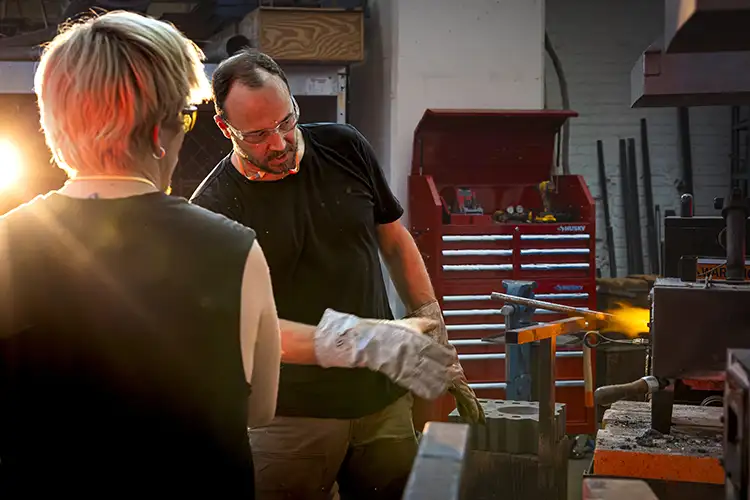
For Adam Hawk, contemporary blacksmithing is not a departure from tradition but a continuation of it. Moving back and forth between digital and analog, he strikes a balance where craft is expanded through new tools, sustained by material knowledge, and grounded in process.
“I might start with a hand sketch, develop that into a digital model, and use processes like CNC machining, 3D printing, or CNC plasma cutting to create a starting form, then bring it back to the forge where the work is ultimately shaped and resolved through hand processes,” he explained.
Rather than seeing digital tools as competing with craft, he describes them as “an ongoing conversation or collaboration that allows contemporary tools to expand the discipline while still staying grounded in its core values.”
That perspective developed over time.
“Early on I struggled with whether certain technologies even belonged in a craft practice,” he said. “There was a moment when using digital tools honestly felt like cheating or stepping outside of tradition.”
Working through that tension, he came to see that the tools themselves are neutral, and it’s the intention behind their use that really matters. Forging remains central to that intention.
“Forging teaches patience, humility, and resilience,” he said. “Progress rarely happens in big jumps; it comes from repetition, failures, and thoughtful reflection.”
He describes the act of heating and reshaping iron as “deeply human,” a process that mirrors the gradual nature of growth in both craft and learning.
Building a Contemporary Craft Initiative
That commitment to sustaining and advancing craft found an institutional partner in the Windgate Foundation, which has awarded three grants to UWM’s Peck School of the Arts in support of the Contemporary Craft Initiative since 2019.
“Throughout my career I’ve seen the Windgate Foundation support contemporary craft through education, fellowships, and long-term investment in artists and institutions,” Hawk said. “Their focus on advancing craft practice while strengthening visual arts education has always felt closely aligned with what I have always wanted to build—spaces where blacksmithing could grow within a contemporary art and design context without losing its connection to material practice.”
When Hawk first arrived at UWM, his forging setup was limited.
“I had scaled down my personal studio to make the move to Wisconsin, and my new studio space didn’t allow for the same types of blacksmithing tools or processes that I had previously worked with,” he recalled.
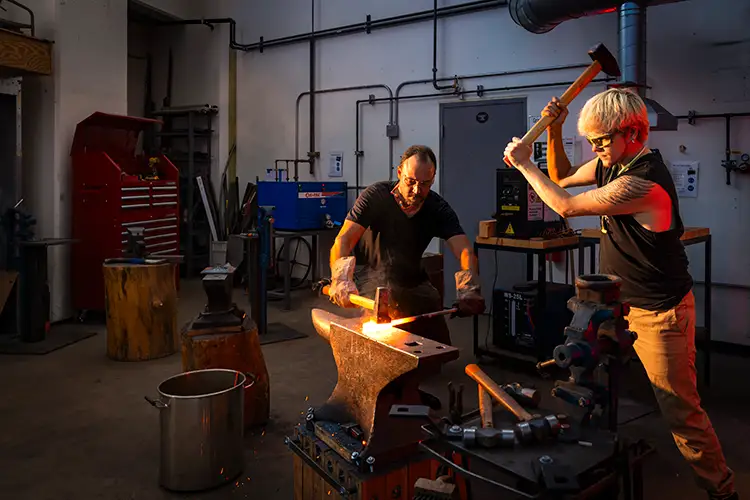
“Windgate’s support allowed us to build a fully functioning blacksmithing research and teaching facility, and that changed what was possible almost immediately for both my own practice and for students.”
Each phase of funding built on the last, beginning with infrastructure upgrades, expanding into graduate research support, and now supporting program growth and a graduate fellowship.
“For the program, it transformed a very modest forging setup into a space where contemporary blacksmithing could really take root.”
Expanding access and interdisciplinary community
The expanded facilities have introduced forging to students across Sculpture, Jewelry & Metalsmithing, and Digital Fabrication studio disciplines.
Students now share access to processes that encourage “a different relationship to material—one that is grounded in physical transformation and problem solving.”
Soon, a new blacksmithing certificate and expanded coursework will allow students to approach blacksmithing both as a focused craft discipline and as a place for interdisciplinary experimentation.
The most recent grant supports a graduate fellowship and continued program development. Graduate-level research, Hawk says, creates the time and space needed for deeper experimentation, which is essential for pushing contemporary blacksmithing forward.
The graduate fellow works closely with him in the blacksmithing area while pursuing their own creative research.
“I try to approach the fellowship as a collaboration in which we identify areas that align with the graduate fellow’s interests and building projects that support both the studio and their artistic investigation,” he explained.
“The goal is for their contributions to directly feed into their practice while strengthening the broader community.”
Sustaining the field
Working within a research university, Hawk sees a responsibility to contribute beyond campus.
“Working within a research university gives me the opportunity to explore ideas that many practicing smiths don’t always have the time or resources to pursue, and I’m very aware of that privilege,” he said. “It allows me to experiment, take risks, and develop approaches that I can then share through teaching, demonstrations, and public engagement.”
For Hawk, sustainability is ultimately about people and environments.
“Strong facilities, thoughtful curriculum, and collaborative networks help artists develop and grow over time,” he said.
“By integrating emerging tools with traditional forging practices and sharing those experiences outward, I hope to contribute to a broader ecosystem where contemporary blacksmithing continues to evolve while staying grounded in the values that define the craft.”
Story by Oliver J. Johnson