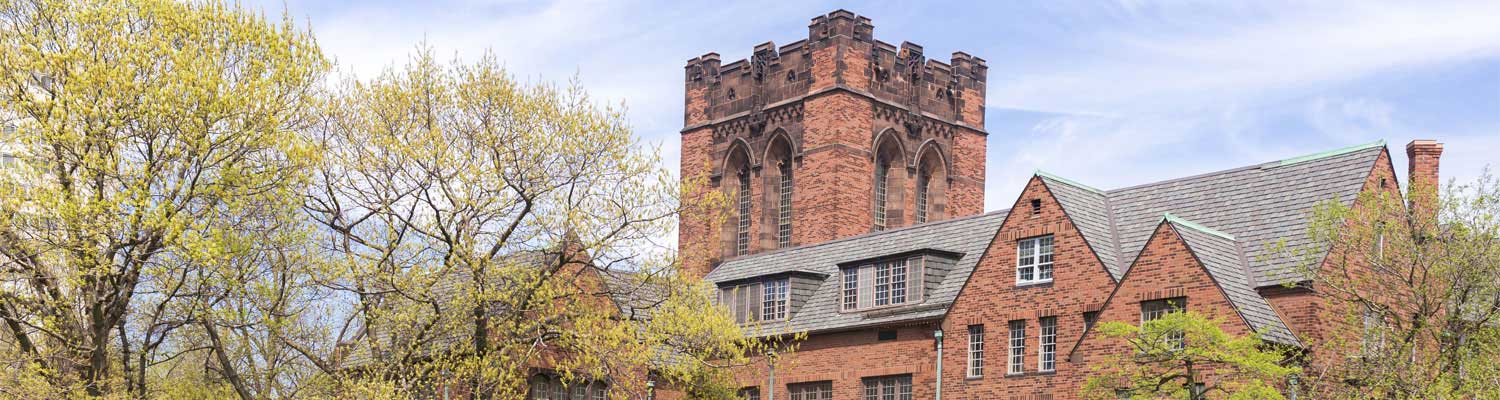
Social Welfare PhD
The PhD in Social Welfare prepares students for work as faculty members, researchers and leaders in social work or criminal justice. Faculty expertise and course curriculum reflect a number of substantive areas within social welfare.
Program Type
Doctoral
Program Format
On Campus
UWM’s Social Welfare PhD
The goals and objectives of the PhD program reflect the school’s concern with urban social problems, social and economic equity and well-being, cultural diversity, and the empowerment of individuals, families, organizations and communities to effect change.
PhD Areas of Faculty Focus
- Applied Gerontology
- Child and Family Welfare
- Criminal Justice & Criminology
- Health and Behavioral Health
- Mental Health
- Resilience and Well-Being Across the Lifespan
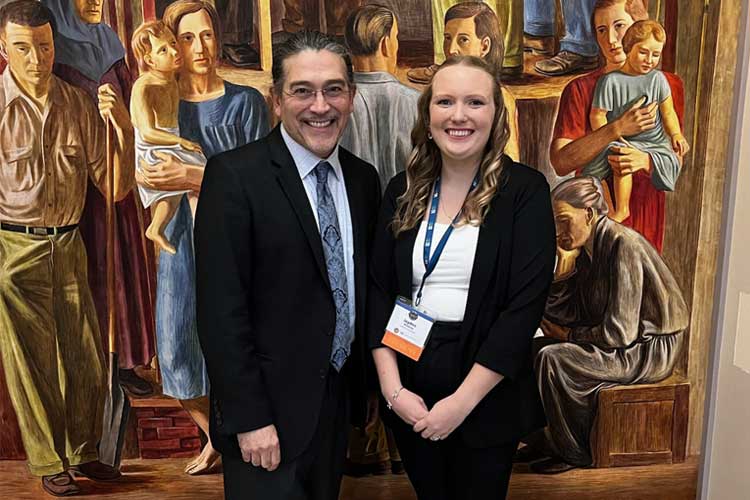
The Helen Bader School of Social Welfare includes the Social Work Department and Department of Criminal Justice and Criminology. Our PhD program includes faculty from both departments and serves students interested in either social work or criminal justice.
We also offer Joint MSW/PhD and Joint MSCJC/PhD options through which students can earn the Master of Social Work or Master of Science in Criminal Justice and Criminology as well as the PhD in Social Welfare.
Funding
- Three-year research and teaching assistantships available through a competitive application process.
- Nine-month contract, September-May, approximately 20 hours per week.
- Tuition remission, stipend and health insurance eligibility.
- We prioritize assistantships for PhD students over those in the joint programs who are still completing MSW or Master of Science in Criminal Justice and Criminology coursework.
Study at a Top-Tier Research University
The University of Wisconsin-Milwaukee is ranked as a “highest research activity” campus by the Carnegie Classification of Institutions of Higher Education. This ranking, often referred to as R1, was earned by only 187 out of nearly 4,000 U.S. colleges and universities nationwide in 2024.
Extramural funding at the school is close to $15 million annually; the school brings in the most research dollars among professional schools at UW-Milwaukee. Learn more about current research.
Build Relationships With Faculty
Our program is small and close-knit, and we strive to maximize opportunities for students to build learning relationships with faculty. Students benefit from accessible faculty and are vital contributors to faculty research.
Follow in Our Graduates’ Footsteps
Our graduates have launched diverse and successful careers as faculty, post-doctoral scholars, research scientists and program directors.
Curriculum Highlights
- Interdisciplinary coursework in social work, criminal justice, theory, and research methods/analysis (42 credits).
- Advanced research training with faculty mentors.
- Opportunities for community-based research and partnerships.
- Teaching preparation for academic careers.
- Average time for PhD degree completion is four to five years.
- Most PhD courses are in person, and vary across days and times.
- Most courses for the MSW and Master of Science in Criminal Justice and Criminology are online. As such, these programs do not meet F1 Visa requirements for international students.
Curriculum Overview
Program of Study
In consultation with the major professor and as soon as possible after admission, each student designs a program of study to gain the knowledge and skills appropriate to their educational goals.
- Students with master’s degrees in fields related to criminal justice and criminology or social work at the time of admission may be required to take up to 12 credits of master’s level coursework in order to ensure their familiarity with core concepts and perspectives in the social welfare knowledge base.
- The course(s) required will be determined on a case-by-case basis by the doctoral program committee in consultation with the student and their advisor.
- A minimum degree of 42 graduate credits beyond the master’s degree are required, at least 36 of which must be earned in residence at UWM.
Classroom Curriculum
*Listed as an example. Students may choose methods classes from other disciplines
| Course Number | Course Name | Credits |
|---|---|---|
| Methods and Statistics | ||
| SOCIO/URB STD 982* | Quantitative Research Methods | 3 |
| NURS 882* | Qualitative Research Methods | 3 |
| ED PSY 724 | Educational Statistical Methods II | 4 |
| ED PSY 824/825 | Multivariate Methods | 3 |
| SOC WRK 950 | Systematic Review and Meta Analysis | 3 |
| Proseminars | ||
|---|---|---|
| SOC WRK 991 | Grant Writing and Research Ethics | 3 |
| SOC WRK 999 | Teaching in Higher Education | 2 |
| SOC WRK 991 | Orientation to Doctoral Studies | 1 |
| Theory | ||
|---|---|---|
| SOC WRK 901 | Philosophy of Science | 3 |
| SOC WRK 932 | Theories and Research on Behavior Change | 3 |
| Seminars (choose one) | ||
|---|---|---|
| SOC WRK 791 | Children and Families Seminar / Policy and Systems Change | 3 |
| SOC WRK 791 | Criminal Justice Practice and Policy | 3 |
| Electives | ||
|---|---|---|
| Choose four elective courses; one must be a methods/stats course. | 12 | |
| Total Credits | 42 |
We accept students in the spring of each year for admission in the following fall semester. Between three and five students are typically accepted in each cohort. The deadline to apply is January 2. Apply through the UW-Milwaukee Graduate School.
What do I need to apply?
- All official college transcripts.
- A reason/narrative statement that includes:
- Your reasons for pursuing a doctoral degree.
- Your goals as a future scholar.
- The reason you believe our program will be a good fit with your interests.
- A topic or issue in the field you consider to be particularly challenging and worthy of study. You may also provide other information you consider relevant regarding your commitment to criminal justice or social work in the academic arena.
- A writing sample that showcases your analytic abilities and theoretical understanding.
- Published works reporting research results are best, but please indicate your precise role in the project if you submit a co-authored publication.
- Also acceptable is a sole-authored student paper, if written within the past five years.
- The following materials are not acceptable evidence of your scholarship: bibliographies (even if annotated), group projects; book reviews, teaching/content outline for classes, and abstracts without full text.
- Three letters of recommendation.
- They should be persons who are familiar with your achievements and academic potential, including at least one current or former employment supervisor and a current or former instructor (a graduate instructor if applicable).
- If applicable, documentation of English proficiency as defined by the Center for International Education.
PhD in Social Welfare
- The expected time to complete the degree requirements is four to five years.
- International students must complete all additional requirements for international applicants. Refer to the Center for International Education website or contact them directly at isss@uwm.edu or 414-229-4846.
Enrollment Status for the PhD in Social Welfare
- Students may apply for either full- or part-time study.
Criminal Justice & Criminology Specialization
Applicants for the criminal justice and criminology specialization of the PhD program must hold a master’s degree or equivalent in criminal justice, criminology, or otherwise titled degree in the criminal justice field.
Social Work Specialization
Applicants for the social work specialization of the PhD program must hold a master’s degree or equivalent in social work (preferred), a related field, or be assigned MSW-level coursework to fulfill any deficiency requirements. We require a copy of transcripts that demonstrate fulfillment of MSW degree, equivalent requirements, or that satisfy social work training deficiencies.
Joint Programs
Applicants for the joint Master of Social Work and PhD (MSW/PhD) or joint Master of Science in Criminal Justice and Criminology (MSCJC/PhD) program must have a bachelor’s degree in any field and meet admission requirements of the UWM Graduate School.
Enrollment Status for Joint Programs
- The joint programs are full-time only. The joint programs do not offer an option for part-time study.
What is the time to completion for the joint MSW/PhD program?
- The expected time to completion of degree requirements for the MSW and PhD program is approximately four and a half years.
- MSW portion: Approximately two and a half years.
- PhD portion: Approximately one and a half to two years.
- Students who hold a BSW degree earned within the past five years at a CSWE-accredited program may be able to shorten the time to completion of the MSW degree by up to one year.
What is the time to completion for the joint MSCJC/PhD program?
- The expected time to completion of degree requirements for the Master of Science and PhD program is approximately five to six years.
- Master of Science portion: Approximately three years.
- PhD portion: Approximately two to three years.
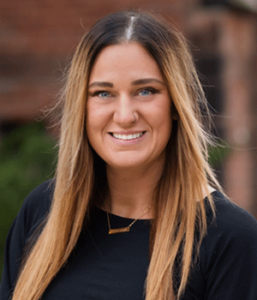
- Associate Professor, Criminal Justice & Criminology
- PhD Program Director
- rkonkel@uwm.edu
- 414-229-6874
- Enderis Hall 1115
Field Programs
Rebecca Headley Konkel, PhD
Associate Professor & PhD Program Director
rkonkel@uwm.edu