Neuroscience is an interdisciplinary field devoted to the study of the nervous system. Research in this area can be broken down into many sub-categories including behavioral neuroscience, cognitive neuroscience, computational neuroscience, systems neuroscience, developmental neuroscience, etc. Many of these categories involve overlapping interests and use common resources and tools. In our department, we have explicitly chosen to avoid such labels so as to encourage a breadth of graduate level training focused on the field of psychology, the science of behavior. Thus, the faculty who are part of our neuroscience doctoral program all measure or manipulate the functions of the nervous system to study the neural basis of behavior.
Training Goals
The goal of our neuroscience doctoral program within psychology is to produce scholar-scientists of the highest caliber who value both the creation and dissemination of knowledge. To this end, we employ an apprenticeship model in which graduate students are admitted to work in the lab of their chosen major professor. (You are asked to rank your top three advisor matches in our application.) Major professors may be any faculty member listed as a core or affiliate member of the Neuroscience faculty. The major professor is responsible for the research training that will help you become an independent research scientist, coupled with a set of highly-specialized graduate level courses relevant to your lab work.
Students are part of the greater Milwaukee Area Neuroscience group, which includes faculty members and students from various departments at UWM, the Medical College of Wisconsin, Milwaukee School of Engineering, and Marquette University. Students learn a wide range of techniques working with laboratory animals and human subjects. These include experimental design, behavioral testing and analysis, neurophysiology, aseptic surgical techniques, quantitative protein and mRNA assays, immunohistochemistry, eyetracking, and functional magnetic resonance imaging (fMRI).
Specialized courses may be from either inside psychology or outside, and many of our students take courses from the partner institutions mentioned above. In addition, as part of their curricular requirements, all of our students are required to take a set of four core neuroscience graduate courses that provide a common central breadth of knowledge, augmented by a series of professional development seminars and scientific journal clubs. When coursework is complete and after the thesis-based masters degree has been earned, students demonstrate their comprehensive neuroscience training in the form of a preliminary examination which, once passed, moves the student to dissertator status during which time they form their dissertation committee and ultimately propose and defend a dissertation.
Specific Areas of Faculty Research
A small sampling of current research topics of our Neuroscience faculty include:
- cellular and molecular mechanisms of learning and memory;
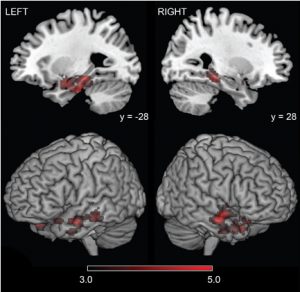
- measuring the neural mechanisms involved in memory and emotion in humans and rodents using fMRI;
- using neuroimaging to elucidate the role of attention in “chemobrain”;
- effects of exercise on cerebral blood flow;
- mechanisms of recovery from brain damage;
- effects of aging on learning and memory;
- network dynamics of visual and auditory perception.

Neuroscience faculty conduct research using a wide range of techniques working with laboratory animals and human subjects. These include, but are not limited to:
- psychophysical testing and analysis,
- neurophysiology,
- functional magnetic resonance imaging (fMRI),
- optogenetic and chemogenetic manipulation,
- magnetoencephalography (MEG),
- quantitative protein and mRNA assays,
- computational modeling,
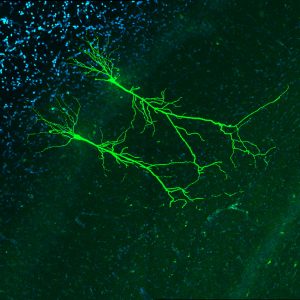
- immunohistochemistry,
- diffusion-weighted imaging (DTI/DSI),
- eye-tracking,
- electroencephalography (EEG), and
- transcranial magnetic stimulation (TMS).
Our partnerships with local institutions provide access to an extensive array of resources (both physical/technological and human) where many of our faculty hold adjunct appointments.
Funding
Funding
See our financial support page for more information.
Master’s Thesis
Under the direction of his or her major professor, students must develop an acceptable thesis based on empirical research. Candidates must pass an oral examination in defense of their thesis.
Note: Students who, upon admission, already have a master’s degree in psychology or neuroscience that included an empirically based master’s thesis are exempt from the requirement of having to earn the MS at UWM. Students admitted with a master’s degree in psychology or neuroscience that did not include a thesis must complete a thesis and earn the MS at UWM.
Preliminary Exam
To advance to doctoral candidacy, students must pass a preliminary examination in neuroscience after they earn the MS and within five years of enrolling.
Dissertation for PhD
Candidates must write an empirically-based dissertation that demonstrates the ability to formulate a research topic and pursue an independent and original investigation. Candidates must pass an oral examination in defense of the dissertation.
Time Limits
Doctoral students must earn the MS within three years of enrolling (by March 10 of their third year for most favorable consideration within the teaching assistant priority system), and they must earn the PhD within seven years of enrolling.
Neuroscience Student Activities
The Neuroscience Brownbag meets Mondays at noon in Garland 204. Contact georgiop@uwm.edu
The Neuroimaging Journal Club meets every two weeks on Wednesdays at noon in Garland 204 and on Teams. Contact bowman2@uwm.edu
Admissions
See our application page for more information, deadlines, and a link to the application.
For more information about the program’s requirements, visit the academic page for the PhD in psychology for the at the link below.
-
 Psychology, PhDDoctoralOn Campus