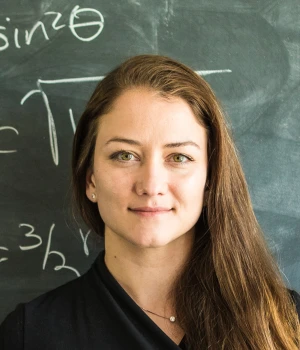
Lia Medeiros
- Assistant Professor, Physics
Research Interests
Medeiros is a computational high-energy astrophysicist interested in compact objects. She sees space as the ultimate laboratory where theories can be tested in the most extreme environments imaginable, and compact objects are one of the best examples of this. Her work includes running and analyzing general relativistic magnetohydrodynamic simulations of accreting supermassive black holes, simulating the observational appearance of these black holes with radiative ray-tracing simulations, and comparing these simulations to astronomical data to constrain accretion physics, black hole parameters, and potential deviations away from the predictions of general relativity. She is a member of the Event Horizon Telescope Collaboration (EHTC) and much of her work has focused on preparing for these observations, as well as analyzing and interpreting the data. She co-coordinated the Gravitational Physics Inputs Working Group within the EHT and co-coordinated that working group's most ambitious project, the sixth paper in the Sgr A* series, which presents new strong-field gravitational tests. Medeiros has also developed a new machine-learning based algorithm for EHTC data analysis that uses high-resolution, high-fidelity simulations as a training set for interferometric imaging. Medeiros used the PRIMO algorithm to reanalyze EHT data and achieved considerable improvement in effective image resolution.
Biographical Sketch
Dr. Medeiros has been an Assistant Professor at UWM since Jan 2025. Before arriving at UWM she was a NASA Hubble Fellowship Program, Einstein Fellow at Princeton University, was a member of the Institute for Advanced Study (IAS) from 2019 to 2023 and was a National Science Foundation (NSF) Astronomy and Astrophysics Postdoctoral Fellow from 2019 to 2022. She completed her undergraduate education at the University of California-Berkeley in Physics and Astrophysics, class of 2013. She then received her Masters and PhD (2019) in Physics from the University of California-Santa Barbara. After completing her classes in Santa Barbara, she took advantage of the flexibility allowed by an NSF Graduate Research Fellowship and spent three years at the Steward Observatory at The University of Arizona and one year at the Black Hole Initiative at Harvard. Her PhD thesis was completed in collaboration with University of Arizona Professors Feryal Özel and Dimitrios Psaltis.