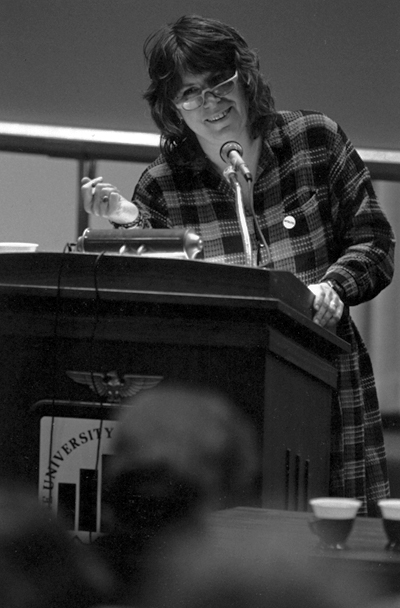
Television: Representation, Audience, Industry
April 13-15 1988
with Michèle Mattelart, John Caughie, Patrice Petro, Margaret Morse, Stephen Heath, Lidia Curti, Mary Ann Doane, Patricia Mellencamp, Jane Feuer, John Hartley, James Collins, Lynn Spigel, Andrew Tolson, Andrew Ross, Mimi White, Pamela Falkenberg, James Schwoch, Simon Frith, William Boddy, Douglas Gomery, Judith Barry, Ondina Fachel Leal, Robert Deming, John Fiske, and H.U. Gumbrecht
[metaslider id=”5438″]
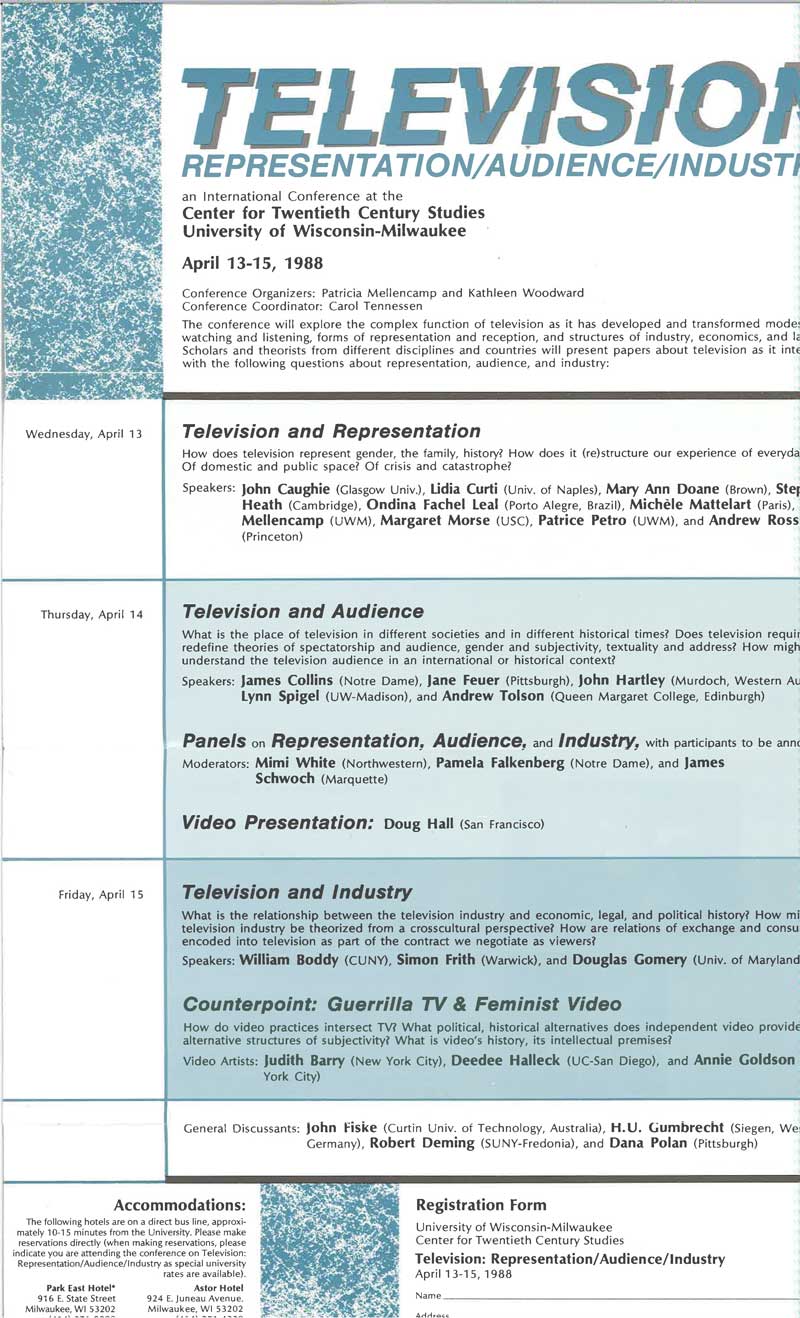
Wednesday, April 13
Representation
9:00-11:00AM Kathleen Woodward, Introduction
Patricia Mellencamp, “Measures of TV Time: Scandal, Catastrophe, Age”
Patrice Petro, “Courting the Law: Television and the Trial”
Stephen Heath, “Representing Television”
1:30-2:30PM John Caughie, “Playing at Being American”
Andrew Ross, “Made Max: Three Lives in the Day of”
2:30-3:30PM Discussion
Moderator: Dana Polan
4:00-5:00PM Mary Ann Doane, “Information, Crisis, Catastrophe”
Lidia Curti, “Fe/male Narratives”
7:30PM Michèle Mattelart, “Audiences et représentation: Notes pour une polémique”
Margaret Morse, “Chronotopes of Television: The Magazine, The Freeway”
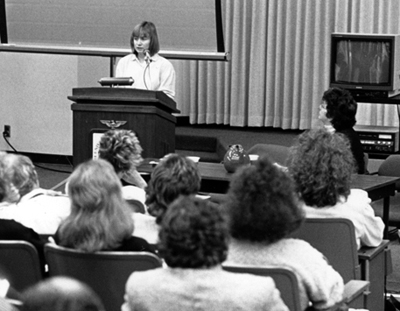
Thursday, April 14
Audience
9:00-10:00AM Jane Feuer, “People Meters and Positioned Subjects: The Construction of Audiences”
Ondina Fachel Leal, “Popular Taste and Erudite Repetoire: The Plae and Space of Television”
10:30-12:00 James Collins, “Watching Ourselves Watch Television”
Andrew Tolson, “On Public Record: Television, Representation, and the Interview”
Lynn Spigel, “Television in the Family Circle, 1948-55”
2:00-3:00PM Issues to be Addressed in Panels: Mimi White, Pamela Falkenberg, James Schwoch
3:00-6:00PM Panels
Panel on Representation:
Richard Campbell, “Centering the Audience: Narrative Maps in 60 Minutes”
Lynne Joyrich, “Television/Gender/Postmodernism: Contradictions in Max Headroom and Pee-Wee’s Playhouse”
Hilary Radner, “‘I’m worth it.’: The Shrew and the Cover Girl: Moonlighting and Feminine Enuncation”
Carole-Anne Tyler, “Representing Femininity: Transvestism, Transsexualism, and the Renee Richards Story”
Panel on Audience
Connie Balides, “Television and Memory”
Charlotte Brundson, “Gender, Genre, and Audience”
Laura Goostree, “The Space of Wild Intertextuality: Toward an Audience-based Television Aesthetic”
Glenn Hendler, “‘None of What You Are Seeing is Actually Happening’: Simulated Responses to Nuclear Catastrophe in Two TV Movies”
Panel on Industry
Ana Lopez, “Beyond the Postmodernist Problematic: TV in Cuba”
Brian Nienhaus, “Beyond Medium and Text: Commodity Relations”
Thomas Streeter, “Commercial Television and the State: Broadcast Policy and the Contradictions of Liberal Political Discourse”
William Uricchio, “The Transmissions in Search of an Audience: The Contradictions of Early German Television”
8:00PM Counterpoint: The Politics of Art
Doug Hall, Chip Lord
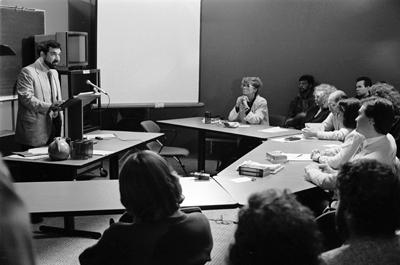
Friday, April 15
9:30-11:00AM William Boddy, “The Seven Dwarves and the Money Grubbers: The Public Relations Crises of American Television in the Late 1950s”
Douglas Gomery, “Hollywood and Television”
1:30PM Counterpoint: The Art of Politics
Judith Barry, DeeDee Halleck, Annie Goldson
Discussants: Robert C. Allen, Jane Gaines, John Fiske, H.U. Gumbrecht, Robert Deming, Eileen Meehan, Brian Winston