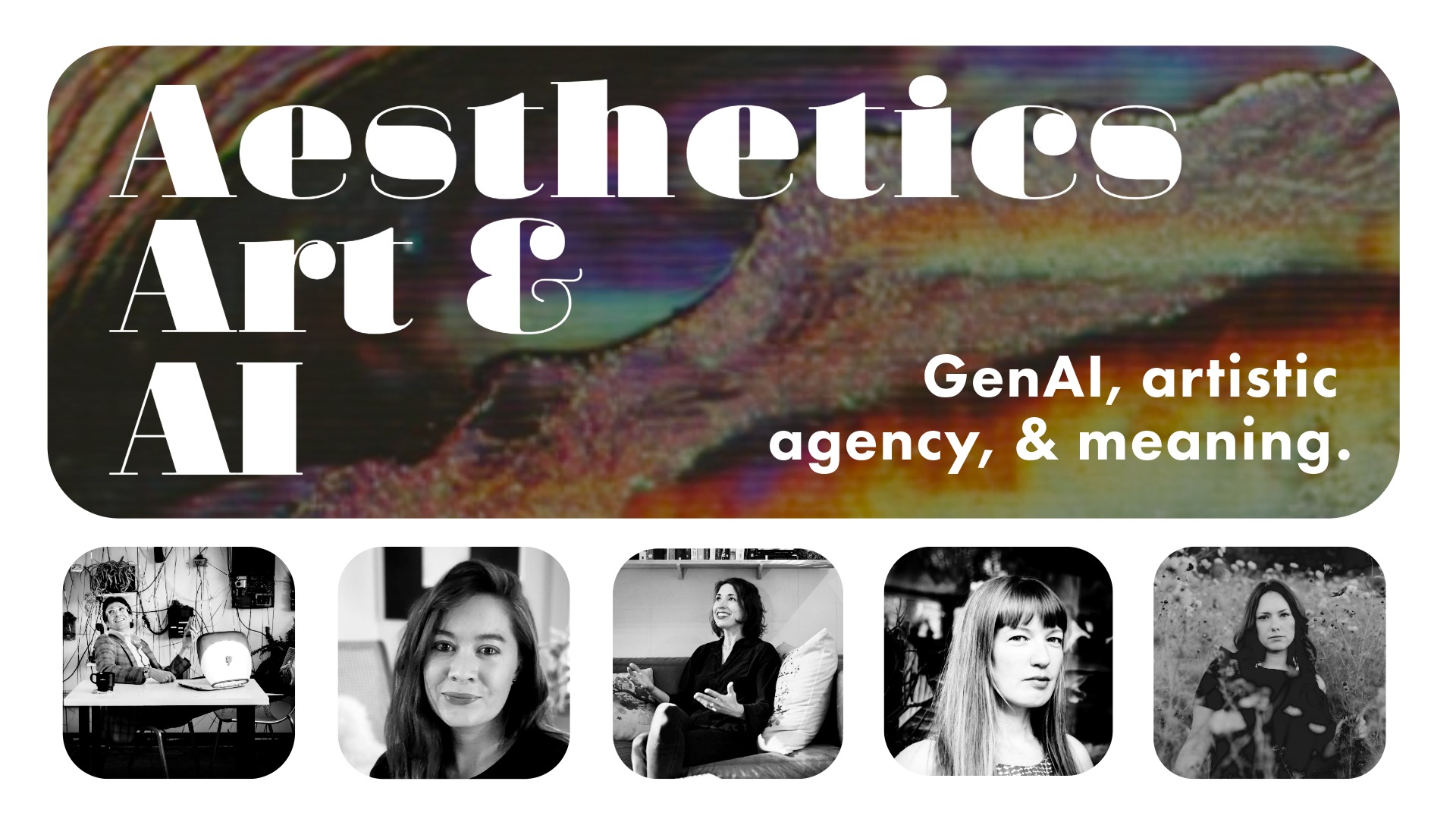
Aesthetics, Art, & AI was a programming series that focused on the relationship between AI and artistic practice, exploring how AI-generated aesthetics reshape creative production, authorship, and interpretation. By engaging scholars, artists, and technologists, we examined the ethical and aesthetic implications of computational creativity, raising fundamental questions about artistic agency, originality, and the boundaries between human and machine-generated cultural production.
Project Overview
Artificial intelligence, and machine learning more generally, is faster than us humans. While we continuously feed it large quantities of data accumulated over long periods of time, AI sorts, filters, recombines, and refeeds it back to us in a performative and hyper-present loop. But how does AI conceptualize time and history – or does it at all? And how do human practices of artmaking visualize and embody the durational contexts that AI bypasses in its functional efficiency? While these questions have started to receive critical attention from disciplines such as law and philosophy, the technical and policy nature of these engagements make little room for matters of authorship, creativity, art, and aesthetics.
This oversight is unfortunate because aesthetic considerations are not ancillary but central to the chronopolitical implications of AI. Caught in timestamps of data that are discrete and fragmented, AIs are seemingly devoid of a past, present, and future continuum that is embedded in embodied memory and experience. In contrast with the iterative performativity that maintains AI’s feedback loop of input and output as well as its optimized predictions based on large domains of data, these lived perspectives afford the histories of human experience of and in time.
Programming
| FEBRUARY 12, 2026 | |
|---|---|
| Generation to Generation: Conversing with Kindred Technologies Opening | Reception for Generation to Generation: Conversing with Kindred Technologies, on view at Kenilworth Square East Gallery (UW-Milwaukee) from February 12 to 20, 2026. |
| Language as Collaborator: Co-Creating with Thinking Machines | Workshop with Generation to Generation: Conversing with Kindred Technologies artists Nathaniel Stern and Sasha Styles that explored language as a vital creative material and as a medium for collaborative authorship. |
| Generations and Generativity: Post-AI Aesthetics in Practice | Panel discussion with Nathaniel Stern, Sasha Stiles, and The Brooklyn Rail editor-at-large Charlotte Kent about the boundaries between human and machine-generated cultural production. |
| FEBRUARY 26, 2026 | |
|---|---|
| Model Collapse: Art, AI, and the Seductions of Hallucinations | Lecture by Dr. Kris Paulsen at Center for the Humanities, UW-Madison | It has become commonplace to describe machine learning and generative AI systems as prone to “hallucination.” That is, they confabulate statements or documents that appear convincing or “truth apt,” while in fact, they are merely statistically probable. While developers typically frame hallucination in Large Language Models (LLMs) as a bug to be fixed or a problem to be mitigated, image generation tools are designed to “make things up.” The very same processes that produce accurate information with generative tools also conjure the “hallucinations.” This talk explores the ways in which artists working with various forms of generative AI seek out hallucination for a range of effects—critical, manipulative, or revelatory—and how these affect our relationships to and trust in the archive. |
| MARCH 12, 2026 | |
|---|---|
| Kite – Artist Talk | Artist talk with Kite, an Oglála Lakȟóta artist, composer, and scholar whose scholarship and practice investigate contemporary Lakota ontologies through research-creation, computational media, and performance (UW-Milwaukee). |
Programs were co-hosted by C21 and UW-Madison’s Center for the Humanities as part of a collaborative research initiative on Aesthetics, Art, and AI with support from the Consortium for Humanities Centers and Institutes (CHCI).