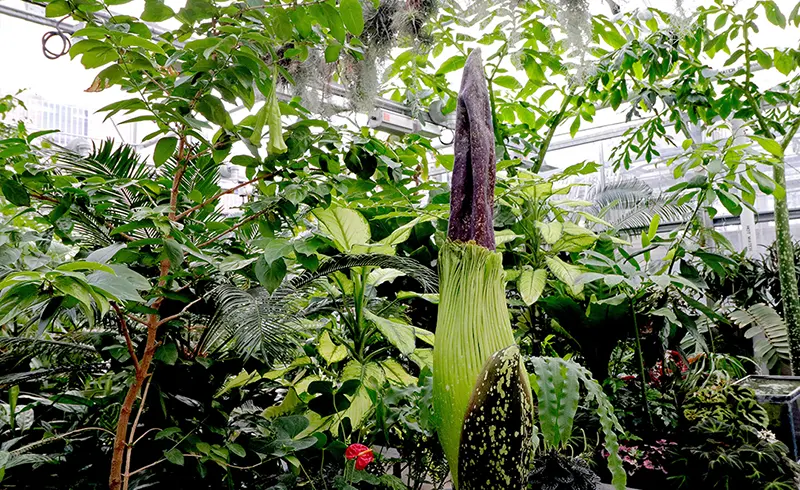
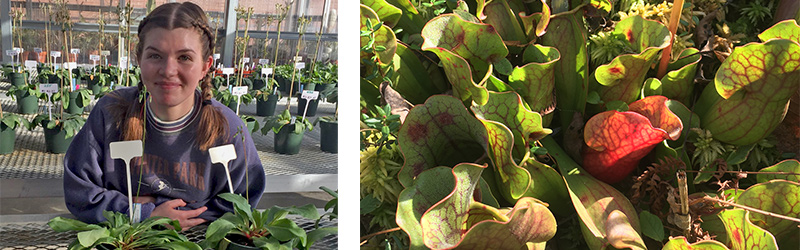
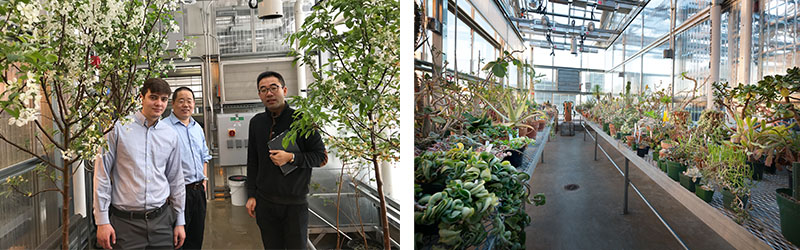
The greenhouse is a 9,625 square foot hidden gem located on the roof of the NWQ Building Complex. The state-of-the-art facility maximizes research capability and provides an open, flexible environment for botanical instruction, supporting both undergraduate and graduate education and cutting-edge NSF funded research.
The facility is divided into 3 wings, with 18 separate rooms and includes an expanded head house utilized as both a potting area and a classroom, modern wet lab space, a vibration lab, 4 instructional houses, 1 propagation house, 6 research houses, a cold room, an office and student lounge, and greenhouse support spaces, with an additional 1,200 square feet of outdoor planting beds available for research and instruction.
The diverse instructional plant collection comprises approximately 672 species representing over 100 plant families, showcasing a range of plant biodiversity, evolution and adaptation, with specimens representing lower vascular plant lineages, to cycads, to a strong representation of flowering plants. The greenhouse maintains a collection of native plants which is supplemented by 270 tree and shrub species planted throughout the campus. An 11-acre conservancy area on campus is also available for study. Lapham Hall houses 17 plant growth, insect, environmental or cold chambers for research and instructional use.
For questions or to visit, please contact Greenhouse Manager Paul Engevold at 414-229-4248, or via email (preferred) at engevold@uwm.edu.
The Biological Sciences Greenhouse facility houses both long-term research, supporting the work of faculty members, and short-term projects for undergraduate and graduate student research.
Sergi CM & Rodríguez RL. 2025. A test for basic animal consciousness through distraction by inward-directed attention, and a case study with black widow spiders. Behaviour 162(3-4), 259-276.
Augusto-Alves, G., Feagles, O. S., Toledo, L. F., & Höbel, G. (2025). Visual cues do not function in a multimodal signalling context for mate attraction in eastern gray treefrogs. Biological Journal of the Linnean Society, 144(4), blae060.
Rodríguez RL, Wood TK, Stearns FW, Snyder RL, Tilmon KJ, Cast M, Hunt RE & Cocroft RB. 2025. The means of signal divergence early in a host shift. The American Naturalist 206(2), 130-149.
Flynn, K.J., Atkinson, A., Beardall, J., Berges, J.A., Boersma, M., Brunet, C., Calbet, A., Caron, D.A., Dam, H.G., Glibert, P.M., Hansen, P.J., Jin, P., Lønborg, C., Mayor, D.J., Menden-Deuer, S., Mock, T., Mulholland, M.R., Needham, D.M., Polimene, L., Poulton, A.J., Robinson, C., Rokitta, S.D., Rost, B., Saiz, E., Scanlan, D.J., Schmidt, K., Sherr, E., Stoecker, D.K., Svensen, C., Thiele, S., Thingstad, T.F., Våge, S., 2025.
More realistic plankton simulation models will improve projections of ocean ecosystem responses to global change. Nature Ecology & Evolution 9: 1562–1570. doi.org/10.1038/s41559-025-02788-3
Wachala, S.N., Janssen, J., Young, E.B., Berges, J.A., 2025.
Seasonal population characteristics and gut contents of the invasive mysid, Hemimysis anomala, in Milwaukee Harbor, Lake Michigan. Journal of Great Lakes Research 51: 102462. doi.org/10.1016/j.jglr.2024.102462.
Trevathan-Tackett, S.M., Kepfer-Rojas, S., Malerba, M., Macreadie, P.I., Djukic, I., Zhao, J., Young, E.B., York, P.H., Yeh, S.-C., Xiong, Y., Winters, G., Whitlock, D., Weaver, C.A., Watson, A., Visby, I., Tylkowski, J., Trethowan, A., Tiegs, S., Taylor, B., Szpikowski, J., Szpikowska, G., Strickland, V.L., Stivrins, N., Sousa, A.I., Sinutok, S., Scheffel, W.A., Santos, R., Sanderman, J., Sánchez-Carrillo, S., Sanchez-Cabeza, J.-A., Rymer, K.G., Ruiz-Fernandez, A.C., Robroek, B.J.M., Roberts, T., Ricart, A.M., Reynolds, L.K., Rachlewicz, G., Prathep, A., Pinsonneault, A.J., Pendall, E., Payne, R., Ozola, I., Onufrock, C., Ola, A., Oberbauer, S.F., Numbere, A.O., Novak, A.B., Norkko, J., Norkko, A., Mozdzer, T.J., Morgan, P., Montemayor, D.I., Martin, C.W., Malone, S.L., Major, M., Majewski, M., Lundquist, C.J., Lovelock, C.E., Liu, S., Lin, H.-J., Lillebo, A., Li, J., Kominoski, J.S., Khuroo, A.A., Kelleway, J.J., Jinks, K.I., Jerónimo, D., Janousek, C., Jackson, E.L., Iribarne, O., Hanley, T., Hamid, M., Gupta, A., Guariento, R.D., Grudzinska, I., da Rocha Gripp, A., González Sagrario, M.A., Garrison, L.M., Gagnon, K., Gacia, E., Fusi, M., Farrington, L., Farmer, J., de Assis Esteves, F., Escapa, M., Domańska, M., Dias, A.T.C., de los Santos, C.B., Daffonchio, D., Czyryca, P.M., Connolly, R.M., Cobb, A., Chudzińska, M., Christiaen, B., Chifflard, P., Castelar, S., Carneiro, L.S., Cardoso-Mohedano, J.G., Camden, M., Caliman, A., Bulmer, R.H., Bowen, J., Boström, C., Bernal, S., Berges, J.A., Benavides, J.C., Barry, S.C., Alatalo, J.M., Al-Haj, A.N., Adame, M.F., 2024.
Climate Effects on Belowground Tea Litter Decomposition Depend on Ecosystem and Organic Matter Types in Global Wetlands. Environmental Science & Technology 58, 21589-21603. doi.org/10.1021/acs.est.4c02116.
Feagles, O. S., & Höbel, G. (2024). Personality affects female mate choice: frogs displaying more consistent bold behaviors are choosier. Behavioral Ecology, 35(1), arad101.
Stratman, K., & Höbel, G. (2024). Within-population variation in preference functions reveals substantial among-female disagreement in mate assessment. Journal of Evolutionary Biology, 37(11), 1278-1287.
Townley RA, Stacy KS, Cheraghi F,
de la Cova CC. The Raf/LIN-45 C-terminal distal tail segment negatively regulates signaling in Caenorhabditis elegans. Genetics. 2024. 228(3):iyae152.
DOI: 10.1093/genetics/iyae152Rodriguez Torres CS, Wicker NB, Puccini de Castro V, Stefinko M, Bennett DC, Bernhardt B, Garcia Montes de Oca M, Jallow S, Flitcroft K, Palalay JS, Payán Parra OA, Stern YE, Koelle M, Voisine Cindy, Woods IG, Lo T, Stern MJ,
de la Cova CC. The Caenorhabditis elegans protein SOC-3 permits an alternative mode of signal transduction by the EGL-15 FGF receptor. Developmental Biology. 2024. 516:183-195.
DOI: 10.1016/j.ydbio.2024.08.014.Chowdhury TA, Luy DA, Farache D, Lee ASY, Quinn CC (2024). Ortholog of autism candidate gene RBM27 regulates mitoribosomal assembly factor MALS-1 to protect against mitochondrial dysfunction and axon degeneration during neurodevelopment. PLoS Biology 22(10): e3002876.
Kodra AL, Sharma Singh A,
de la Cova C, Ziosi M, Johnston LA*. The Drosophila TNF Eiger promotes Myc super-competition independent of canonical JNK signaling. Genetics. 2024. iyae107.
DOI: 10.1093/genetics/iyae107.
Drozd CJ, Chowdhury TC, Quinn CC. (2024) UNC-16 interacts with LRK-1 and WDFY-3 to regulate the termination of axon growth. Genetics, iyae053.
Welmillage SU, James EK, Tak N, Shedge S, Huang L, Muszyński A, Azadi P, Gyaneshwar P.0.A rhamnose-rich O-antigen of
Paraburkholderia phymatum MP20 is required for symbiosis with
Mimosa pudica. J Bacteriol0:
e00422-24.https://doi.org/10.1128/jb.00422-24Desjonquères C, Speck B, Seidita S, Cirino LA, Escalante I, Sergi C, Maliszewski J, Wiese C, Höbel G, Bailey NW & Rodríguez RL. 2023. Social plasticity enhances signal-preference codivergence. The American Naturalist 202(6), 818-829.
Townley R, Deniaud A, Stacy KS, Rodriguez Torres CS, Cheraghi F, Wicker NB,
de la Cova CC. The E3/E4 ubiquitin ligase UFD-2 suppresses normal and oncogenic signaling mediated by a Raf ortholog in Caenorhabditis elegans. Sci Signal. 2023. 16(800):eabq4355.
DOI: 10.1126/scisignal.abq4355.
Ketelboeter, L.M., Gordon, A., Welmillage, S.U. , Sreevidya, V. S., Paliy O., Gyaneshwar P. Transcriptomic and physiological responses of Rhizobium sp. IRBG74 to Sesbania cannabina and rice (Oryza sativa L) rhizosphere. Plant Soil 483, 515–532 (2023)
Ketelboeter LM, Mitra S, Gyaneshwar P. A thiamine transporter is required for biofilm formation by Rhizobium sp. IRBG74. FEMS Microbiol Lett. 2023 Jan 17;370:fnad046. doi: 10.1093/femsle/fnad046. PMID: 37253601.
de la Cova CC. The Highs and Lows of FBXW7: New Insights into Substrate Affinity in Disease and Development. Cells. 2023. 12(17):2141.
DOI: 10.3390/cells12172141.
Drozd CJ, Quinn CC (2023) UNC-116 and UNC-16 function with the NEKL-3 kinase to promote axon targeting.Development, 150(18): dev201654.
Shelton WR, Mitchell RJ, Christopher DA, Jack LP and Karron JD. 2023. Among‐individual variation in flowering phenology affects flowering synchrony and mating opportunity. American Journal of Botany doi.org/10.1002/ajb2.16269
Castorani, Max C., Reed, Daniel, Raimondi, Peter, Alberto, Filipe A., Bell, Tom W., Cavanaugh, kyle C., Siegel, David A., and Simmons, Rachel D.
“Fluctuations in population fecundity drive variation in demographic connectivity and metapopulation dynamics” Proceedings of the Royal Society of London B().
Hinow, Peter, Strickler, J. R., and Yen, Jeannette. “Olfaction in a viscous environment: The "color" of sexual smells in Temora longicornis” The Science of Nature (Naturwissenschaften)().
Hutz, Reinhold J.“Familiar and novel reproductive endocrine disruptors: xenoestrogens, dioxins and nanoparticles” Current Trends in Endocrinology().
Gajeski, Katie, , Hutz, Reinhold J., and . “Fish consumption patterns of African-Americn subsistence fishers in milwaukee and multi-method risk:benefit communication” Environmental Research().
Larson, Jeremy K., , Hutz, Reinhold J., and . “Reproductive nanotoxicology: current developments and future diretions” Biology of Reproduction().
Dey, Madhusudan, and Uppala, Jagadeesh K.“Pull-down of Biotinylated RNA and Associated Proteins” Bio-Protocol(2022).
Höbel G & Rodríguez RL. 2022. Positive-to-negative behavioural responses suggest hedonic evaluation in treefrog mate choice. Proceedings of the Royal Society B: Biological Sciences 289(1967).
Strzepek, Robert, Nunn, Brook, Bach, Lennart, Berges, John A., Young, Erica B., and Boyd, Philip.
“The ongoing need for rates: can physiology and omics come together to co-design the measurements needed to understand complex ocean biogeochemistry?” Journal of Plankton Researchfbac026. (2022).
Fremin, Brayon J., Bhatt, Ami S., Kyrpides, Nikos C., Global Phage Small Open Reading Frame (GP-SmORF) Consortium, , and Young, Erica B.
“Thousands of small, novel genes predicted in global phage genomes” Cell Reports39. (2022): 110984.
Strzepek, Robert, Nunn, Brook, Bach, Lennart, Berges, John A., Young, Erica B., and Boyd, Philip.
“The ongoing need for rates: can physiology and omics come together to co-design the measurements needed to understand complex ocean biogeochemistry?” Journal of Plankton Research fbac026. (2022).
Gareis, J A., Larson , E I., Ardón , M, Berges, John A., Brandt , J E., Busch, K M., Chraibi, V L., Gallagher, E N., Hondula , K L., Kincaid , D W., Levine , T D., Little , C J., Nodine , E R., Rock, A M., Shogren , A J., and Vanni , M J.
“Using Wikipedia Assignments to Teach Critical Thinking and Scientific Writing in STEM Courses” Frontiers in Education 7. (2022): 905777.
Feagles, O., & Höbel, G. (2022). Mate preferences and choosiness are distinct components of mate choice in eastern gray treefrogs (Hyla versicolor). The American Naturalist, 200(4), 506-517.
Fernández B, Chittoor-Vinod V, Kluss J, Kelly K, Bryant N,
Nguyen APT, Bukhari S, Smith N, Ordóñez A, Fdez E, Chartier-Harlin M, Wilson M, Montine T., Moore DJ, West AB, Cookson M, Nichols J and Hilfiker S. "
Evaluation of current methods to detect cellular Leucine-rich repeat kinase 2 (LRRK2) kinase activity."
Journal of Parkinson's Disease, May 20,
2022.
Fischer NC, Friedman V, Martinez-Reyes MA, Hao H, Chowdhury TA, Starr DA, Quinn CC (2022) The ANC-1(Nesprin-1/2) organelle-anchoring protein functions through mitochondria to polarize axon growth in response to SLT-1.PLoS Genetics, 18(11): e1010521.
Rodriguez RL, Wood TK, Stearns FW, Snyder RL, Tilmon KJ, Cast MS, Hunt RE & Cocroft RB. 2021. Adaptation without specialization early in a host shift. The American Naturalist 198(3), 333-346.
Welmillage SU, Zhang Q, Sreevidya VS, Sadowsky MJ, Gyaneshwar P. Inoculation of Mimosa Pudica with Paraburkholderia phymatum Results in Changes to the Rhizoplane Microbial Community Structure. Microbes Environ. 2021;36(1):ME20153
Hoikkala, V., Ravantti, J., Díez-Villaseñor, C., Tiirola, M., Conrad, Rachel A., McBride, Mark J., Moineau, S., and Sundberg, Lotta R.
“Cooperation between different CRISPR-Cas types enables adaptation in an RNA-targeting system” mBio12. (2021): e03338-20.
Christopher DA, Karron JD, Semski WR, Smallwood PA, Trapnell DW, Mitchell RJ. 2021. Selfing rates vary with floral display, pollinator visitation and plant density in natural populations of Mimulus ringens.
Journal of Evolutionary Biology 34: 803-815 doi.org/10.1111/jeb.13781
Lorencik, Katarzyna, Ekiert, Robert, Zhu, Yongtao, McBride, Mark J., Gennis, Robert B., Sarewicz, Marcin, and Osyczka, Artur.
“The monoheme c subunit of respiratory alternative complex III is not essential for electron transfer to cytochrome aa3 in Flavobacterium johnsoniae” Microbiology Spectrum9. (2021): e00135-21.
Bittleston, Leonora, Freedman, Zachary, Bernadin, Jessica, Grothjan, Jacob J., Young, Erica B., Record, Sydne, Baiser, Benjamin, and Gray, Sarah.
“Exploring microbiome functional dynamics through space and time with trait-based theory” mSystems6.4 (2021): e00530-21.
Berges, John A., Driskill, Allison M., Guinn, Emily J., Pokrzywinski, Kaytee, Quinlan, Jessica, von Korff, Benjamin, and Young, Erica B.
“Role of nearshore benthic algae in the Lake Michigan silica cycle” PLOS one16.8 (2021): e0256838.
Berges, John A., Driskill, Allison M., Guinn, Emily J., Pokrzywinski, Kaytee, Quinlan, Jessica, von Korff, Benjamin, and Young, Erica B.
“Role of nearshore benthic algae in the Lake Michigan silica cycle” PLOS one 16.8 (2021): e0256838.