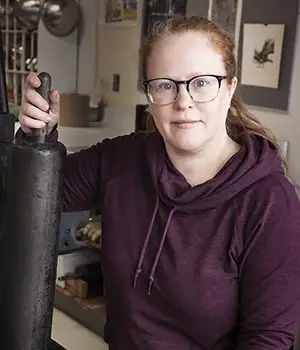
- brinichl@uwm.edu
- Mitchell Hall 371
- She / Her
Cynthia Brinich-Langlois
- Teaching Faculty II, Printmaking & Book Arts
- Teaching Faculty II, First Year Program
Education
- MFA, Studio Art - Printmaking, University of New Mexico, 2008
- BA, Studio Art, Kenyon College, 2004
Biography
Cynthia Brinich-Langlois grew up in the small town of Bethel, Alaska, a flat landscape dotted with tundra ponds extending across the Yukon-Kuskokwim river delta. She attended Kenyon College, where she created work in sculpture and etching for her Studio Art major, and researched aquatic systems and genetics for her Environmental Biology minor. While completing an MFA in Printmaking from the University of New Mexico, she participated in field-based studio research through Land Arts of the American West and produced several print editions as part of the Tamarind Institute’s Collaborative Lithography program.
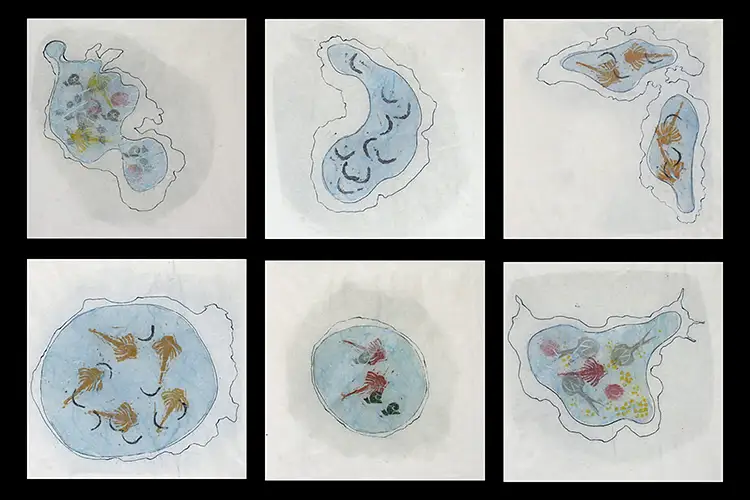
Throughout her research, Brinich-Langlois emphasizes the effects of human interventions through altered landscapes, while creating metaphorical interpretations of ecological systems. She draws upon autobiographical experiences from childhood to produce often surreal works that suggest the confusion of dreams, exploring shifting relationships between creatures and the land they inhabit. Recently, Brinich-Langlois has represented these scenes and characters in lithography, using limestone as a substrate to draw, paint, and scratch imagery. After completing each print edition, the image is abraded away from the surface of the stone in preparation for the next drawing. The block of limestone holds fossils and mineral veins that influence the character of its prints. A multitude of others have used the stone in the past, and it will continue to serve as a matrix for long into the future.
To expand her prints into more complex and dimensional forms, Brinich-Langlois cuts apart and collages the resulting prints, dismantling segments of a body, or adding extra heads, antlers, feathers, or footprints to the composition. Recently, these lithographs appeared in solo exhibitions at Grove Gallery and the Museum of Wisconsin Art on the Lake in Milwaukee.
The intricately drawn landscapes, plants, and animals that populate her works confront changing environments and serve as reminders that the complexity of life offers a multitude of remedies in the face of an unsettled future. The Nevada Museum of Art holds Brinich-Langlois’ field notes containing sketches of current and high-water marks, lists of organisms, GPS, and elevations of twenty pools of water at Muley Point, UT. In the desert, the certainty of each pools’ evaporation is evident throughout the day, as borders shrink and water turns to mud. The rain replenishes the tinajas, but in her research, Brinich-Langlois questions the sustainability of our own watery world floating in the desert of space.
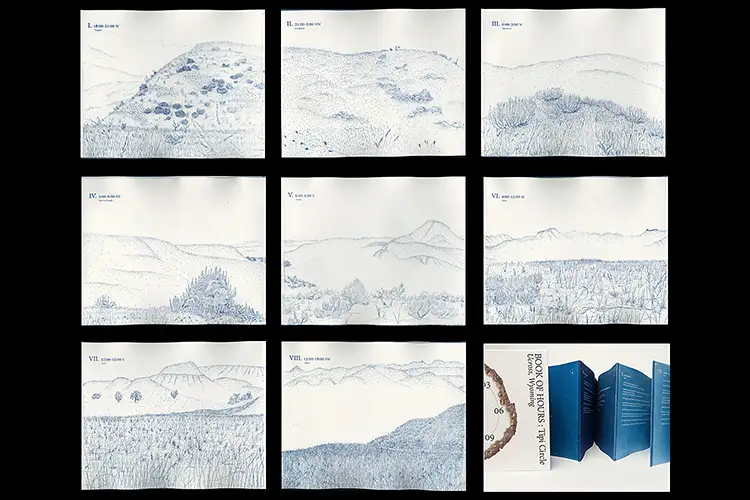
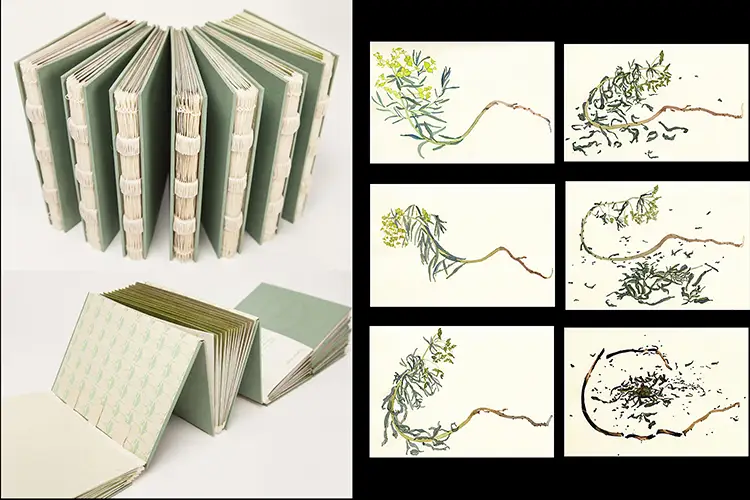
During an artist residency at Ucross Foundation, Brinich-Langlois collaborated with other artists and scientists to create a multifaceted portrait of place. She created durational panoramic drawings of the landscape over a 24-hour period and printed cyanotypes of the scenes into books of hours. She also created a book, Death of a Leafy Spurge, referencing watercolor drawings that document her increasingly aggressive attempts to destroy one specimen of the invasive plant.
As teaching faculty in the Department of Art & Design, Brinich-Langlois instructs printmaking and digital art courses at the University of Wisconsin-Milwaukee, where she continues to make work that explores the intricacies of the natural world.
Links
Recent & Selected Works
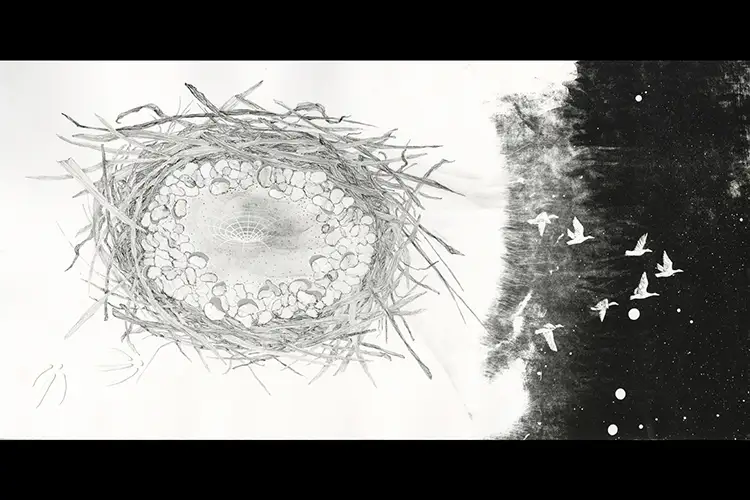
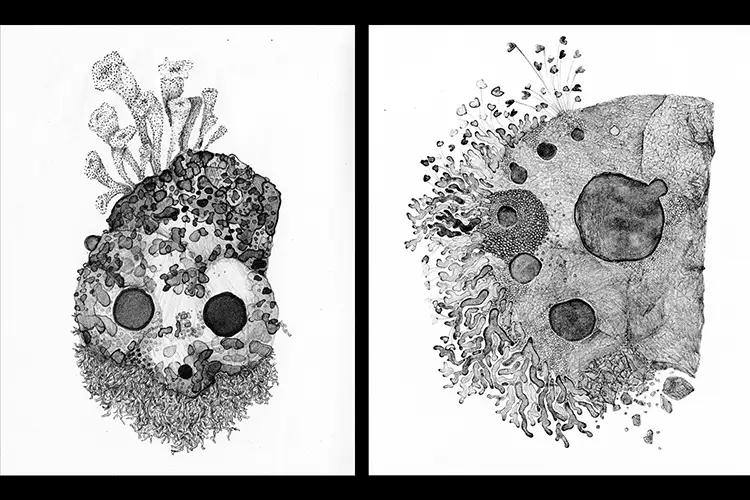
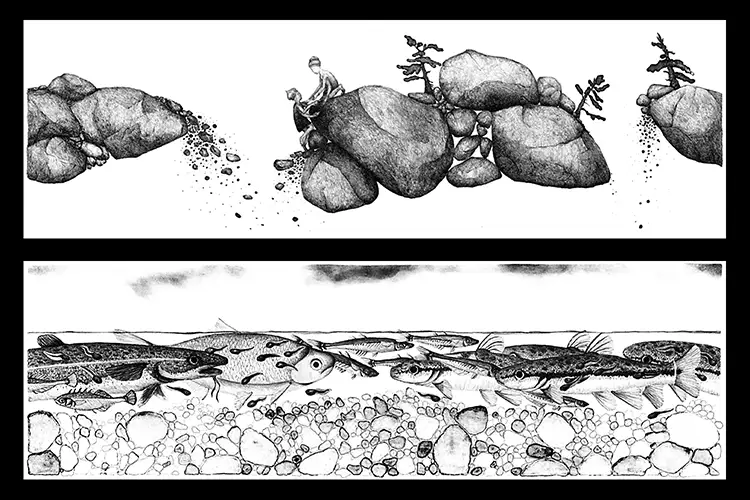
Artistic Exhibitions & Artwork
- Brinich-Langlois, Cynthia. Watersheds. 2025, Museum of Wisconsin Art on the Lake, St. John’s on the Lake, Milwaukee, WI; 2018, Ploch Gallery, Sharon Lynne Wilson Center for the Arts, Brookfield, WI; 2014, Ark Gallery, University of Iowa, Iowa City, IA.
- Brinich-Langlois, Cynthia; Mougel, Joseph. Above Low Tide. 2024, Schlueter Art Gallery, Wisconsin Lutheran College, Milwaukee WI; 2017, Roland Dille Center for the Arts Gallery, MSU-Moorhead, Moorhead MN; 2016, 10th Street Gallery, Milwaukee WI.
- Brinich-Langlois, Cynthia; Cremin, Mallory. Alumnae: 50 Years - Mallory Cremin ’84 & Cynthia Brinich-Langlois ’04. 2019, Gund Gallery, Kenyon College, Gambier OH.
- Gilbert, Bill, et al. Ucross: A Portrait in Place. 2016, School of Forestry and Environmental Studies, Yale University; 2016, Lannan Foundation, Santa Fe, NM; 2015, Ucross Art Gallery, Ucross, WY.
Awards
- Artist-in-Residence, Montello Foundation, Montello, NV, 2017.
- Artist-in-Residence, Iowa Lakeside Laboratory, Milford, IA, 2015.
- Artist-in-Residence, Ucross Foundation Land Arts Residency, Ucross, WY, 2013.
Notable
- Brinich-Langlois, Cynthia. Prints included in refereed exchange portfolios: Inclusions, 2026; Celestial/Terrestrial, 2020; Place/Meaningful Space, 2018. SGCI Archive, Zuckerman Museum of Art, Kennesaw GA. Exchange portfolios also exhibited at conferences Confluence (2027, Pittsburgh, PA), Puertograbando (2025, Puerto Rico), and Altered Landscapes (2018, Las Vegas, NV).
- Brinich-Langlois, Cynthia. A Visual Survey of Twenty Tinajas; Tinaja Notes (sketchbook pages). The Archive, Nevada Museum of Art, Reno NV.