
This is not your same old Physics Department.
Beginning this fall, UW-Milwaukee’s newly renamed Physics & Astronomy Department is enjoying a novel title that reflects the strengths of its fields of study. While our faculty and students continue to carry out groundbreaking research in Condensed Matter and & Surface Physics and Biophysics & Medical Imaging, the Department’s Leonard E. Parker Center for Gravitation, Cosmology, & Astrophysics has been a part of some monumental discoveries in the past few years.
“UWM is such an important center for black hole and gravity research,” said Lia Medeiros. “It’s one of the best places in the world to study black holes.”
Medeiros is another change in the Department. She joined the UWM faculty in January as an assistant professor and is an expert on black holes. If you Google her name, you’ll find dozens of news articles, YouTube videos, and even a Netflix documentary where she explains these mysterious objects.
She’s been busy since she arrived in Milwaukee; Medeiros has been featured in the Milwaukee Journal Sentinel and on WUWM’s Lake Effect show and has been invited to give public talks, including at the Milwaukee Public Museum’s Planetarium in February 2026. And on Nov. 15, she will deliver a TEDx talk in Oshkosh where she’ll talk about some amazing discoveries in space.
There have been quite a few in recent years.
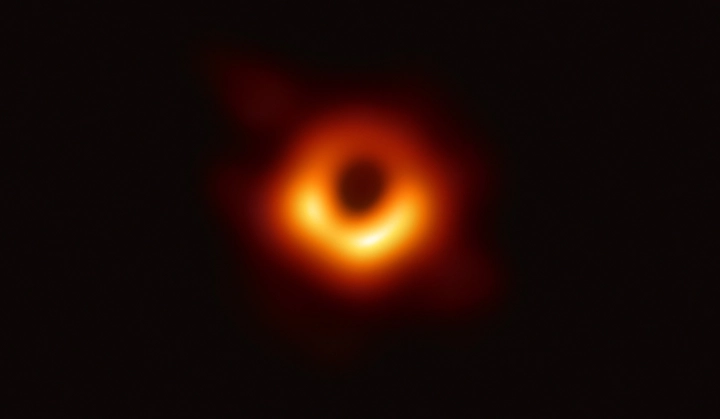
Medeiros is part of the Event Horizon Telescope (EHT) collaboration, an international cohort of about 350 scientists. In 2019, the group published the first-ever image of a black hole. The picture, which looked like a fiery donut, ran on the front page of nearly every major newspaper in the world. Since then, the group has published more images of black holes, constraints on their magnetic fields, and shown how the image and magnetic fields change as a function of time.
Black hole discoveries
To explain why UWM and Medeiros are so prestigious in the world of astronomy, first you need to know a little something about black holes.
A black hole is a super-dense concentration of mass in space with a gravitational pull so strong that not even light can escape it. Most are formed when massive stars, at the end of their lives, explode into supernovae and then collapse in on themselves – but it’s important to note that not all supernovae result in black holes, but can instead create neutron stars. Scientists still aren’t sure how super-massive black holes, like M87, are formed or how they grow so big. Most galaxies have a black hole at their center. The black hole at the center of the Milky Way galaxy has a mass 4 million times greater than that of our sun.
Black holes can collide with each other. When they do, the resulting impact sends out gravitational waves – ripples in the fabric of space time that were first predicted by Einstein. In 2017, UWM physicists played a key role in proving the existence of these waves. Then came the famous 2019 image.
“And then in 2022, we (EHT) published an image of our own black hole in the center of our own galaxy, which is called Sagittarius A* (pronounced A-Star),” Medeiros said. “We published six papers in that particular result.”
As scientists learn more about these phenomena, they uncover more questions. Most recently, EHT published images that show that the magnetic field around a black hole at the center of galaxy Messier 87 has shifted in the last few years.
“We’re not sure why it changed,” Medeiros admitted, “but we get information about the magnetic field structure from the polarization in the light that we receive (in a series of telescopes around Earth). … It’s really interesting in that it appears that something has changed in the magnetic field around this black hole.”
Sharing science with the world
Medeiros is excited to pursue answers to these questions, but she’s also excited to share her knowledge with Milwaukee and the world. Born in Brazil, Medeiros often traveled as a child following her parents’ jobs. She was drawn to mathematics because, no matter where in the world she was, numbers remained a constant language.
In high school, she took an astronomy course and was intrigued by what she learned about black holes – specifically, that their gravitational fields are so strong they can dilate time itself. That set her course for college, her graduate work, and her postdoctoral studies before she landed at UW-Milwaukee.
Along the way, Medeiros accidentally became a science educator.
“Because I am so actively involved with a project that has gotten a lot of media attention, I’ve had a lot of opportunities to communicate about science with the public. I think astronomy can be used to build bridges to communicate about science,” she explained. “When I give a talk about black holes, it gets so many different people excited, because (black holes) are crazy, right? They’re just so fascinating and mysterious.”
That’s one of the reasons Medeiros is so excited to deliver the TedXOshkosh talk on Nov. 15. She hopes that, by sharing her knowledge, she can inspire the next generation of scientists and emphasize the importance of fundamental research.
“Every dollar that is invested in NASA generates about 2.5 dollars of economic growth. There are so many different things that we learn by studying the universe that do have very direct applications to human life, and that really do help the economy,” Medeiros said. For example, the technology behind the Tempur-Pedic Mattress was first developed at NASA.
More than that, she said, gazing at the stars is a shared human experience.
“Astronomy has been an important part of every civilization that we know of. … We have been looking up at the cosmos and trying to understand our place in the universe since the earliest humans,” she said. “There are so many things that we have learned about fundamental physics by studying the (cosmos). When we are doing fundamental physics or fundamental science, we never know what we will learn. We never know what the implications for human society could be from that new knowledge.”
But she can’t wait to find out.
By Sarah Vickery, College of Letters & Science