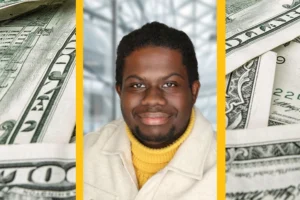
Money laundering is the action of concealing the origin of money obtained through illegal activities like drug trafficking drugs, prostitution, or embezzlement. At Baird Wealth Management, the first line of defense against money laundering is often dedicated interns like UWM economics major Donovan Clark, who works with Baird’s compliance office.
Clark is a busy student. In addition to serving as an anti-money laundering intern, he’s a Lawton Scholar and McNair Scholar, and he’s simultaneously earning his bachelor’s and Master’s degrees in economics through the Economics Department’s accelerated graduate program. He sat down to talk about his internship and how economics allows him to pursue his dreams.
I have never heard of anti-money laundering internship. What does an anti-money laundering intern do?
I knew about money laundering, but I didn’t know that there were jobs surrounding money laundering, per se. I just thought it was more of something that the FBI handled. I didn’t know that there were jobs about it right downtown.
As Baird is a financial institution, we get thousands of people who want to open bank accounts here, and so our department makes sure that these clients aren’t using their money for nefarious means. A lot of the day-to-day stuff involves reviewing reports that highlight our clients. As the interns, we are sometimes the first ones that see these reports, and we do some of the first-hand analysis and research. We present our work to an analyst, and they build off it. We’re trying to make that our clients aren’t, for example, taking money from a drug cartel and then keeping the money here.
What types of information in these reports stand out as “red flags” for money laundering?
I’ll give you an example. If we know that your account has $50,000 in it, then why are you all of a sudden saying “I need to wire $3 million to my account”? That’s a little weird. We also look over reports dealing with our clients who are sending money to somebody out of the country. There are certain sanctions on certain countries. You can’t send money to somebody in Russia, for example.
We’re paying attention to anything that may look like a suspicious activity. If it’s something that normally a client wouldn’t be doing, then we’re trying to make sure – does this make sense? Does this add up?
We look at what scammers are doing too. We have a term called “pig-butchering,” for example. That is where a scammer may find someone’s phone number. They’ll try to develop a relationship via text and try to get you comfortable and entice you. Then, when they finally say, “Hey, I need you to send some money,” you’ll feel like, “We’ve been talking for a month or so. I don’t mind sending money.” Then they ask for more and more.
Have you flagged anything that turned out to be an instance of money laundering?
Usually we have good clients, so we don’t really see anything too suspicious. But sometimes, we’ll look in a database and we happen to see that somebody is linked to something that’s kind of weird, and we’re able to detect it early on. It’s cool when you send it to your manager and later on they’ll tell you, we did some more research and there’s a whole bunch of other things going on with the person. It metastasizes to where we’re now talking to (Baird’s) legal team. Just knowing you’re a part of that process can be rewarding. It doesn’t happen all the time, but it happens quite a bit.
How did you find this internship?
Through the UWM Handshake app, which is, I think, one of the best resources for college students, especially when it comes to finding internships. You create your profile – you put your name, your major, what year you’re in, your interests, and then based on your profile, hiring managers can say, ‘We think we have a great opportunity for you.’ I received a message similar to that.
I’ve been there for a year and a half. There’s never a dull day. The best part is Baird has a great internship program. They do a great job of allowing and giving space for interns to speak with higher officials in the firm, even to the point where we’ve had sessions with the CEO, which I don’t think a lot of other places would really even think about.
Why did you choose UWM for your economics education?
I was born and raised in Milwaukee. I have a lot of family who attended UWM, so it was like carrying on a tradition of sorts. The second reason was, when I was looking for schools, I wanted to stay at home, but I still wanted to go to a school that would give me a college experience, especially my first year. … I just felt like UWM gave the best opportunities for me educationally and recreationally as well.
By Sarah Vickery, College of Letters & Science