
by Kathleen Quirk
How can technology help preserve and protect culture?
That is the question two University of Wisconsin-Milwaukee researchers are trying to answer.
Xiangming (Simon) Mu, associate professor of information studies, and Quanyi (Monica) Zhao, an MFA candidate in the Peck School of the Arts and associate professor at Hubei University of Technology (China), recently presented their proposal for a digital heritage project to an international audience.
Their “Living Heritage Ledger” was one of only six out of more than 600 submissions from 90 countries selected as winners of the United Nations’ Beyonds Challenge. It was featured at the Beyonds Festival-2026 in Geneva in early October.
The idea for the project grew out of conversations Mu and Zhao had been having about how new technologies, including AI, could be used to help preserve cultural heritage.
The idea behind the “Living Heritage Ledger” was to develop a framework that could help quantify decisions around how best to preserve cultural traditions.
Zhao had been studying the culture of East Asia, including some traditions that were dying out and in danger of being forgotten. As she and Mu began to collaborate, they explored ideas about how to preserve and protect traditional skills and techniques. In the process, they came across the United Nations’ recently established “Beyonds Challenge.”
The Beyonds Challenge is an intergenerational and cross-disciplinary initiative to shape sustainable development and global solutions past 2030, according to the Beyond Lab website.
Researchers were encouraged to submit their ideas on the topic as proposals. Mu and Zhao saw it as a good fit for the work they were doing.
The idea behind the “Living Heritage Ledger,” said Mu, was to develop a framework that could help quantify decisions around how best to preserve cultural traditions.
The case study they chose for their pilot project was Tiaohua thread counting, a traditional Chinese counted stitch embroidery technique from the area around the Yangtze River. Artisans skilled in the technique create intricate, freehand geometric patterns by counting fabric warp and weft threads rather than relying on pre-drawn stencils or printed patterns.
Fewer and fewer artisans know how to do this, Zhao said. “It is very beautiful. We wanted to not only preserve the product, but the knowledge behind it,” she explained.
“A finished Tiaohua pattern can survive in a museum after the person who made it is gone,” the researchers wrote in their proposal. “But the image doesn’t tell a future learner how to count threads without a drawn outline, where to begin, how to preserve a return path or why a motif mattered to a family.”
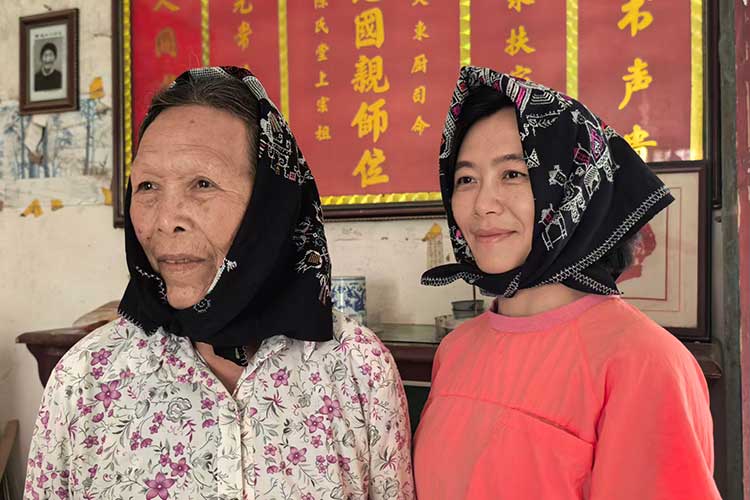
The Living Heritage Ledger they developed is a practical conversation and planning tool, according to Mu and Zhao. While they used the Tiaohua pattern for their case study, the technique can be used for endangered cultural heritage of all kinds—including languages, dance, art and folk music, said Zhao.
The tool helps educators, young people, heritage bearers and local institutions evaluate where transmission is becoming fragile, what actions may become irreversible, and what actions should come first, according to the researchers.
The Ledger’s evaluation also looks at complex questions about copyright, trademarks, ownership and protections. In addition, the prototype touches on issues such as the impact of mass production on the tradition and how local artisans aren compensated for their skills.
“Documentation can help, but recording an object or a performance is not the same as sustaining the conditions in which knowledge can be learned, adapted and passed on,” the researchers wrote in their proposal.
A key part of the evaluation is looking at the specific tradition as part of the broader community’s culture, religion and traditions. It’s also vital to have a community involved in the process of deciding how best to preserve and protect traditions.
It’s not just preserving what they have done, but carrying it forward, and helping new generations continue to learn how to do it.
“Its purpose is to move participants from a general concern — ‘heritage is disappearing’—to a shared diagnosis and future transmission plan,” according to Zhao and Mu’s prototype.
“It’s not just preserving what they have done, but carrying it forward, and helping new generations continue to learn how to do it,’ said Zhao.
In Geneva, Mu and Zhao were able to talk to scholars, representatives from NGOs (non-governmental organizations, and even diplomats.
The response to the project was very positive, Mu said, and they plan to continue to develop their work.
In announcing the award, the Beyonds Challenge Lab team said:
“Your work, “The Living Heritage Ledger,” truly captured the spirit of the Challenge. Its ideas and perspective inspired us and left a strong impression throughout the selection process.”

