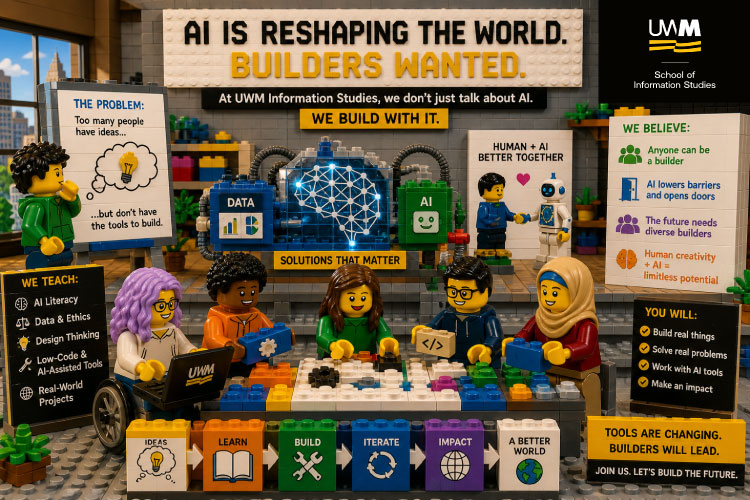
Artificial intelligence is reshaping how the world builds software. But here’s the problem: most people still can’t build anything with it, according to Michel Zam, a teaching faculty member in the School of Information Studies at UWM. It’s not because they lack ideas, he said, but because the tools — and the way we teach them — are still too complex.
Zam is working on a different approach. His premise is simple: if AI is changing how systems are built, education could also change how people learn to build them.
For decades, creating an application meant mastering layers of abstraction — languages, frameworks, infrastructure, Zam said. That required time and specialization and often led to exclusion.
“Building apps the traditional way takes a whole ecosystem of specialists,” Zam said. That model no longer fits a world where everyone is expected to think, act, and create digitally, he explained. So, what replaces it? Zam goes back — far back. To Aristotle.
More specifically, the famous three principles of drama, designed to cultivate, educate, and entertain everyone, not just elites, inspired Zam. Rather than dispersing learning across months, weeks, chapters, tools, and steps, he said everything should happen in one place: the browser. It centers on a single action, building something real and useful in a single moment through immediate, engaging feedback.
“No long setup. No delayed results. No arbitrary burden,” he said. “You act — and the system responds. The feedback loop takes over.” From there, something shifts, he explained. Students don’t start with syntax; they start with interaction. They see what happens. They try. They adjust. “Only later do they name what they already understand — through quick, yet clean microsteps,” Zam said.
This is where low-code and AI come together, Zam said. Instead of writing everything from scratch, learners build visually, using AI when needed, and improve step by step. “The focus moves from how to code to what to build — and why.”
Zam presented this approach at the 2026 Association for Computing Machinery Special Interest Group on Computer Science Education (ACM SIGCSE) conference, the flagship event for computer science education, across three presentations. His Aristotelian perspective is not just about efficiency. It connects science and access — an intentional double focus at UWM. Students in business, healthcare, education, or the arts increasingly need to design digital systems, according to Zam. Yet many are still blocked by technical barriers that have little to do with their goals, he said.
“If you need to engage in building digital apps, you should be able to join the party. Not only after years of training, but from the start.”
In his courses, students build directly in a browser. Interactive elements react instantly, making ideas visible and concrete. The result is not just faster learning; it’s thinking by building.
One student summed it up for Zam: “Working on the assignment has shown me how visual and interactive elements make learning and coding clearer. Overall, it enhanced my coding skills and problem-solving approach.”
And that shift matters, according to Zam, because low-code and AI is not just automating code; it is changing what it means to create software. “The next generation of builders will not be those who memorize syntax, he said. “They will be those who can design, explore, and create with AI.”
That is the gap Zam is addressing, and it extends beyond the classroom, he said. At UWM, this work has evolved into a microcredential funded through the HERA Microcredential Grant, supported by the Higher Education Regional Alliance (HERA) and the U.S. Department of Education. HERA includes 16 Southeastern Wisconsin colleges and universities.
“This microcredential is designed for students and professionals who want to create AI-powered solutions without prior technical background,” according to HERA program director and spokesperson Vicki Turner.
“Artificial intelligence is transforming how digital systems are conceived, built and maintained,” Turner said. “Demand is high for professionals who can integrate AI capabilities in real-world products and services,” she added. “This microcredential can help prepare learners to operate effectively in modern software data teams by focusing on competencies that surround and enable reliable digital delivery.”
“AI is reshaping the world — including how AI skills are built,” said Zam. “Regardless of your technical background, you can now start building yours: build-ai@uwm.edu.”