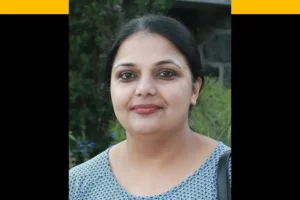
I joined the UWM geography department in 2004. I had recently completed my MS in GIS and wanted to pursue a doctoral degree and focus on a research topic at the intersection of GIS, Society, and Technology intersections. I was particularly interested in the adoption of geospatial technologies by government agencies and the reasoning behind the decision to adopt such technologies. I had just moved to Milwaukee and looked at UW-Milwaukee to weigh my options. I came across Dr. Rina Ghose’s profile on the department website and reached out to her. After meeting me, she agreed to work with me, and I was fascinated with public participatory GIS and the work that Dr. Ghose was doing. I applied to the PhD program and was fortunate to be accepted. For the next five years, I worked under the guidance of Dr. Ghose as my dissertation chair and Dr. Judith Kenny, Dr. Nik Heynen, Dr. Changshan Wu, and Dr. Bill Huxhold as my dissertation committee members. I received invaluable guidance from my dissertation committee members that laid the foundation for my career.
In what way does geography relate to your current work?
I am a tenured professor in the Department of Environmental and Geosciences at Sam Houston State University. I served as the department’s GIS graduate program coordinator for nine years. I taught a variety of graduate GIS courses and continued my research that explores the relationship between science, society, and technology, particularly the process of geospatial technology use for urban governance in a non-western context. The focal point of my research has been on urban local bodies in South Asia. Additionally, I have also utilized remote sensing technology to understand earth-environment interactions. Currently, I also serve as the Associate Dean for Graduate Student Success in the Graduate & Professional School at Sam Houston State University. In my role as the Associate Dean for graduate student success, I work with graduate programs across campus to focus on graduate student success strategies, retention, engagement, and development. Following a student-centric vision, I serve as a liaison between the Graduate & Professional School and different colleges and graduate programs at Sam Houston State University. I also served as the university faculty and staff ombudsperson and was responsible for establishing the ombuds office on campus.
What is your favorite memory of being a student in the Department of Geography?
One of my favorite memories during my time in Milwaukee was the fall department gathering that we would have before classes had started. The gathering used to be held outdoors, and it used to be a potluck, and everyone brought different dishes. My favorite dish was rhubarb pie. We always had someone bring rhubarb pie to the potluck. Even since moving to the south, I have not seen rhubarb pie.
How do you keep the balance between work and life? What do you do for your extra time?
I have tried my best to maintain a balance between work and life. My priority has always been my family. When I’m not working, my husband and I drive my daughter to tennis practice, dance lessons, competitions, etc. We are fortunate to have access to a variety of cultural events here in Houston, which my husband, daughter, and I enjoy as a family. I look forward to visiting the department someday with my family.
Any suggestions for our geography students?
Listen to your professors. You will learn lifelong lessons from them that will establish a firm foundation as you move into the real world.
The knowledge and skills that I acquired during my time in the geography department taught me invaluable lessons about teaching, research, and service, which are at the core of an academic role. These lessons laid the foundation for my academic career. I am forever grateful for the support and guidance from my professors in the geography department.
Dr. Mukherjee also shares her new book, Introduction to Geographic Information, with Roman & Littlefield. Her book offers a comprehensive and grounded introduction to geographic information systems and science basics. It is perfect for beginners and anyone looking to expand their knowledge of the complex and sophisticated field of GIS and spatial thinking. From understanding spatial data to applying GIS in real-world applications, the book covers many topics.
Congratulations on your great achievement, Dr. Mukherjee!