
Mapping Racism & Resistance Receives Statewide Recognition and Expands Community Impact
The Department of Geography congratulates Professor Anne Bonds (Professor of Geography)and Professor Derek Handley (Associate Professor of English) on a remarkable year of recognition, outreach, and public scholarship through their Mapping Racism & Resistance project.
In 2026, the project received the Governor’s Archives Award for Archival Advocacy, an honor bestowed by the Wisconsin Historical Society and the Board of Curators. Led by Bonds and Handley in collaboration with hundreds of community volunteers, Mapping Racism & Resistance documents and maps racial covenants across Milwaukee County, making important historical records accessible to the public and supporting broader conversations about housing discrimination and racial justice.
Drs. Bonds and Handley formally received the award at a ceremony held at the Wisconsin Black Historical Society on August 28, 2026, where community members gathered to celebrate the project’s achievements and impact. The award recognizes outstanding efforts to preserve, interpret, and share Wisconsin’s historical records with the public.
The project’s visibility continued to grow throughout the year. In June, Bonds and Handley were invited to present their research to the University of Wisconsin Board of Regents during its Milwaukee meeting. They also shared their work with the Milwaukee County Committee of Mayors, bringing research findings and historical insights to municipal leaders from across Milwaukee County.
Beyond these recognitions, Drs. Bonds and Handley have continued to engage communities throughout the region through public presentations and discussions. In September, they participated in events highlighting the history of racial covenants in Milwaukee County and the ongoing work of communities seeking to address this legacy. Their presentations helped connect historical research to contemporary conversations about equity, inclusion, and local policymaking.
The success of Mapping Racism & Resistance demonstrates the power of community-engaged geographic research to preserve historical knowledge, foster public dialogue, and promote a deeper understanding of how past policies continue to shape present-day landscapes. We congratulate Anne Bonds, Derek Handley, and the many community partners and volunteers who have contributed to this important and award-winning project.
Downer Woods Featured in Historic Milwaukee’s Doors Open Milwaukee

Downer Woods, UWM’s 11-acre urban forest and living laboratory, was featured in Historic Milwaukee’s Doors Open Milwaukee. Managed by the UWM Field Station, the site showcases ongoing ecological restoration efforts and serves as a valuable space for research, teaching, and community engagement. The Department of Geography is proud of the connections between Downer Woods and the work of Dr. Alison Donnelly (Professor, the Department of Geography), whose research and teaching help students engage directly with urban environmental systems. The department also extends its sincere appreciation to Dr. Donnelly for her outstanding contributions to the event and for helping share the ecological significance of this unique campus resource with the broader community.
Geography Colloquium Explores Art, Ecology, and Environmental Connection

The Department of Geography and the Center for 21st Century Studies (C21) welcomed J. Philip Grygny, an interdisciplinary artist, scholar, and founder of the Performance Ecology Project, for a Geography Colloquium titled Wild Knowing: The Role of the Arts in Ecological Culture on September 18. During his presentation at the American Geographical Society Library (AGSL), Dr. Grygny used stories, sound, and imagery to explore how the arts can help foster deeper relationships with the natural world and contribute to a more ecological culture.
The event was followed by an interactive workshop and guided activities in Downer Woods, inviting participants to engage in practices that encourage reflection, sensory awareness, and connection with the living environment. Co-sponsored by Geography and C21, the program brought together students, faculty, artists, educators, and community members interested in the intersections of art, nature, and environmental stewardship.
Geography Celebrates the Retirement of Distinguished Professor Emeritus Dr. Mark D. Schwartz
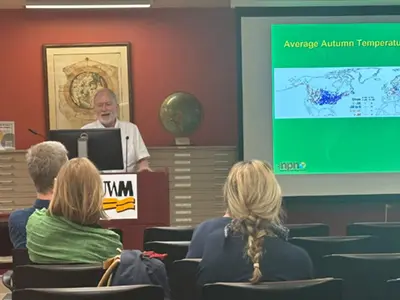
The Department of Geography celebrated the retirement of Dr. Mark D. Schwartz, Distinguished Professor Emeritus, with a series of events honoring his outstanding career in research, teaching, and service.
On August 30, 2026, colleagues, former students, alumni, friends, and family gathered at Hubbard Park for a retirement celebration recognizing Dr. Schwartz’s many contributions to the department, the university, and the field of climatology and phenology. The gathering provided an opportunity to share memories, express appreciation, and celebrate his lasting impact on generations of students and scholars.
The celebration continued on September 11 with a retirement lecture at the American Geographical Society Library (AGSL). Entitled Pursuing the Onset of Spring: A Phenoclimatological Career, the lecture reflected on Dr. Schwartz’s distinguished academic journey and his pioneering contributions to the study of phenology, climate variability, and seasonal environmental change. Through reflections on decades of research, teaching, and mentorship, Dr. Schwartz highlighted the importance of long-term observations of seasonal phenomena for understanding a changing climate and the evolution of phenoclimatology as a field.
Together, the retirement celebration and lecture provided fitting tributes to Dr. Schwartz’s remarkable career and enduring legacy within the Department of Geography and the broader scientific community.
New Book and a book talk by Geography Faculty

UWM faculty members, Drs. Anna Mansson McGinty (Professor, Department of Geography), Caroline Seymour-Jorn (Professor, Department of World Languages & Cultures), and Kristin M. Sziarto (Associate Professor, Department of Geography) recently published Muslims in Milwaukee: Placemaking, Belonging, and Activism (Syracuse University Press, 2026). The book offers a nuanced portrait of Milwaukee’s Muslim communities and their contributions to civic life, identity, and activism. The authors celebrated the publication with a book talk and audience discussion at Boswell Book Company on August 25.
Celebrating our Newest Geography Graduates
The Department of Geography congratulates four recent graduates on their outstanding academic achievements. Dr. Matthias Dietmar Schilli completed his Ph.D. with research on violent crime, social vulnerability, and urban environments in Chicago. Dr. Lulu Liu earned her Ph.D. with research examining the effects of urban morphology and tree canopy on microclimate variation and has joined Austin Peay State University as an Instructor. Thea Brenner earned her M.S. in Geography with a thesis exploring Milwaukee’s performing arts landscape, while Jay Jensen completed the M.S. Geography GIS Professional track. We are proud of their accomplishments and wish them continued success in their future careers.
Geography Undergraduate
- Vaughn Kerrigan (BA)
- Lauren Tomsa (BA)
- Henry Valley (BA)
- Alexandra Vyborny (BA)
Geography Master
- Thea Brenner (MA)
- Jay Jensen (MS)
Geography PhD
- Lulu Liu (PhD)
- Matthias Dietmar Schilli (PhD)
International Phenological Gardens Ireland June 2026
In June 2026 Dr. Alison Donnelly (Professor of Geography) accompanied the coordinator, Suzanne Jochner-Otte and Lisa Buchner (researcher), of the International Phenological Gardens (IPG), on a tour of a number of the IPG sites across Ireland and attended a national workshop focused on the future of the network and the valuable data it generates.

The IPG network is one of the longest-running phenological monitoring programmes in Europe. Established in the 1950s, the network uses genetically identical trees and shrubs planted across a wide geographical range to monitor the timing of seasonal events (phenology) such as budburst, flowering, leaf development, and autumn senescence. By observing the same plant material under different climatic conditions, the network provides unique insights into the impacts of climate variability and climate change on trees and shrubs across Europe.
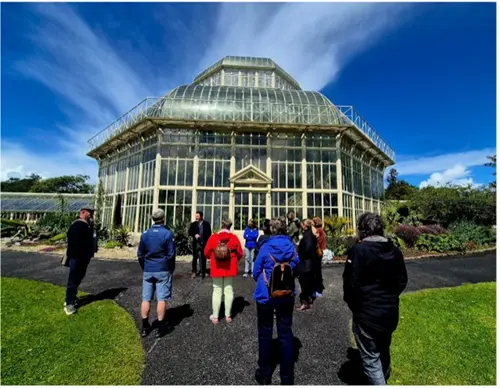
Three Irish IPG sites were visited: At the John F. Kennedy Arboretum in County Wexford, a new IPG tree was planted. Visits were also made to the National Botanic Gardens in Dublin and to Valentia Observatory in County Kerry. The visits provided an opportunity to review site conditions, discuss local experiences with data collection, and highlight the importance of maintaining long-term observation records.


A national IPG workshop, entitled The Role of IPG Data: Linking Collection, Coordination, and Science, was held at the National Botanic Gardens, Dublin, on 9 June. The event brought together observers, researchers, and garden staff to discuss the scientific value of the network and opportunities for its future development.
Presentations were given by Susanne Jochner-Oette (the IPG Coordinator), who outlined the importance of the IPG network, current challenges, recent scientific findings, and future prospects; Lisa Buchner, who presented research on reproduction, phenology, and seasonality across Europe; and Alison Donnelly, who demonstrated how the observations collected by network participants contribute to scientific research and broader understanding of environmental change.
The afternoon session focused on discussion and feedback regarding challenges facing the network, potential improvements, data use, and preparations for the upcoming conference in Eichstätt, Germany. The workshop concluded with a guided tour of the National Botanic Gardens, providing participants with an opportunity for further discussion and networking.
Harold and Florence Mayer Lecture Features Dr. Eric Tate (Spring 2026)
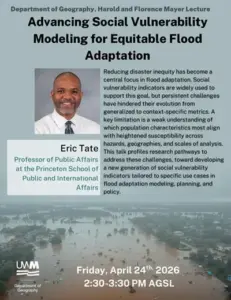
The Department of Geography welcomed Dr. Eric Tate, Professor of Public Affairs in the Princeton School of Public and International Affairs, as the featured speaker for the annual Harold and Florence Mayer Lecture. Held on April 24, 2026 at the American Geographical Society Library (AGSL), the lecture, Advancing Social Vulnerability Modeling for Equitable Flood Adaptation, examined how social vulnerability can be more effectively measured and applied to support equitable approaches to flood adaptation, planning, and policy.
In his presentation, Dr. Tate discussed the growing importance of addressing disaster inequities and the challenges associated with current social vulnerability indicators. He highlighted the need to move beyond generalized measures toward context-specific metrics that better capture how different population characteristics influence susceptibility to hazards across places and scales. Drawing on ongoing research, the lecture explored pathways for developing a new generation of social vulnerability indicators tailored to support flood adaptation modeling, planning, and decision-making.
The annual Mayer Lecture brought together faculty, students, alumni, practitioners, and community members interested in hazards, climate resilience, public policy, and environmental justice. The event highlighted the important role geographic research plays in understanding social vulnerability and advancing more equitable responses to environmental risks.