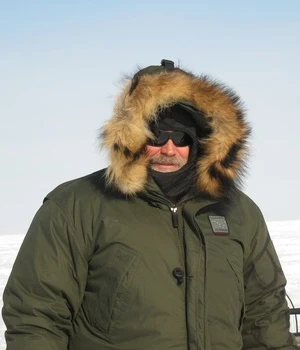
Frederick E. Nelson
- Adjunct Professor, Geography
- Professor Emeritus, Department of Geography, University of Delaware
Education
- PhD, Geography (Geomorphology and Analytic Cartography), University of Michigan, 1982
- MS, Geography (Geomorphology), Michigan State University, 1979
- BS, (honors) Geography (Physical Geography), Northern Michigan University, 1973
Office Hours
By appointment
Research Interests
Fritz Nelson has long-standing interests in permafrost (perennially frozen ground) and periglacial (cold-climate, nonglacial) geomorphology. He has participated in research projects in many of the world’s cold regions and served on the faculties of Rutgers University, Cornell University, SUNY-Albany, the University of Delaware, Michigan State University, Northern Michigan University, and the University of Michigan. He has published ten monographs and edited volumes and more than 160 peer-reviewed scientific papers. He was Lead or Contributing Author on several of the Intergovernmental Panel on Climate Change Assessment Reports, and was part of the IPCC group collectively awarded the 2007 Nobel Peace Prize. Since 1991 he has played a leading role in the Circumpolar Active Layer Monitoring (CALM) program, which maintains a network of more than 200 permafrost observatories in the polar regions. He has served on the boards of the Arctic Institute of North America, the American Geographical Society, the U.S. Permafrost Association, the International Permafrost Association, and several international scientific journals.
In recent years Nelson has become increasingly involved in research on the history of Arctic science, polar exploration, and geographical science. He served for nearly a decade as Chair of the Association of American Geographers’ Archives and Association History Committee. At UW-Milwaukee he is closely involved in the extraordinary collections of the American Geographical Society Library. Nelson is eager to work with graduate students through the UWM Department of Geography’s degree programs, and on historical topics through the joint MA/MLS program administered by the department and the School of Library and Information Science.