Qingsu Cheng, Assistant Professor of Biomedical Engineering and MIDD member supports a team of scientists from the University of Nevada, Reno and the University of Illinois at Chicago to develop a marketable POC platform technology using Smartphone Time-Resolved Luminescence Imaging and Detection (STRIDE).
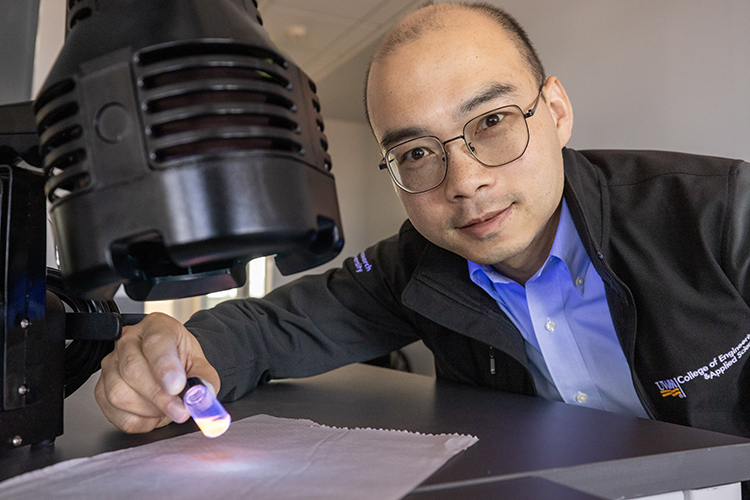
The work, supported by the NSF convergence accelerator research grant (2344476), focuses on the use of quantum dots to develop sensitive assays to detect pathogens, enable food quality analysis, and cancer diagnosis. The assay will be readable with a low cost smartphone based AI-assisted time-resolved luminescence measurement (TRLM) instrument. The work includes a strong emphasis of developing an integrated education and workforce and supports broad connections with academia/industries for scientific collaboration and commercialization. The MIDD is currently synthesizing functionalized quantum dots for the project. A recent UWM Report article highlighted Dr. Qingsu Cheng’s work.