Language as Collaborator: Co-Creating with Thinking Machines
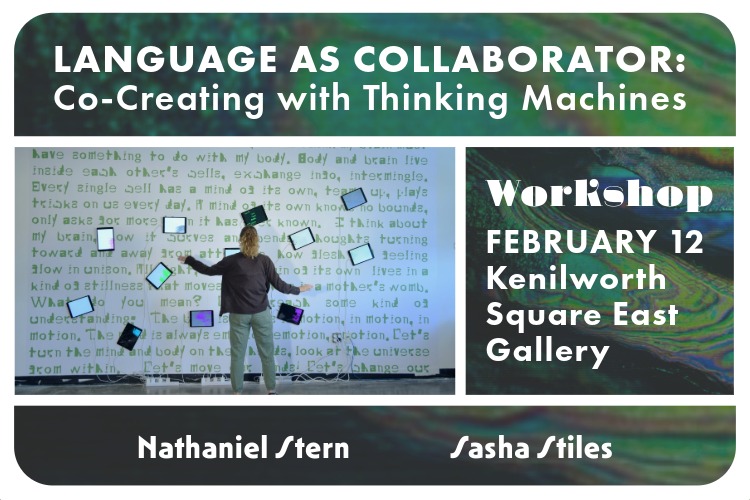
Workshop with Sasha Stiles & Nathaniel Stern
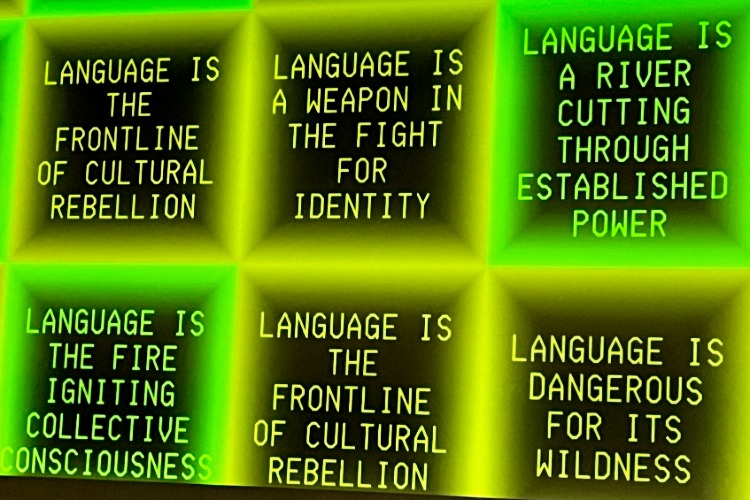
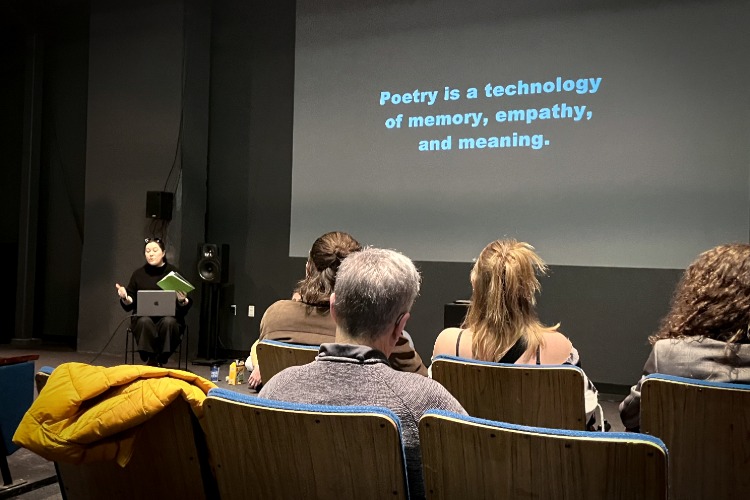
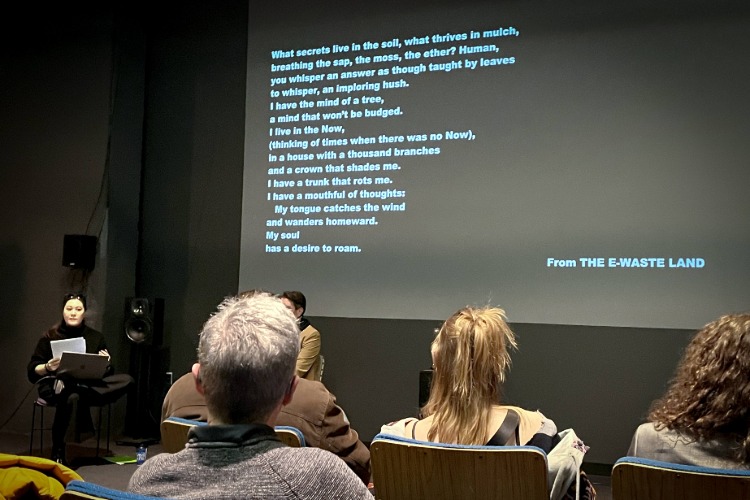
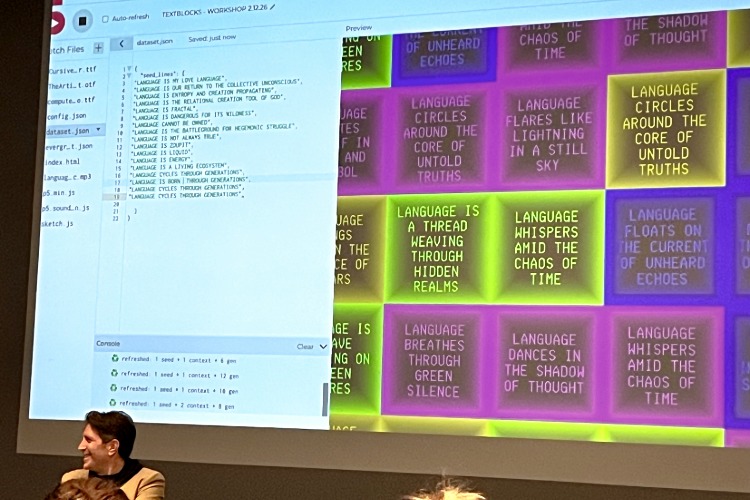
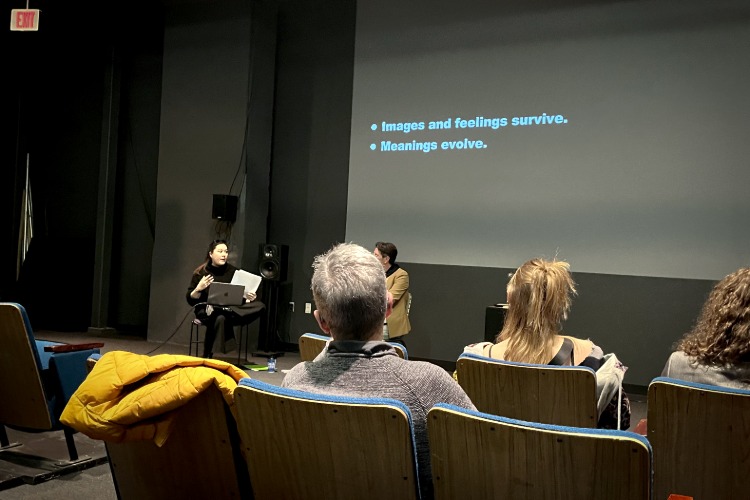
To coincide with the exhibition Generation to Generation: Conversing with Kindred Technologies by Nathaniel Stern and Sasha Stiles, this workshop with the artists explored language as a vital creative material and as a medium for collaborative authorship. Through hands-on experimentation, participants will engaged questions of imagination, translation, and meaning-making in the age of AI.
About the Artists

Sasha Stiles is a first-generation Kalmyk-American poet, artist and AI researcher whose work bridges tradition and innovation through hybrid poetics, generative imagination and collaborative intelligence. Her transmedia practice reframes poetry as both art and technology — a means of encoding human experience across space and time — and blends word, image and algorithm to explore the role of human voice in a digital age.
Since 2018, Stiles has been at the forefront of human-machine co-creation, using language as a lens to probe the promise and peril of creative technologies like machine learning and blockchain. Her experiments and insights have established her as a leading voice in creative AI, and a thoughtful contributor to the global conversation about the future of art, technology, and humanity. From Technelegy (2021) — a first-of-its-kind poetry and art collection co-authored with a personalized AI model and praised by Ray Kurzweil — to award-winning projects such as “Cursive Binary” and “Repetae,” Stiles continually pushes the boundaries of expression, situating AI within the broader question of what it means to be human in an increasingly posthuman world. Stiles’ work has been recognized by the Prix Ars Electronica, Sigg Art Prize, Lumen Prize, Women in AI Awards, and Future.Art.Awards; featured in Artforum, Christie’s, NPR, The Washington Post, and Poets & Writers; and exhibited and performed internationally, from Lincoln Center and the V&A to MoMA, Art Basel, Kunsthalle Zurich, Outernet London, New York’s Times Square, and Tokyo’s Shibuya Crossing.

Nathaniel Stern is an artist and writer, Fulbright and NSF grantee and professor, interventionist and public citizen. He has produced and collaborated on projects ranging from ecological, participatory, and online interventions, interactive, immersive, and mixed reality environments, to prints, sculptures, videos, performances. and hybrid forms. His first book, Interactive Art and Embodiment: The Implicit Body as Performance (Gylphi 2013), takes a close look at the stakes for interactive and digital art, and Ecological Aesthetics: artful tactics for humans, nature, and politics (Dartmouth 2018) is a creative and scholarly collection of stories about art, artists, and their materials, which argues that ecology, aesthetics, and ethics are inherently interconnected, and together act as the cornerstone for all contemporary arts practices. Stern’s ongoing work with startups and industry, on the other hand, has helped launch dozens of new businesses, products, and ideas. He has been featured in the likes of the Wall Street Journal, Guardian UK, Huffington Post, Daily Mail, Washington Post, Daily News, BBC’s Today show, WIRED, Boing Boing, Gizmodo, PetaPixel, M Magazine, Time, Forbes, Fast Company, Scientific American, the Milwaukee Journal Sentinel, Leonardo Journal of Art, Science and Technology, Rhizome, Furtherfield, Turbulence, and more. According to Chicago’s widely popular Bad at Sports art podcast, Stern has “the most varied and strange bio of maybe anyone ever on the show,” and South Africa’s Live Out Loud magazine calls him a “prolific scholar” as well as artist, whose work is “quite possibly some of the most relevant around.” “Technological, thought-provoking and unexpected” (NPR) he’s been dubbed one of Milwaukee’s “avant-garde” (Journal Sentinel), called ”an interesting and prolific fixture” (Artthrob.co.za) behind many “multimedia experiments” (Time.com), “accessible and abstract simultaneously” (Art and Electronic Media web site), someone “with starry, starry eyes” (Wired.com) who “makes an obscene amount of work in an obscene amount of ways” (Bad at Sports) – both “bizarre and beautiful” (Gizmodo). According to Cory Doctorow at Boing Boing, Stern makes “beautiful, glitched out art-images,” and Caleb A. Scharf at Scientific American says Stern’s art is “tremendous fun,” and “fascinating” in how it is “investigating the possibilities of human interaction and art.”