
Biological Sciences Colloquium: Dr. William C. Beckerson
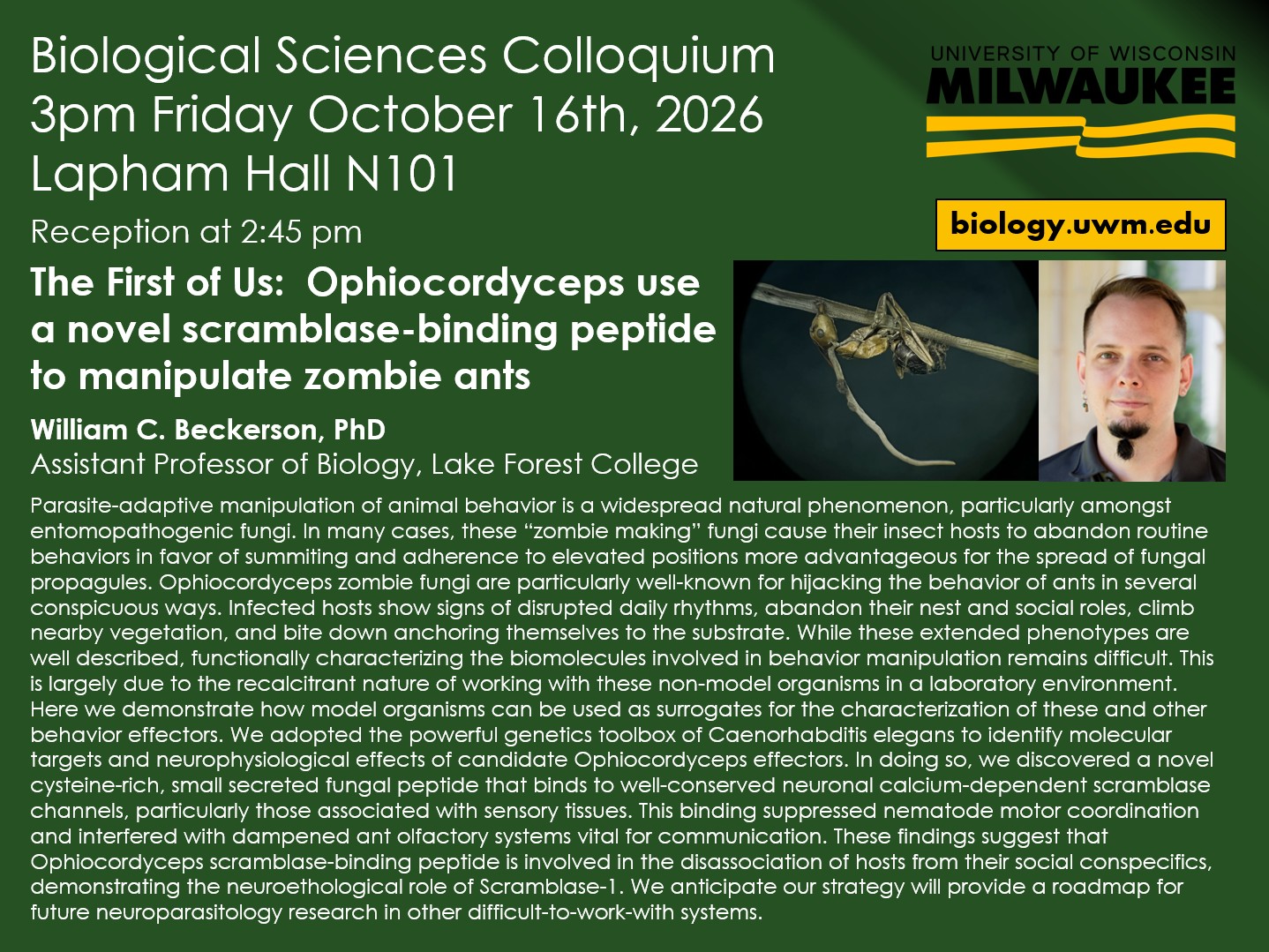
Dr. William C. Beckerson, assistant professor of biology at Lake Forest College, will be presenting a talk about his work entitled “The First of Us: Ophiocordyceps use a novel scramblase-binding peptide to manipulate zombie ants.” The abstract is as follows:
Parasite-adaptive manipulation of animal behavior is a widespread natural phenomenon, particularly amongst entomopathogenic fungi. In many cases, these “zombie making” fungi cause their insect hosts to abandon routine behaviors in favor of summiting and adherence to elevated positions more advantageous for the spread of fungal propagules. Ophiocordyceps zombie fungi are particularly well-known for hijacking the behavior of ants in several conspicuous ways. Infected hosts show signs of disrupted daily rhythms, abandon their nest and social roles, climb nearby vegetation, and bite down anchoring themselves to the substrate. While these extended phenotypes are well described, functionally characterizing the biomolecules involved in behavior manipulation remains difficult. This is largely due to the recalcitrant nature of working with these non-model organisms in a laboratory environment. Here we demonstrate how model organisms can be used as surrogates for the characterization of these and other behavior effectors. We adopted the powerful genetics toolbox of Caenorhabditis elegans to identify molecular targets and neurophysiological effects of candidate Ophiocordyceps effectors. In doing so, we discovered a novel cysteine-rich, small secreted fungal peptide that binds to well-conserved neuronal calcium-dependent scramblase channels, particularly those associated with sensory tissues. This binding suppressed nematode motor coordination and interfered with dampened ant olfactory systems vital for communication. These findings suggest that Ophiocordyceps scramblase-binding peptide is involved in the disassociation of hosts from their social conspecifics, demonstrating the neuroethological role of Scramblase-1. We anticipate our strategy will provide a roadmap for future neuroparasitology research in other difficult-to-work-with systems.
The presentation will begin at 3:00 PM in Lapham Hall N101, preceded by an informal reception from 2:45-3:00 PM.