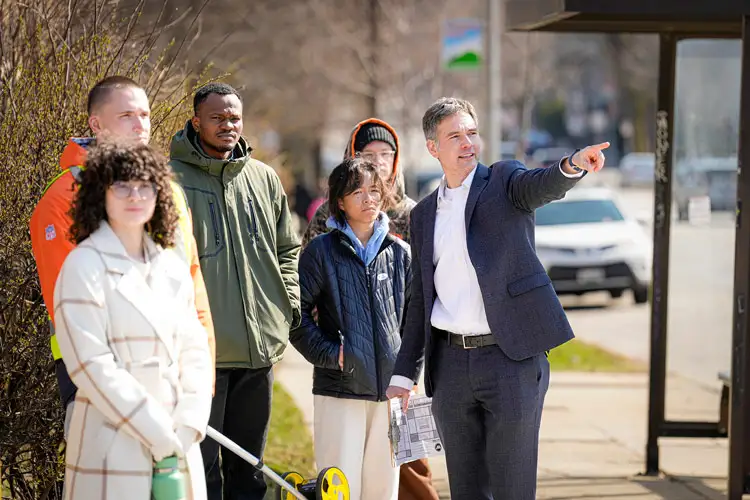
When Robert Schneider envisions a thriving community, he pictures neighborhoods where people can easily and safely walk, bike or use public transit. Research has long shown walkability promotes public health, protects the environment and grows local economies.
“Yet many communities were designed mostly with drivers in mind, making it unsafe for people to bike to school or walk to a local café,” he said.
Schneider’s on a mission to change that, in Milwaukee and beyond. A professor and co-chair of the Department of Urban Planning at the University of Wisconsin-Milwaukee, he’s authored more than 30 peer-reviewed journal articles — many of them award-winning — about traffic safety, travel behavior and transportation data collection. That work has been used to inform changes in cities, counties and state urban planning.
Along with conducting research and consulting with transportation and urban planning departments, Schneider trains UWM students to work in the field.
“I tell my students that even if you drive and walk to the front door of a building from the parking lot, you’re a pedestrian,” he says. “If you walk anywhere, you’re a pedestrian, and you deserve to feel safe getting around.”
The path to urban planning
Growing up in a suburb of Madison, Schneider chose to walk or bike to school almost every day — but even as a teen, he recognized that wasn’t possible for everyone. “I knew how to navigate a system designed for cars, but many people don’t even realize there could be a different way to get around,” he said.
That simple realization has fueled Schneider’s education and career. After graduating from Augustana College in Illinois with a geography and math degree, he interned with the Wisconsin Department of Transportation, researching barriers for pedestrians crossing state highways. Near Washington, D.C., he worked as a pedestrian and bike safety consultant creating city plans for pedestrian and bike transportation. He then went on to earn his PhD in city and regional planning from the University of California, Berkeley.
In 2013, Schneider began teaching at UW-Milwaukee. His Pedestrian and Bicycle Transportation class, which he created at UC Berkeley, was the first class of its kind in the UW system — and an on-ramp that’s sparked passion in students in UWM’s Master of Urban Planning program.
“Many of our grads now have careers in the field and are working on pedestrian and bike transportation projects and plans,” Schneider said.
Blazing trails for pedestrian safety
Schneider, who also serves as associate director of the U.S. Department of Transportation-funded Center for Pedestrian and Bicyclist Safety, regularly works on projects whose impacts extend well beyond Milwaukee. He’s conducted multiple studies for the Wisconsin Department of Transportation that are intended to improve pedestrian and bicyclist safety statewide.
His research as a UWM faculty member informs city, county and state projects to better serve pedestrians. For example, Schneider’s research team received a Safe and Healthy Streets Grant, in partnership with the Medical College of Wisconsin. In 2020, as part of the grant, the team surveyed 500 Milwaukee residents about pedestrian safety.
“They liked the idea of these healthy activities, but they were scared to walk or bike in their neighborhoods because traffic was too fast and drivers were reckless,” Schneider said. The results provided a foundation for Milwaukee’s Department of Public Works to initiate new street projects throughout the city, many of which are already in progress.
In his latest study, Schneider and his team are creating a simple method to evaluate street crossings and sidewalk segment safety, based on how stressed pedestrians feel in them. The findings, he hopes, will help planners around the country determine what to prioritize in pedestrian safety projects — work that could transform public health around the country.
“I don’t want to just do interesting theoretical studies,” Schneider said. “I want to do work that actually creates more opportunities to walk and bike safely where they live.”
Story by Ashley Abramson | Explore more in Make New Waves