On warm summer nights during the Milwaukee Bucks’ 2021 NBA championship run, the Deer District pulsed with excitement. Tens of thousands of fans flooded the plaza outside Fiserv Forum, flowing through intuitive pathways designed to bring people together. Standing shoulder-to-shoulder beneath huge screens and the exposed steel and masonry of adjacent businesses that evoked Milwaukee’s industrial past, the crowd erupted after every basket.
That night, the 30-acre, mixed-use development transformed into a giant community gathering space. For Matt Rinka, it felt like one of his architectural renderings had come to life.
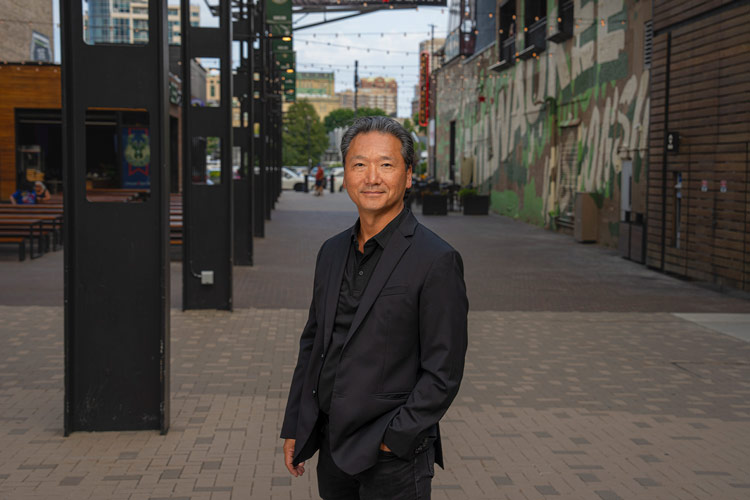
“We always talked about creating a living room for the city,” said Rinka, whose eponymous firm RINKA designed the Deer District. “Architecture is nothing without the experience of people using it.”
Rinka, a 1997 graduate of the University of Wisconsin-Milwaukee School of Architecture & Urban Planning, has helped shape some of the area’s most recognizable recent building projects, such as The Couture, a striking new lakefront tower. But long before redefining the local skyline, he was a kid living in an unusual Wisconsin home — one that quietly influenced the way he understood design, environment and human experience.
Inspired by place
Built into a rural hillside 30 miles west of Milwaukee, the solar-powered house Rinka grew up in used skylights, greenhouse heat and carefully planned sun angles to warm and cool itself naturally. College students occasionally visited to study the home’s innovative design.
“I learned how your surroundings impact your life tremendously,” Rinka said.
Inspired by family trips to Europe and South Korea, the country he was adopted from when he was 5 years old, Rinka became fascinated with the intersection of environment and culture. “Architecture can have a profound impact both positively and negatively on the direction societies take,” he said.
That early curiosity with how spaces affect people eventually led him to UWM, which has Wisconsin’s only accredited architecture program. Attracted to the school’s urban setting and creative atmosphere, Rinka loved that students could explore unconventional solutions to problems. He recalled beloved former professor Harry Van Oudenallen encouraging him not just to draw up an idea, but to build a mockup of it in the lab.
“UWM challenged us to find rogue paths to better conclusions,” Rinka said. “And you actually learn more from that.”
His perspective expanded further after graduate school at the University of Washington and professional experiences in Seattle and New York. But despite opportunities on both coasts, Rinka was drawn back to Milwaukee. “I felt like Milwaukee could use architects that thought bigger and more broadly about what the city could become,” he said.
He founded RINKA in 2006 with a vision that still guides the firm today: to inspire through thoughtful design. “We need to inspire people to live better, work better, be better through the environments we create,” he added.
Shaping Milwaukee
Rinka has left an imprint on Milwaukee’s cityscape with large-scale developments that deliver a shared experience. Rinka views the Deer District not simply as a sports and entertainment venue, but as a year-round neighborhood intentionally designed to bring people together.
Other RINKA projects, including downtown high-rises like The Moderne and The Couture, reflect what he sees as a changing vision for the city itself: more connected, more contemporary, more forward-looking.
RINKA has offices in Milwaukee, Madison and Fort Lauderdale, Fla., and has received more than 130 industry awards for its 850-plus projects, as well as recognition for its workplace culture. As a leader, Rinka said much of his focus now is on fostering relationships with clients and opportunities for others — enabling younger architects to grow, collaborate and develop their own ideas.
“My job is to help lift up other people,” he said.
Building a legacy
That commitment extends back to his alma mater, where Rinka has served for nearly a decade on the UWM Foundation Board — as chair until 2025 and currently as vice-chair. In 2023, he received the Distinguished Alumni Achievement Award for his contributions.
Many of the architects and designers at RINKA are UWM graduates, something he sees as part of the university’s broader impact on Milwaukee.
“The school needs to continue to thrive, challenge the field and produce talented professionals,” he said. “People care about what gets built in their city.”
For Rinka, the connection between architecture and experience still drives everything he designs.
“Architects are asked to define experiences for people’s lives,” he said. “Whether it’s for work or play or living, we’re trying to create better experiences through the environments we build.”
Story by James Carlton | Explore more in Make New Waves