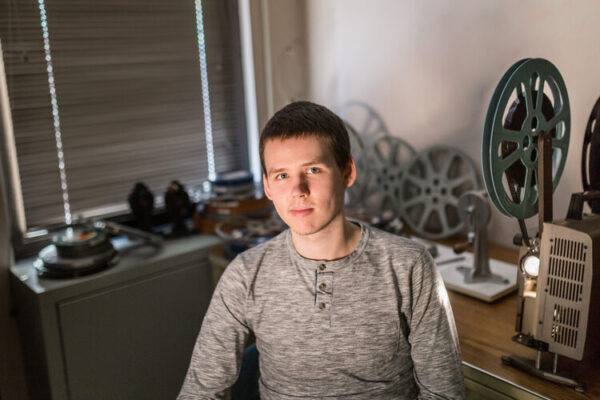
When he first started at UWM, Hugo Ljungbäck thought he wanted to pursue a career in film production. It wasn’t until he took his first film history class that he realized that there’s a lot more to films than just making them. He began work in film archiving and restoration as a sophomore in 2017 under the guidance of English and film studies associate professor Tami Williams. His project started as a study of the history of the UWM Film Studies program (one of the oldest programs of its kind in the country), but before long, his focus shifted to the extensive collection of 16mm film reels being kept in Curtin Hall. Ljungbäck, alongside fellow undergraduate researcher Christian Balistreri, spent the next three years making new uses for this old archive.
Ljungbäck was busy during his time at UWM beyond the 16mm archival project. He worked on a magazine produced by the Film department and ran a weekly movie night through the Honors College for a year. He also volunteered as a curator for the late Carl Bogner and the Milwaukee LGBT Film/Video Festival in 2017 and 2018. It was then that Ljungbäck started investigating the history of queer filmmaking. Bogner also inspired him to pursue topics of coming of age, coming out, and personal biography in his own artistic work. Regarding his undergraduate research, Ljungbäck said, “I realized that the things I wanted to do mattered on a larger scale; rather than submitting a course paper that only the professor read, I could keep tinkering with those ideas and it wasn’t a waste of time.”
After graduating with a BFA in Film and Media Studies in 2020, Ljungbäck went on to get his MFA at University of North Carolina at Chapel Hill. His focus was on moving image, but his work was interdisciplinary and experimental. His master’s thesis, titled “Queer Archiveography,” used historical film, film from his personal archive, images, and written word to express themes of memory, autobiography, and sexual empowerment.

His next step was University of Chicago, where he is currently pursuing a PhD. He initially thought he would pursue a project surrounding AIDS activist film and video, which he had started with Carl Bogner, but he is now developing a dissertation project focused on gay amateur filmmakers. He described a certain beauty in people making films in private to show friends and lovers. Often, it was their first chance to show themselves on screen, even if it was a small screen in their apartments. The films Ljungbäck is researching were only recently digitized, and he’s considering different ways to revitalize and preserve them.
Ljungbäck expressed that most of his favorite memories at UWM are surrounding research. Professor Tami Williams was always there for guidance and support, but Ljungbäck enjoyed her hands-off approach to mentorship. She allowed him to focus on certain films or projects that interested him. Their work was still very collaborative; they founded the UWM Moving Image Society together, they engaged with students, community members, and other scholars frequently, Ljungbäck was editorial assistant on two of Williams’ book projects, and they co-organized three symposia. While his future is still unknown, he said his experiences at UWM allowed him to develop a lot of various skills in film production, research, archival work, and administration that should allow him to land some sort of position in academia—many of which he acquired all the way back as an undergraduate researcher.