“The health of our waters is increasingly dependent on our handling of stormwater. This is true both locally and globally, making stormwater research a significant component of the search for a sustainable future. This is particularly true for Milwaukee, where access to fresh water of Lake Michigan is perhaps the City’s most important long-term economic asset.”
Professor Jim Wasley, The Pavilion Gateway Demonstration Project Principal Investigator
UW-Milwaukee plays an important role in the City of Milwaukee as well as with our northern neighbor, the Village of Shorewood. The northern border of UWM’s campus is a low-laying area prone to flooding during heavy rain events, and the combined sewer can become over stressed during heavy rains. UWM, with its available landscape and rooftops, helps manage stormwater runoff through a variety of green infrastructure solutions and resilient landscapes. Through research and application, UW-Milwaukee diverts approximately 16.5 million of gallons of stormwater every year and strives to lead by example in the region.
The implementation of green roofs at UWM is a prime example of addressing sustainable objectives in an urban environment.
Green roofs address the problem that cities have with the Urban Heat Island Effect and increased rapid stormwater runoff from impervious surfaces. Green roofs also provide the benefits of reduced costs on heating and cooling, decreased long-term maintenance and longer life span than a conventional roof, improved air quality, and increased urban habitat for wildlife.
A green roof system is an extension of the existing roof which involves a high quality water proofing and root repellant system, a drainage system, filter cloth, a lightweight growing medium and plants.
Since the early 1990’s, UWM has installed green roofs. From parking garage roofs at ground level, to student demonstration projects, to full scale green roofs, the UWM campus has established many green roofs, and looks to execute more based on future roof repair and accessible locations.
Green Roofs at UWM
Golda Meir Library
Year Built: 2011 Footprint: 50,000 Square Feet
The Golda Meir Library green roof features two separate roof sections and a 30-kilowatt system of solar panels sponsored by WE Energies, with the support of Focus on Energy grants. This is the largest green roof at UWM. The green roof project was made possible through a partnership with the Metropolitan Milwaukee Sewerage District (MMSD). Student research projects at the Golda Meir Library green roof have showed the co-benefits of pairing solar panels and green roofs together to improve energy efficiencies of the solar array. Students have also studied the migration patterns of pollinators in the urban environment and the positive benefits greens roofs can provide beyond water quality.
Cambridge Commons
Year Built: 2010 Footprint: 13,000 Square Feet
Cambridge Commons, UWM’s newest residence hall addition, features two green roofs which help to reduce heating and cooling costs and absorb pollutants from stormwater runoff. These green roofs share their space with a grey water system which collects rainwater and is used to water both the green roofs and the green space surrounding Cambridge Commons. For more information on how much rainwater is collected visit the UWM Dashboard.
Sandburg Commons
Year Built: 2008 Footprint: 33,000 Square Feet
Sandburg Commons, surrounded by four University Housing towers, features two highly visible green roof tiers. The upper level maintains taller prairie plants, while the lower level is primarily sedum, that can weather the extreme winds and heat of the rooftop. The green roof was designed by UWM Professor of Architecture, James Wasley. Historically, the roof has been used to also grow food used in the Sandburg Cafe in the past and now primarily improves water quality, reduces urban heat island effect, and supports pollinators with a diverse array of plants.
Student Union, West Entrance
Year Built: 2007 Footprint: 100 Square Feet
The student organization, EcoTone, spearheaded this initiative, installed, and planted the green roof found on the west side of UWM’s Student Union in the spring of 2007 (near the Maryland bridge entrance). The project was made possible by the assistance of Physical Plant Services and several volunteers. This green roof is planted with several Wisconsin native and endangered species and served as a visible early example of green roofs on the UWM campus.
Great Lakes Water Institute
2003 – 7,600 Square Feet
UWM’s Water Institute, now known as the School of Freshwater Sciences, teamed up with the Milwaukee Metropolitan Sewerage District (MMSD) to test a method of water pollution control that also reduces the amount of pavement surrounding the facility with this tray system green roof. This was UWM’s first “official” green roof.
Spaights Plaza
2002 – 15,000 Square Feet
The vegetated areas through Spaights Plaza are constructed as a green roof over the parking structure. In 2002, repairs to the deck were made and a hot rubberized asphalt membrane was applied. PVC drains were specified by UWM Physical Plant, and the weep holes were enlarged to allow for better subgrade drainage. UWM biologist (Thomas Schuck) was involved in choosing plants that are native to Wisconsin.
Lubar Hall
1992 – 6,500 Square Feet
The Business School (Lubar Hall) was constructed in 1992. It was designed by Kahler Slater Architects. The grassy plaza on the east side is actually designed as green roof over part of the parking structure. This area is also known as Pangaea Mall, an area where students like to lounge and study on the green.
The “Urban Heat Island Effect” is the difference in temperature between a city and the surrounding countryside. It is mainly due to the expanse of hard and reflective surfaces, such as roofs, which absorb solar radiation and re-radiate it as heat.
Rain Gardens
Pavilion Gateway Demonstration Project – Heat Plant Parking Lot
Parking Lot “18” near the Heat Plant and its surrounding area are the heart of The Pavilion Gateway Demonstration Project. All northerly drainage of the demonstration project comes to this site. The 5,011 sq. ft. spiral garden is planted with native species supporting ecological restoration and habitat creation goals as well as proving the point that native perennial plantings can be seen as decorative gardens in a formal campus setting. The second feature is the treatment train, a 358 linear foot system of vegetated bio-swales that captures runoff from the parking lot.
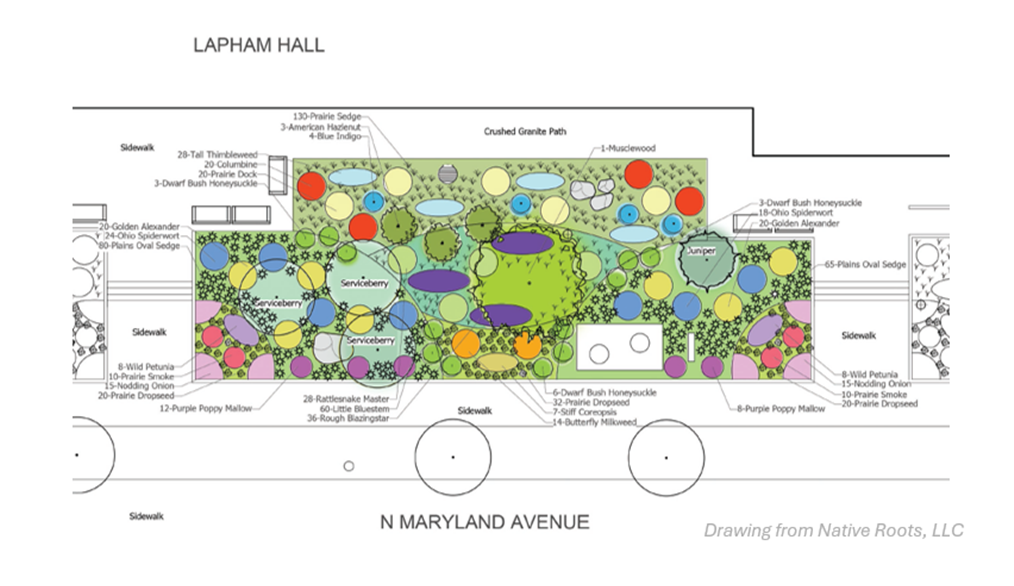
Lapham Hall Native Garden
In June 2023, the Office of Sustainability, Biological Sciences Greenhouse, and UWM Grounds Department collaborated to install a new native garden in front of Lapham Hall. Over 20 different native plant species will provide for local pollinators as well as provide colorful blooms to the front of Lapham Hall, home to many of UWM’s natural science programs.
Sandburg Hall Rain Garden
In order to address the severe slope, pathways, and need for water collection, a rain garden that ends in an underground cistern was developed at this site. This stormwater interpretive path meanders through a series of native plant waysides, improving water quality all the way to its underground collection. There it becomes a source of sustainable irrigation, for growing the many vegetables, herbs, and fruits of these campus gardens.
Sabin Hall Rain Garden
A disconnected downspout, native plantings, and slope design all work together to reduce the rate of stormwater runoff from the roof of Sabin Hall. Rainwater (or snowfall) is routed to the garden and filtered naturally by the plants and soils in this garden. This filtration process removes nutrients and pollutants, while retaining water closely to the site. By keeping as much rainwater as possible close to where it falls, we reduce the impact on our lakes and streams, as well as the local wildlife.
Sabin Hall rain garden was established by the student organization EcoTone. With the help of grant funding, and volunteers, this garden was planted in 2006.
Above Ground Cisterns
Heat Plant Cisterns
12,360 gallon double cistern
The project consists of two linked sculptural cisterns and a pair of sluices – one conveying water into the system from the Power Plant and another conveying water into the Spiral Garden as an overflow from the cisterns. A small sculptural fountain jet and a hidden lower outlet drains the system over a twenty four hour period following each rain event.
Physics Garden Catchment
350 gallon cistern off the Physics south awning
This simple cistern not only diverts rainwater runoff from the combined sewer system, but it also helps supply half the water necessary to support 58 rented garden plots. The original concept and design was completed by UWM students in Engineers Without Borders with support from a Southeastern Wisconsin Watershed Trust grant.
Below Ground Cisterns
Sandburg Garden Aqua Blox Cistern
5,000 gallon modular cistern
This stormwater path meanders through a series of native plant waysides, improving water quality all the way to its underground Aqua Blox collection. There it becomes a source of sustainable irrigation, for growing the many vegetables, herbs, and fruits of Sandburg campus gardens.
Cambridge Cistern
20,268 gallon cistern
This greywater system collects rainwater to water both the green roofs and the green space surrounding Cambridge Commons.
Children’s Center Cisterns
30,000 gallon cistern
These are multiple cisterns around campus installed underground in order to capture large amounts of stormwater runoff as part of each building’s construction.
Additional Cisterns
Sandburg East Tower
8,000 gallon cistern
Kenwood Integrated Research Complex
12,000 gallon cistern
Around the Community
Rain gardens exist throughout the community. Close by UWM there are also rain gardens at the Shorewood High School, North Point Lighthouse in Lake Park, as well as along Bradford Beach to capture and filter polluted runoff before it reaches Lake Michigan.
Utilize the buttons below to find out more about planting a rain garden in your own backyard.