Youth-Oriented Substance Use and Trauma Counseling Program

The Youth-Oriented Substance Use and Trauma Counseling Program (YOSUT III) at UW-Milwaukee trains clinically-oriented MSW students who are committed to serving children or youth in the dual competencies of substance use and trauma counseling, and places them in professional behavioral health settings serving high-need/high-demand areas. To offset the cost of advanced clinical training, each YOSUT III student receives $25,000.
Program Description
Students in this program complete:
- Certified curricula in substance use counseling and trauma-informed care.
- Experiential training at integrated behavioral health placement sites serving high-need, high-demand areas.
Students receive:
- Experience delivering evidence-based, culturally competent, mental and behavioral health services, including tele-mental health, within inter-professional teams.
- Support and guidance in post-graduation job placement by the YOSUT III leadership team through professional networking and career services.
Financial Assistance
- Accepted students receive a $25,000 stipend over two semesters to offset the cost of advanced clinical training;
- Information about loan repayment programs for which YOSUT III students may be eligible.
Applying
We encourage applications from admitted MSW students interested in careers serving children, youth, and young adults within high-need/high-demand areas in the mental and behavioral health field.
There are limited spots available. Students admitted to the traditional in-person MSW program should apply by March 15 ahead of the semester they plan to take Social Work 821 Field Instruction III. Applicants must meet the program eligibility and requirements below.
Program Eligibility
- Must be a U.S. citizen, non-citizen national, lawfully admitted permanent resident, or “qualified alien.”
- Must be admitted or enrolled in the traditional, in-person MSW program.
- If enrolled, must have a GPA of 3.0 or better.
- Must not have started Social Work 821 (Field Instruction III).
Instructions for Applying
- Apply online
- Application materials: Resume and two professional references
- Please complete the following:
- In 250 words or less, please describe your interest in the Youth-Oriented Substance Use and Trauma Counseling III program. Please make reference to your previous experience working with individuals impacted by mental and/or behavioral health conditions.
- In 250 words or less, please describe your future goals and how the YOSUT III program will help you achieve these goals.
- In 100 words or less, please indicate why you think you will succeed in the YOSUT III program.
- Admissions criteria will additionally include recent performance in the MSW program.
Program Requirements
- Must maintain MSW student status and a GPA of 3.0 or better.
- Course plan must include substance use counseling education and the trauma-informed care graduate certificate program.
- Must complete nine additional credits beyond MSW graduation requirements
(one additional academic semester). - A field practicum in a select mental/behavioral health clinic, outpatient treatment center, or integrated health center.
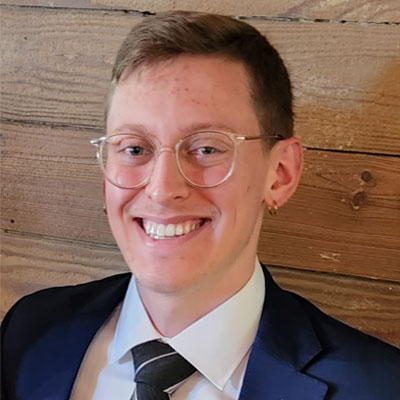
I hope to become a therapist in a behavioral health treatment center, focusing on interventions with clients engaging in substance use and with backgrounds of trauma. I’d like to build strong relationships with clients, wherein I am able to celebrate their strengths and accomplishments, as well as empathize with and validate the gravity of their lived experiences.
Resources for YOSUT III Students
- HRSA Workforce Connector
- NPI Application and Login Page
- We will provide application assistance.
- NPI Registry
- Students can look up their NPI number using this resource.
YOSAT III Loan Repayment Opportunities
This information is subject to change. Always contact your loan servicer(s) with questions and concerns. Follow changes on studentaid.gov
| Loan Forgiveness Source | Name of Program | What is it? | Where do I have to work? | How long do I have to work before I qualify |
|---|---|---|---|---|
| HRSA National Health Service Corps | Loan Repayment Program | Receive loan repayment assistance through the NHSC Loan Repayment Program (NHSC LRP). Must serve at an NHSC-approved site in a Health Professional Shortage Area (HPSA) | NHSC-approved site | 2 years |
| HRSA National Health Service Corps | Substance Use Disorder Workforce Loan Repayment Program | Supports the recruitment and retention of health professionals needed in underserved areas to expand access to SUD treatment and prevent overdose deaths. | NHSC-approved SUD service site | 3 Years of full-time or part-time service |
| HRSA National Health Service Corps | Substance Use Disorder Treatment and Recovery (STAR) Loan Repayment Program | Up to $250,000 for eligible substance use disorder (SUD) treatment clinicians and community health workers. | Serve six years (full time) in a STAR Loan Repayment Program-approved facility. | 6 years |
| HRSA National Health Service Corps | Pediatric Specialty Loan Repayment Program | Up to $100,000 for eligible clinicians providing service in certain pediatric sub specialties or child and adolescent mental and behavioral health care. | Three years (full time) at an eligible Pediatric Specialty Loan Repayment Program-approved facility. | 3 years |
| HRSA National Health Service Corps | Faculty Loan Repayment Program | Up to $40,000 for faculty members from disadvantaged backgrounds. | Two years (full or part time) in an eligible health professions school | 2 years |
| HRSA National Health Service Corps | Rural Community Loan Repayment Program | Loan forgiveness for providers working to combat the opioid epidemic in the nation’s rural communities. Provides evidence-based substance use treatment, assist in recovery, and prevent overdose deaths across the nation. | NHSC-approved rural SUD service site | 3 Years of full-time or part-time service |
| Federal Student Loan Aid | Income Driven Repayment Plan: Revised Pay As You Earn Repayment Plan (REPAYE) | Any borrower with eligible federal student loans. Pay typically 10% of your discretionary income per monthly payment. Receive forgiveness after either a 20 or 25 year period of time. | N/A | 20 years if all loans you’re repaying under the plan were received for undergraduate study. 25 years if any loans you’re repaying under the plan were received for graduate or professional study. |
| Federal Student Loan Aid | Income Driven Repayment Plan: Pay As You Earn Repayment Plan (PAYE) | Generally, 10 percent of your discretionary income, but never more than the 10-year Standard Repayment Plan amount. Payment must be less than what you would pay under the Standard Repayment Plan with a 10-year repayment period. Meet this requirement if your federal student loan debt is higher than your annual discretionary income or represents a significant portion of your annual income. To qualify for the PAYE Plan you must also be a new borrower. | N/A | 20 years |
| Federal Student Loan Aid | Income Driven Repayment Plan: Income-Based Repayment Plan (IBR) | Generally 10 percent of your discretionary income if you’re a new borrower on or after July 1, 2014*, but never more than the 10-year Standard Repayment Plan amount. Generally 15 percent of your discretionary income if you’re not a new borrower on or after July 1, 2014, but never more than the 10-year Standard Repayment Plan amount. The payment you would be required to make must be less than what you would pay under the Standard Repayment Plan with a 10-year repayment period. You’ll meet this requirement if your federal student loan debt is higher than your annual discretionary income or represents a significant portion of your annual income. | N/A | 20 years if you’re a new borrower on or after July 1, 2014 25 years if you’re not a new borrower on or after July 1, 2014 |
| Federal Student Loan Aid | Income Driven Repayment Plan: Income-Contingent Repayment Plan (ICR) | Any borrower with eligible federal student loans can make payments under this plan. Only available income-driven repayment option for parent PLUS loan borrowers. Although PLUS loans made to parents can’t be repaid under any of the income-driven repayment plans (including the ICR Plan), parent borrowers may consolidate their Direct PLUS Loans or Federal PLUS Loans into a Direct Consolidation Loan and then repay the new consolidation loan under the ICR Plan (though not under any other income-driven plan). | N/A | The lesser of the following: 20 percent of your discretionary income or What you would pay on a repayment plan with a fixed payment over the course of 12 years, adjusted according to your income or 25 years |
| Federal Student Loan Aid | Public Service Loan Forgiveness Program | Forgives the remaining balance on your Direct Loans after you have made 120 qualifying monthly payments under a qualifying repayment plan while working full-time for a qualifying employer. Receive credit toward PSLF (Public Service Loan Forgiveness Program) or TEPSLF (Temporary Expanded Public Service Loan Forgiveness) for the period of suspension as though you made on-time monthly payments in the correct amount while on a qualifying repayment plan. Student Loan Dashboard on Student Aid site assists in tracking number of payments made towards program out of 120. | Government organizations at any level (U.S. federal, state, local, or tribal) – this includes the U.S. military, or Not-for-profit organizations that are tax-exempt under Section 501(c)(3) of the Internal Revenue Code, or Serving as a full-time AmeriCorps or Peace Corps volunteer also counts as qualifying employment for the PSLF Program. | 120 qualifying payments |
| Indian Health Services | Indian Health Services Loan Support | Clinicians to repay their eligible health profession education loans (up to $40,000) in exchange for an initial two-year service commitment to practice in health facilities serving American Indian and Alaska Native communities. Based on Indian health program facilities with the greatest staffing needs in specific health profession disciplines. Eligible to extend your contract annually until your qualified student debt is paid. | Health facilities serving American Indian and Alaska Native communities Health facilities serving American Indian and Alaska Native communities. | 2 Years |