Rehabilitation Science & Technology: Human Factors Innovations (HFI) MS
Occupational careers are lasting longer, and therefore retirement should not be the finish line but rather the start to the next phase in life. In order to achieve longevity in career and beyond, organizations are embracing and leveraging health science experts to support optimal health and performance through innovation and design thinking.
The MS Rehabilitation Science and Technology (MS-RST) Human Factors Innovations (HFI) track is designed for students who wish to gain advanced knowledge and skills aimed at helping individuals achieve peak occupational health and performance through the interaction of human factors and human function. The track will also emphasize application and generation of knowledge within an entrepreneurial and innovation framework.
Depending on the student’s career goal, the HFI track can prepare the student for a path to enhance safety, reduce injury, and improve workability in the occupational worker.
Program Type
Master’s
Program Format
On Campus
Human Factors Innovations is…
the exploration of systems and processes to optimize health and human interaction with said systems.
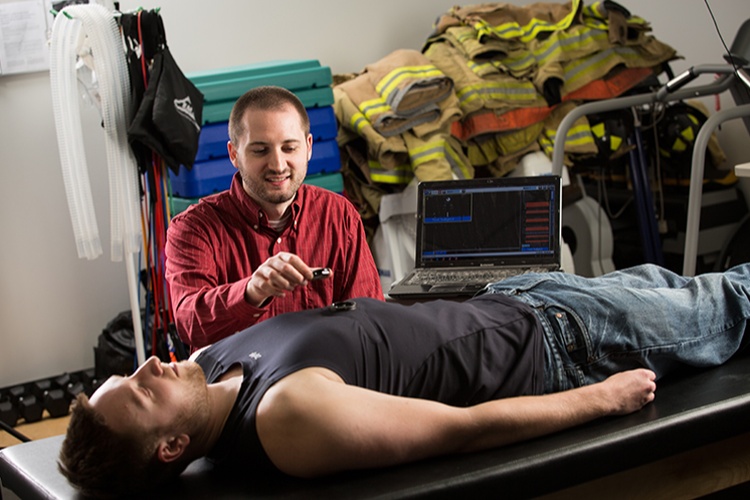
- MS-RST HFI track provides students integrated opportunities to study specialized knowledge in foundational physiological, psychological, and process design through entrepreneurial experiential learning environments.
- Students will experience traditional in-class learning as well as experiential learning coupled with our key community partnerships to solve real-world health and performance problems.
- All students have the opportunity to participate in research, either through a thesis or capstone project experience, by working closely with a faculty advisor.
- Faculty has wide range of international and national experiences in teaching, research, and applied practice.
Employment Outlook
Employment outlook is dependent on the student’s desired career trajectory.
Related Programs
To apply for the Master of Science in Rehabilitation Science & Technology Human Factors Innovations (MS-RST HFI), all application materials must be submitted through the UWM Graduate Application Portal. The MS-RST HFI seeks to admit highly qualified students interested in a career in occupational health and performance.
Application Deadline
MS-RST SPP accepts rolling admissions.
Admission Criteria
Students must meet the general requirements of admission to a graduate program at UWM. As stated by the Graduate School, these requirements include:
- a baccalaureate degree, or its equivalent as determined by the UWM Center on International Education, from a regionally accredited institution, completed before the first term of enrollment in the Graduate School;
- proficiency in the English language, and;
- a minimum cumulative undergraduate grade point average (GPA) of 2.75 on a 4.0 scale, or an equivalent measure on a grading system that does not use a 4.0 scale.
Additional admission requirements include:
- transcripts from all university degrees/coursework;
- reasons statement that include a rationale and career goals;
- current resume or curriculum vitae, and;
- two letters of recommendation from persons most knowledgeable about the applicant’s recent academic and relevant work experiences.
- The MS-RST HFI encourages submission of GRE scores.
- The general test of the GRE should have been taken within the last five years. Applicants are encouraged to complete the GRE approximately six months before application submission, if not sooner. This allows an applicant to repeat the test to increase scores if desired. Applicants are encouraged to prepare in advance for the test. Additional information (including preparation materials) is available on the GRE’s website. UWM’s institutional GRE Code is 1473.
Prerequisites
Students applying to the MS-RST HFI must have completed the following undergraduate prerequisites:
- statistics (3 credits);
- laboratory-based natural sciences (4 credits), and;
- psychology.
A grade of B- or better must have been obtained in each prerequisite course. Prerequisites will be verified through transcript review at the time of application. Students deemed not to have satisfied one or more of the prerequisites may be admitted on probation and complete the prerequisite(s) as deficiency credits within their first two semesters. Deficiency coursework will not count towards the MS-RST degree.
Additional Requirements
- The Graduate School requires that each student have a major professor to advise, supervise, and approve the program of study.
- Students are assigned a faculty advisor upon acceptance to the program.
- The student must complete all degree requirements within seven (7) years of initial enrollment.
The MS in Rehabilitation Science and Technology is a flexible 30-credit graduate program, consisting of core, foundation, and specialization courses. For more details on course and credit requirements, please visit the course catalog:
https://catalog.uwm.edu/health-professions-sciences/rehabilitation-sciences-technology/rehabilitation-science-technology-ms/#requirementstext
Prospective Students
If you have questions about pursuing a career in occupational health and performance, reach out to:
Dr. Kyle T. Ebersole
Professor
Director, Human Performance & Sports Physiology Laboratory
Email: ebersole@uwm.edu
Office: PAV364
Dr. Barbara B. Meyer
Professor Director, Sport and Performance Psychology Laboratory
Email: bbmeyer@uwm.edu
Office: PAV369
Students
At UWM, students in MS programs are assigned a Faculty Advisor upon admission. Depending on the MS-RST program track you are enrolled in, and your program of study, you will also be assigned a Capstone Project Chair or a MS Thesis Chair. It is possible that one person may serve in various roles. To avoid confusion, below you will find brief explanations of various faculty roles at UWM related to MS-RST.
Capstone Project Chair is a UWM faculty, who is also a member of the School of RST Graduate Faculty, responsible for supervising your capstone experience.
Course Instructor is a member of the UWM faculty responsible for course delivery. Depending on your program of study, your course instructors may belong to other UWM schools and colleges (e.g., counseling, engineering, kinesiology, psychology, social work).
Faculty Advisor is a UWM faculty, who is also a member of the School of RST Graduate Faculty, and typically responsible in assisting and guiding you throughout your studies.
MS Thesis Chair is a UWM faculty, who is also a member of the School of RST Graduate Faculty, and responsible for guiding your independent study courses and thesis courses.
MS Thesis Committee Member is a UWM faculty, who is also a member of the School of RST Graduate Faculty, chosen by you and your Thesis Chair to be a member of your Thesis Committee.

- Professor, Athletic Training, Physical Therapy
- ebersole@uwm.edu
- 414-229-6717
- Pavilion 364

- Professor, Athletic Training & Sport Psychology
- Laboratory Director, Laboratory for Sport Psychology & Performance Excellence
- bbmeyer@uwm.edu
- 414-251-6393
- Pavilion 369