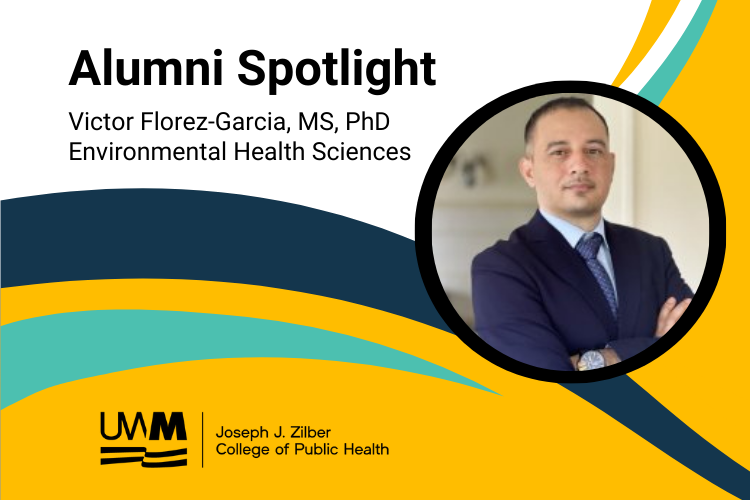
For Victor Florez-Garcia, MS, PhD, choosing the University of Wisconsin–Milwaukee’s Zilber College of Public Health for his doctoral studies was more than an academic decision—it was a commitment to advancing environmental health with purpose, equity, and global awareness.
Victor was drawn to the Environmental Health Sciences PhD program because of its unique position at the intersection of health, environment, and social justice. “The program sits at a powerful crossroads,” he explains. What stood out even more was the faculty’s deep experience not only as scientists, but as mentors who engage meaningfully with international scholars. For Victor, that global perspective made UWM the ideal place to grow both academically and personally.
Once immersed in the program, he discovered that the experience offered far more than rigorous scientific training. The sense of community and support became one of the most meaningful aspects of his time at UWM. He describes the breadth of opportunities—from collaborations and networking to peer connections—as instrumental to his development. Beyond the coursework and research, he found what he calls a “hidden curriculum,” one that helped him navigate academia as an international scholar and equipped him with tools that will shape his career for years to come.
Today, Victor is a Postdoctoral Research Associate in the Division of Epidemiology and Biostatistics at the University of Illinois Chicago. His work centers on three core pillars that are preparing him to become an independent investigator: developing competitive research grants, advancing scientific publications, and mentoring students. These experiences continue to build on the strong foundation he established at UWM.
Looking toward the future, Victor envisions a career dedicated to environmental epidemiology, with a commitment to building a robust, independent research portfolio. At the same time, he remains closely connected to his home country of Colombia. He hopes to strengthen research bridges between Colombia and the U.S., fostering collaborations that can generate evidence to inform real-world public health interventions. His long-term mission is clear: to address the environmental exposures that disproportionately impact vulnerable populations, particularly in global and underserved communities.
For students considering a similar path, Victor offers thoughtful advice. The relationships you cultivate—with professors, mentors, and peers—are “key to shaping long-term opportunities,” he emphasizes. When those relationships are paired with genuine passion and the lived experiences that drive you, they become the foundation for turning ideas into meaningful action.
Victor’s journey reflects the transformative power of combining rigorous research training with global awareness, community support, and a commitment to equity. His work continues to advance the field of environmental health—and to inspire the next generation of scholars who aim to do the same.