When Cheron Copeland was 16 years old, she was given a simple assignment in her engineering class: research potential careers and job shadow someone in the field.
Copeland knew she wanted a career related to food, but not culinary arts. So she decided to explore nutrition.
That decision would eventually lead her to the UW-Milwaukee Zilber College of Public Health, where she is now pursuing her Bachelor of Science in Nutritional Sciences after transferring from Milwaukee Area Technical College (MATC).
“Once I had the opportunity to job shadow some really wonderful dietitians, I realized this was amazing work,” Copeland said. “It was right up my alley because I love science, and I love helping people.”
As a non-traditional student, Copeland’s path to UWM was not a straight line. She began college at Purdue University in 2017, but after taking time away from school, she enrolled at MATC in 2021 determined to pursue her goals.
At MATC she discovered a pathway that helped her build confidence and experience while preparing for the next step in her education.
“At first, transferring was a little intimidating,” Copeland said. “But now I can say the pathway is so well structured. MATC, UWM and Mount Mary have really created a system that supports students every step of the way.”
Through MATC, Copeland first earned certification and completed the coursework to become a Registered Dietetic Technician. From there, she had the option to continue her studies in either a clinically focused program or a more community- and public health-focused path.
For Copeland, the choice became clear.
“When I first started, I thought I might just work in a hospital,” she said. “But MATC encouraged us to explore different specialties, and by the time I finished there, I knew I wanted to pursue public health and come to UWM.”
Today, Copeland is in her second year at UWM and expects to graduate in fall 2026. She says the Zilber College’s emphasis on prevention and community health aligns closely with her goals.
“I think one of the biggest issues in our country is that by the time many people end up in the hospital, it’s almost too late,” Copeland said. “There are so many preventable diseases. I want to help people understand how to take care of themselves earlier so they can have a better quality of life.”
That passion for prevention has already inspired Copeland to begin sharing her knowledge with others.
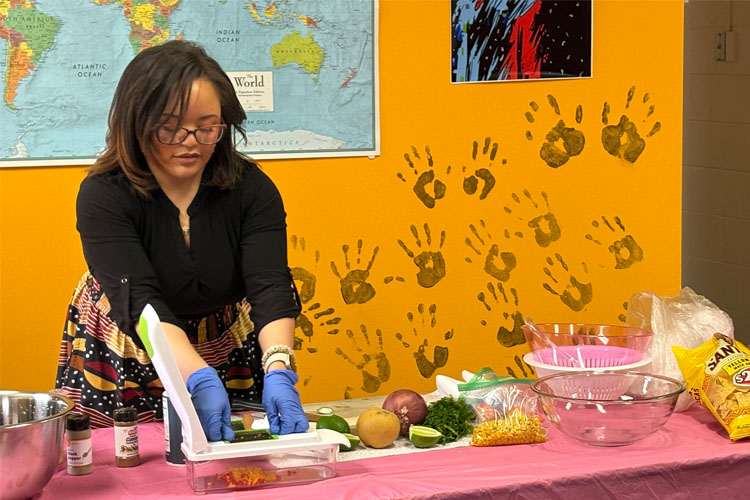
This spring, she partnered with UWM’s Black Student Cultural Center to offer a three-part nutrition and wellness workshop series for students.
“The biggest thing for me is making sure people leave with something they can actually use,” she said. “Even if I only meet someone one time, I want them to walk away with information they can apply in their own life.”
The workshops made a lasting impression on participants. One student attended all three sessions and asked Copeland whether she had ever considered teaching.
That question reinforced something Copeland has heard from several professors, supervisors and mentors.
“People have told me I should think about teaching at the college level because of the way I explain science,” she said.
While she once dreamed of working for the USDA’s Team Nutrition program, Copeland is now considering several possible futures. After earning her bachelor’s degree, she hopes to stay at UWM to pursue a Master of Public Health in Nutrition and Dietetics.
“Having an MPH connected to nutrition and dietetics would open up so many opportunities,” she said. “My associate degree and bachelor’s degree are both in nutrition sciences, so having that public health background would allow me to make an even bigger impact.”
She is also considering teaching and dreams of one day opening her own holistic nutrition shop where people can come for whole foods, supplements and guidance.
No matter where her career takes her, Copeland says the support she has received at UWM has made all the difference.
“One of the things I appreciate most about the nutrition program is that the instructors genuinely care about their students,” she said. “You can tell they want us to succeed.”
Copeland credits the guidance of faculty and staff—including her academic advisor, Kelsi Faust, and the many instructors who regularly share internships, workshops and career opportunities—with helping her feel supported throughout her journey.
“They never make us feel like we’re alone in the process,” she said. “That’s why I’m always telling people, ‘You should come to our program.’ It’s such a wonderful program, and the energy is just beautiful.”