By Kelly Meyerhofer
Milwaukee Journal Sentinel
January 29, 2026
Key Points
- Iranian college students have struggled to hear from family back home amid a government-imposed communications blackout.
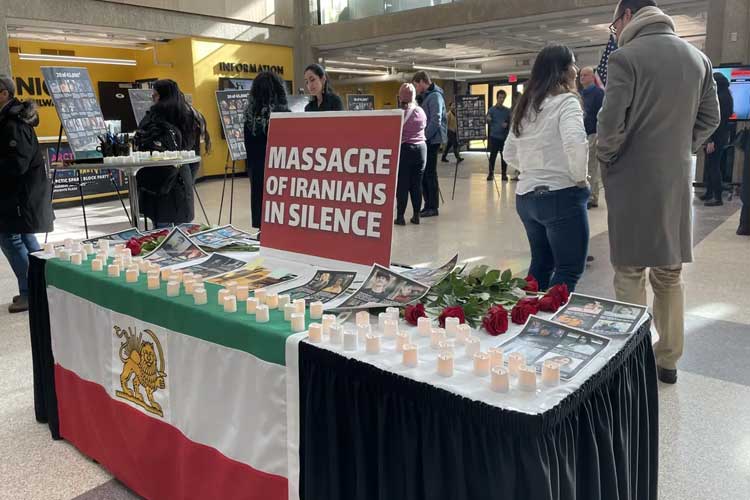
- The Iranian Student Association at UWM created a memorial Jan. 27 to educate others about the government crackdown.
- Iranians are one of the largest international student population at UWM. Most are pursuing master’s degrees and PhDs.
For weeks, Narges couldn’t reach her family and friends back home in Iran. The University of Wisconsin-Milwaukee graduate student worried about the worst-case scenario as she watched protests convulse her home country and the government brutally crack down on demonstrators.
“These are ordinary people – artists, athletes, journalists,” she said. “The news we are hearing is like a horror movie.”
At least 41,000 protesters have been arrested and 6,100 people have died, according to the U.S.-based Human Rights Activists News Agency. The group confirms each death with a network of activists on the ground in Iran. The numbers may grow as they continue verifying, but it’s been difficult to do so because the Iranian government shut down the internet and disrupted phone service.
It was only on Jan. 27 that Narges, a Ph.D. student in public health, heard from her sister. Her family was OK but some friends were not. A colleague of her brother’s, for example, was arrested at his workplace because he had written critically of the Islamic regime on social media. No one has heard from him since the arrest, she said.
Narges and others in the Iranian Student Association set up a makeshift memorial in the middle of UWM’s student union for a few hours during the first week of classes. Votive candles and roses surrounded pictures of victims. Instrumental Iranian music played from nearby speakers, adding to the funereal scene.
“People in Iran don’t have a voice,” Narges said. “It’s the responsibility of Iranians living outside the country to be their voice.”
Iranians are one of the largest international student population at UWM. Most are pursuing master’s degrees and PhDs. The students interviewed for this story requested the Milwaukee Journal Sentinel publish only their first names, fearing retribution for their families back home.
Some students living two lives as protests rock Iran
The demonstrations began in late December over high inflation and economic grievances but have grown into a nationwide movement to end the Islamic Republic system of government.
The citizen uprising poses the most serious threats to the Islamic regime in years, according to the New York Times. The Iranian government and its leader, Ayatollah Ali Khamenei, have blamed “terrorist” teams tied to Israel and the U.S. for infiltrating the protests and stoking more violence.
Iranian students in Milwaukee are living two lives, caught between their coursework and a humanitarian crisis unfolding in their homeland.
The effort to connect with family amid a communications blackout has emotionally exhausted them. One student sent a list of names to a friend of friend, asking for them to check in on her loved ones’ well-being. Maryam, a Ph.D. student in civil engineering, said her family borrowed a friend’s Starlink device to tell her they were safe.
Activists smuggled thousands of the Starlink satellite internet devices into the country as a way to bypass the government and communicate with the outside world. But the system is available to just a sliver of the Iranian population.
Maryam was relieved to hear her family members had survived. But others hadn’t fared as well. She said a friend of her father’s, a doctor, was arrested for treating injured protesters and was taken to a prison. Human rights groups have decried abusive conditions inside state prisons.
Maryam felt an obligation to speak out. She turned her anger into education to the wider UWM community.
The Iranian Student Association scoured social media and news reports to write short profiles of more than 150 protest victims, which they displayed on posters as part of the memorial. A handout sheet encouraged people to post about Iran on social media, discuss it in classes and bring it up among friends.
Some people were moved by the memorial. One student wiped away a stray tear. Others stuck Post-it notes onto a whiteboard, affirming their support of human rights and solidarity with Iranians.
“This is what we can do to support our people,” Maryam said. “We try to be their voice.”
A rally to support the Iranian people is planned for 2 p.m. Sunday, Feb. 1. It begins at Colectivo Coffee, 1701 N. Lincoln Memorial Drive.